SER Expert Certification at Rosprirodnadzor: Preparation Experience and Pitfalls
For years, you have been managing the State Environmental Review (SER): analyzing materials, responding to comments, and defending design solutions. Now imagine sitting on the other side of the table and evaluating a third-party organization's documentation as an expert. These are two different roles, and they require different preparation approaches.
Is accumulated practical experience enough for a seasoned industrial environmental practitioner to pass certification at Rosprirodnadzor? What should you pay attention to in advance? Let's break it down.
Start with the rules of the game
First of all, study the Expert Certification Procedure itself. The baseline document is Rosprirodnadzor Order No. 110 dated February 21, 2025 [1], amended by Order No. 726 dated November 12, 2025 [2]. Preparing with the original version without checking the amendments is a surefire way to waste your time.
Next, choose your certification areas and honestly compare them against your experience. There are 15 certification areas in total:
- assessment of impact on the geological environment, rational use and protection of subsoil;
- assessment of impact on groundwater;
- assessment of impact on specially protected natural areas;
- protection and rational use of land resources;
- assessment of impact on soil cover;
- management of production and consumption waste;
- ambient air protection;
- assessment of physical factors' impact on the environment;
- surface water protection;
- flora protection;
- fauna protection;
- protection of aquatic biological resources;
- industrial environmental control and monitoring;
- emergency situations and assessment of their environmental impact consequences;
- application of best available techniques.
You can also undergo additional certification to become an SER commission chair. Suppose you have worked with waste at an operating facility for many years. Does this mean you are equally confident in navigating design requirements for waste management facilities and assessing their environmental impact? Not necessarily. For myself, I chose areas where I genuinely believe I have the deepest expertise.
At the same time, check your education and work experience documents against the Procedure's requirements. A job title in your employment record does not always reflect what you actually did. Therefore, it is best to start gathering supporting documents in advance, especially if your career spans multiple employers. Young and entry-level specialists will not be able to obtain expert status, as candidates must be at least 30 years old.
Submitting the application
Once you have selected your certification areas and prepared the required scanned document copies, what comes next? To submit an application, go to the Rosprirodnadzor website https://rpn.gov.ru/expert_attestation/ and log in via your personal Gosuslugi account. After logging in, you will need to enter your passport details and TIN, select the desired certification areas, and upload scanned copies of the following documents:
- certification application (form specified by the Procedure);
- summary of professional activities over the 5 years preceding the certification year (free form);
- copy of higher education diploma;
- employment history records (an electronic employment record extract can be used);
- criminal record and/or criminal prosecution certificate (can be obtained electronically via Gosuslugi);
- 2 color photos (3×4 cm);
- consent to personal data processing (form specified by the Procedure).
Make sure that uploaded files do not exceed 1 MB each, otherwise the system will return an error. If everything is done correctly, the system will generate a registration number for your certification application. Once the application is reviewed, an email with the results will be sent to the specified address; if approved, as in my case, it will state the date, time, and venue of the certification exam. In my case, a Rosprirodnadzor inspector also called my mobile phone to confirm I had received the email.
What to expect at the exam
The qualification exam is conducted as a computer-based test (clauses 63, 68–73 of the Procedure). The format is as follows:
- Single area: 30 questions (10 general and 20 specialized), time limit — up to one hour.
- Multiple areas at once: each additional area adds 20 specialized questions and 40 minutes. The general section remains 10 questions.
- Expert commission chair: 30 general questions. When applying simultaneously as a chair and an expert, specialized questions for the selected areas are added [1].
Therefore, tailor your preparation to your specific certification option, and verify organizational details in the notification you receive.
How scores are calculated — and why the overall percentage is misleading
The passing threshold is defined in clause 86 of the Procedure and depends on the number of selected certification areas:
- Single area: at least 25 correct answers out of 30, including at least 8 general questions.
- Multiple areas: at least 17 correct specialized answers for each area. The same general question requirements apply.
- Commission chair: at least 25 correct general answers. When certifying simultaneously as a chair and an expert, at least 17 specialized answers per area are also required [1].
The practical takeaway is clear: during practice tests, looking only at the total percentage is not enough. Count your mistakes separately for the general section and for each specific area. Otherwise, strong knowledge of one topic may create a false sense of readiness for the entire exam.
The "we have always done it this way" trap
In daily work, an environmental specialist is usually deeply immersed in a specific set of tasks, whereas exam preparation requires recalling regulations that are rarely applied at your facility.
There is an even more treacherous habit — answering based on established practice. "We have always done it this way" or "the regulator used to accept this approach" are useful arguments in a workplace discussion, but they do not replace regulatory justification. The test checks something else: whether you understand which rule applies and what conditions limit its scope.
My recipe for every tricky question consists of four steps:
- Identify the subject of regulation.
- Find the relevant legal provision.
- Read it together with its exceptions.
- Only then formulate your answer.
Pay special attention to phrases like "is entitled to", "is obliged to", and "except for", as well as decision-making deadlines and grounds. A missed condition can completely change the meaning of an answer.
How I worked with the questions
I used practice tests and AI-generated answer breakdowns with references to regulatory legal acts, and I also read the primary regulatory sources directly. The main benefit of this approach is that it quickly exposes knowledge gaps. A question might look familiar, yet explaining without prompts why a specific provision applies is not always easy.
Use the list of questions from Appendix 5 to the Procedure as your foundation. For self-study, it is convenient to keep a spreadsheet: question, answer, reference to the article or clause, and a brief explanation. If an answer raises doubts, flag it and go back to the primary source. Memorizing an unverified answer reinforces mistakes and complicates further preparation.
It helps to practice in two modes:
- Study mode: thoroughly analyze mistakes and read regulatory documents.
- Exam mode: answer within a time limit and without hints.
The second mode is not a whim. Clause 65 of the Procedure prohibits using regulatory acts, the internet, reference materials, notes, and communication devices during the exam [1]. Therefore, the skill of quickly finding a regulation during preparation must gradually turn into the ability to recall its content from memory.
What remains after preparation
In my view, the biggest bonus is systematizing the requirements you have worked with for years. When you break everything down sequentially, the boundaries between statutory requirements, subordinate regulations, and the habitual practices of a specific company become much clearer.
This immediately proves useful in projects. Justifications become much more precise when they explicitly state which requirement applies to the facility in question, what baseline data confirms compliance, and why the chosen solution is permissible. This approach helps both when preparing documentation and when discussing comments from the expert commission.
How the certification exam actually takes place
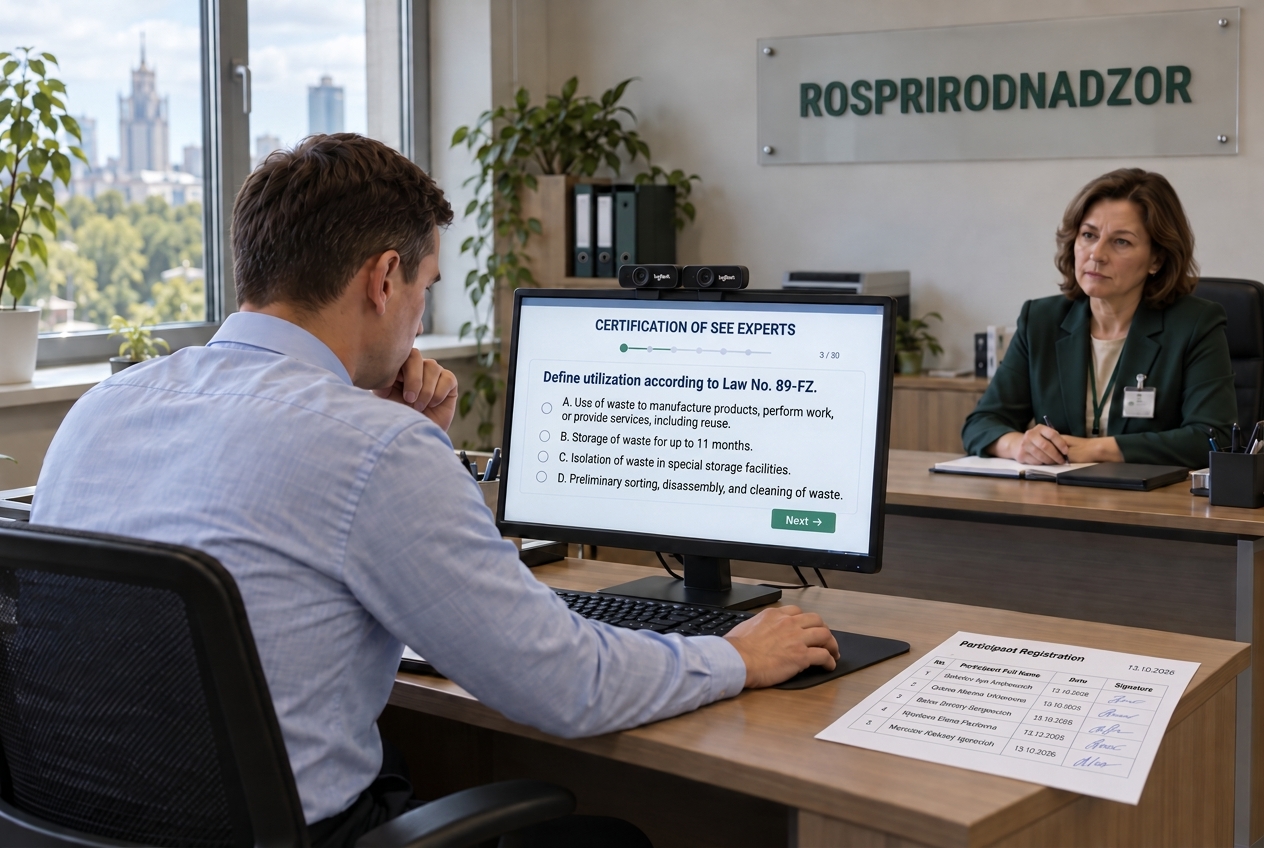
I arrived 15 minutes before the start since it was my first time at that Rosprirodnadzor office. I had to get a visitor pass and go up to the room specified in the notification, which in my case was on the third floor. Inside the room, a staff member greeted me and asked me to fill out the paperwork — a registration log and a candidate card. The fairly spacious room had a single desktop computer equipped with two webcams mounted on the monitor. A video conferencing client and screen recording software were running on the PC. After an introductory briefing by representatives from Rosprirodnadzor's central office explaining the testing rules, I proceeded directly to the questions. The tests are divided by certification areas; questions may have one or multiple correct answers, and once you select an answer and move to the next question, you cannot go back to double-check it, even if you have plenty of time left. Upon completing the test, you immediately see how many correct answers you gave, so you know right away whether you passed the selected area. The questions contain many subtle nuances that require verbatim memorization of federal law articles, government decrees, and other regulations. Thus, two similarly worded answer choices might differ by just one or two words, or sometimes by a parenthetical clarification, which is common in environmental regulations. It was precisely on such questions that I failed several certification areas — missing the threshold by just 1–2 correct answers in some, and scoring around 60% in others. The result was successful certification in only one area: "waste management".
Conclusions and recommendations
Do not select too many certification areas at once; it is better to prepare thoroughly for a couple of areas and pass them than to fail everything you applied for. When certifying as an SER commission chair, you need to memorize all key articles of the Federal Law "On Environmental Review" and the SER regulations, paying close attention to every "except for", "unless", "including", and parenthetical clarifications. Specialized certification areas also have plenty of trick questions; for example, for waste management certification, memorize Article 11 of the Federal Law "On Production and Consumption Waste", and for industrial environmental control and monitoring, memorize Order No. 109 of the Ministry of Natural Resources of Russia dated February 18, 2022. When preparing for certification, I recommend either printing out the core regulations on paper or working on a tablet with a stylus to highlight text and take notes directly in the document. My key takeaway is that relying solely on practical experience without memorizing regulatory provisions makes passing the exam extremely difficult for a practicing environmental specialist.
How did your preparation go? Have you tried getting certified as an SER expert, or are you just planning to? Which topics turned out to be the most unexpected, and what helped you figure them out?
Share your experience and questions in the comments — let's discuss together.
Regulatory Sources
[1] Rosprirodnadzor Order No. 110 dated February 21, 2025, on approving the certification procedure for SER experts, as amended on November 12, 2025. Clauses 63, 65, 68–73, 86, and Appendix 5 are referenced in the article. Official publication: https://publication.pravo.gov.ru/document/0001202503050007
[2] Rosprirodnadzor Order No. 726 dated November 12, 2025, on amending the appendix to Order No. 110. Official publication: https://publication.pravo.gov.ru/document/0001202601260003