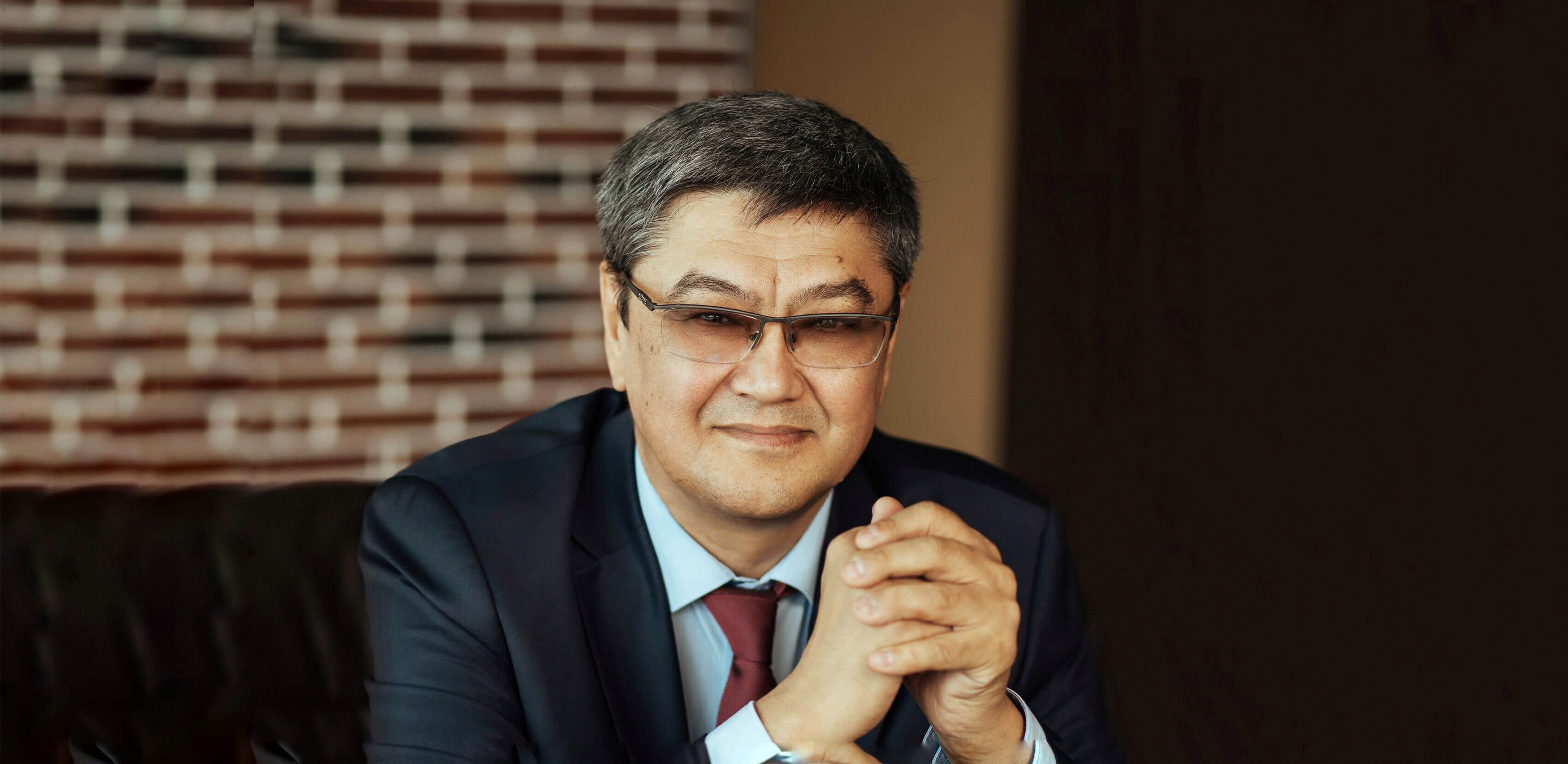
HSE DAYS Project Ambassador Serik Mazhkenov Releases a New Book
Dear Serik Abzalovich, your first book, "Occupational Safety: Mission Possible", published as part of the HSE DAYS project, received excellent reviews from our colleagues. Recently, on the eve of the HSE DAYS project anniversary, your second book, "Human Purpose: Algorithms for Search and Realization", was released. Could you tell us how the idea for this book came about, what it is dedicated to, and how it will be useful to our colleagues?
Thank you for your kind words. I am glad that colleagues liked the first book. I am confident that the second book will also be very interesting and useful to everyone.
As you know, I have been dealing with the issues of building effective HSE management systems, leadership, and safety culture development for quite a long time, over 25 years. In the process of my work, I noticed that today HSE, production management, and HR departments are essentially solving the same problem: how to make an organization's employee a conscious and engaged participant in the work process. It's just that each department calls the methods of solving this problem differently: in HSE, it is safety culture development; in production, it is performance management and quality culture; in HR, it is talent management. Today, everyone understands that in the triad of production activities (equipment – procedure – human), it is the human who is the key element determining the success of the organization as a whole.
To prove these words, I will cite the opinion of the well-known Russian economist and professor N.A. Volgin, who believes that it was the focus on developing its own labor potential that once brought Japan out of its deepest post-war crisis and then propelled it to the forefront of the world's leading economies: the Japanese "miracle" was not achieved by high technologies, automation, and robots, but by the people who created them.
The fact that the HSE department was the first to draw attention to the necessity and importance of conscious human participation in work activities is quite logical. Just as "a theater begins at the cloakroom," any organization can be easily and simply evaluated by its employees' attitude toward occupational safety issues. This is a simple and clear indicator of any company's manageability, reflecting the efficiency of the organization's functioning.
The question arises: how do we achieve the awareness and engagement of every employee in the common cause? What needs to be done for this? What could the solutions be?
Systems theory has become a universal approach to solving this problem. The main goal of systems theory is to discover the basic principles of functioning for systems of various natures and to identify the patterns of their development. In this sense, both a human and an organization are systems. The main property of any system is its purpose, i.e., what it is intended for and the goals and objectives it is designed to solve. The realization of a system's purpose ensures its maximum efficiency. It follows that a person can achieve maximum efficiency in the work process only if they realize their potential. This allows them to find an inner point of support, structures their life, and makes it conscious and purposeful. How do you identify such a person? Very simply: they do not just work; they do what they love.
Then several questions arise: how can a person find their purpose, and then how can they build effective relations with the organization?
To help a person find their purpose, the book describes a step-by-step discovery algorithm aimed at sequentially identifying a person's values, mission, vision (dreams), and goals. It is exactly this sequence of identifying one's core characteristics that allows a person to discover their purpose and talent.
Furthermore, to realize their purpose, a person usually needs certain resources and opportunities that they can obtain from an organization. To do this, they must build effective relations with the organization in the following way:
- Every person has a purpose and a goal in life (the more global, the better).
- The organization has its own goals and objectives.
- To obtain the maximum amount of resources and opportunities, a person must align their goals and objectives with those of the organization. Obviously, by striving to best realize the organization's goals and objectives, they effectively ensure the successful achievement of their personal goals.
- Harmonizing the relationship between the employee and the organization ensures the employee's conscious engagement in work, forms the necessary level of corporate culture, and ensures high work performance.
Such alignment of the parties' interests in the context of HR management is described by the IMAGO algorithm, and in relation to HSE, by the PSOBT algorithm — the personal system of conscious occupational safety.
This is clear for the individual, but what does it give to organizations?
This perspective on the relationship between the parties opens up a new understanding of the essence of organization and business. It turns out that the true or higher purpose of any organization's activities is not total control and personnel management, but finding like-minded people based on shared values and goals, uniting them, and assisting everyone in maximizing their potential. Then, the execution of production plans and the achievement of a given level of quality, efficiency, and occupational safety become a byproduct of each employee's striving for self-realization. In fact, this means abandoning the old paradigm of the organization-human relationship, built as a "system-tool of labor," and transitioning to a new one: "system-system." In my opinion, successful scientific and research organizations, as well as organizations built on teal and quantum principles, are closest to this relationship model. For example, in organizations built on the idea of a quantum approach, each employee is viewed as a quantum personality who possesses not only certain skills and abilities but, most importantly, the potential for further development. It is in such organizations that each employee consciously and voluntarily invests the strongest aspects of their personality into achieving common goals.
Then a natural question arises: what should an organization's leader do if they are inspired by reading the book and want to put this new philosophy into practice? What do they need to do first?
A very valid question! First, the initiative must primarily come from the head of the organization. Second, they need to form a team of like-minded colleagues and, with their help, develop a program for further transformations within the organization. If any questions arise regarding the development or implementation of the program, we can provide the necessary assistance and consultations. Third, implement the planned program within their organization. Here it is important to convey to every employee of the organization that there are no losers in this work. The goal of this program is for every employee to find their strengths and start realizing them. Having a team where the strengths of each member are utilized multiplies the labor potential of any organization and serves as its unique competitive advantage, which cannot be replicated by simple copying or imitation.
Serik Abzalovich, what you have shared is very impressive and inspiring! Thank you for your detailed answer. In conclusion of our conversation, what would you like to wish the HSE DAYS participants?
Today, large-scale processes are taking place in the world that have a significant impact not only on societies and organizations but also on every individual. We must be prepared for all these changes and challenges. Obviously, we cannot instantly restructure and carry out the necessary transformations, but it is already becoming clear what needs to be done and where we need to move. This is our future, and we must prepare for it right now.
I want to wish every project participant success in achieving their set goals and objectives in our common cause: preserving the lives and health of employees in their workplaces. Our HSE DAYS platform provides excellent opportunities for discussing and promoting various ideas aimed at improving the safety level of workers and unlocking human potential.
I wish all colleagues health, well-being, and success in our important work.