Algorithm for Forming Safe Actions Through Awareness
Are you familiar with this great quote? "People spend their health to earn money, and then spend money to restore their health." This was said by Confucius, the Chinese thinker and philosopher, back in 551 BC. It seems to me that little has changed since then, wouldn't you agree?
How can we preserve ourselves for a rich, full life, success, career development, and our dreams? Let's talk about conscious safety. There is nothing more valuable than life and health. And if we preserve both, any goal or dream will be within our reach.
What is conscious safety? Many people talk about it now, but no one has met people who are 100% conscious about their safety.
Conscious safety is when we have a long-term vision of how our unsafe actions and our daily choices determine the outcome — sometimes quite quickly, sometimes delayed over time.
Conscious safety is the ability to see and assess risks and adjust one's behavior in the moment, preventing any damage to health or quality of life.
Conscious safety is the ability to take responsibility for your life and what happens in it, for your daily choices to act in a certain way, without shifting responsibility to the employer, parents, or the state.
Essentially, the responsibility formula looks like this: choice multiplied by the number of repetitions determines the degree of our responsibility for our health and quality of life over time.
Sometimes we put ourselves in danger through our own unsafe actions. Are you familiar with the concept of unsafe actions? These are actions we don't always realize we're taking, which may have no consequences or may end sadly for us in an accident. There is a telling statistic from DuPont: 96% of all accidents are caused by unsafe actions, and only 4% are due to unsafe conditions. Yet, the paradox of this statistic is that unsafe conditions are most often created by our own unsafe actions or inactions.
Most often, our unsafe actions turn into an unsafe habit. When we do something at the level of instinct, without thinking. We develop a habit of impunity because many habitual unsafe actions may not end in anything bad for us. But only up to a certain point. There is a very accurate proverb about this: "Even a stick fires once a year." And this is the second paradox of unsafe actions.
Try right now to become aware of which of your daily unsafe actions you consider habitual. We are talking about those unsafe actions that we can perform not only at work but also in everyday life. Do you buckle up behind the wheel? What about in the passenger seat? Do you hold onto the handrail when going down stairs? And so on, and so forth...
Some of our unsafe habits may not affect us immediately, but after some time, in a delayed mode. When a certain harmful factor affects us systematically, on a constant basis, it seems to us that the minimal harm in the moment does not destroy us globally. But after some time, we will be held responsible for this small error and every wrong choice. With our health. Take, for example, working at a computer. What can happen to our health after N years if we expose ourselves to ergonomic risks, sit incorrectly at the computer, work in the dark, deprive ourselves of breaks, or do not perform preventive warm-ups, for example, for hands or eyes?
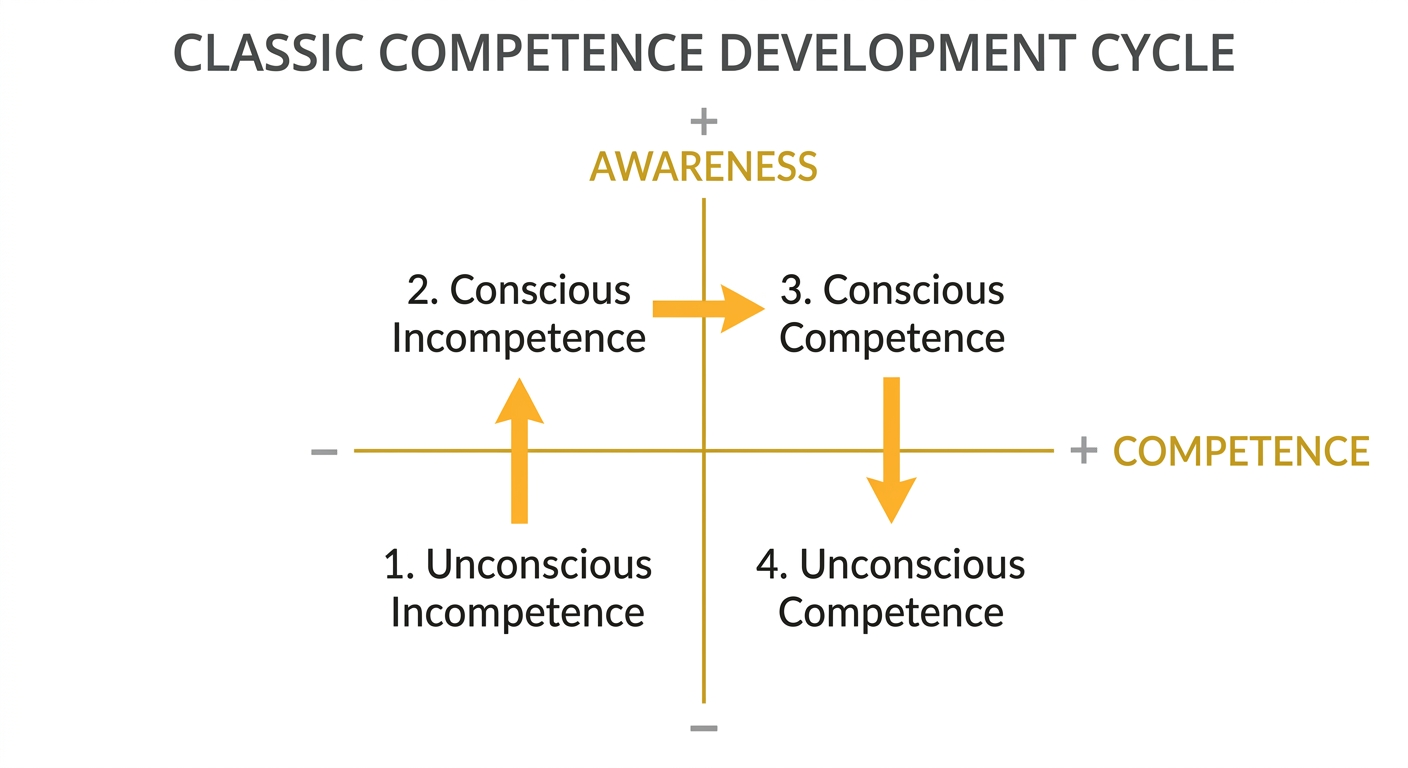
If we talk about how we can change the situation and what we can do with our unsafe habits, we can take the classic competence development cycle as a basis.
Through awareness in behavior, we can achieve a lot, including turning our unsafe habits into safe ones.
- We move our unconscious unsafe actions into conscious mode. (Damn, I don't buckle up in the back seat of the car... hmm... why do I do that?)
- We realize: I systematically act this way, but it can lead to damage to my health. (I do this almost always. What will happen to me if an accident suddenly occurs? At the very least, I'll hit the seat in front of me; at most, I'll fly through the windshield).
- We form and strengthen a neural connection: danger – consequences – how to avoid consequences. (Such a danger exists and the severity of the consequences can be serious. To prevent this, you must always buckle up).
- We make a decision: I will do things differently, and it will be safe for me. (I will always buckle up, without exception).
- We begin to consciously exclude unsafe actions from our lives, replacing them with safe ones. (Wow, I forgot to buckle up again. Fixing it!)
Usually, the formation of a new habit takes from three weeks to two months, on average, 21 days. Therefore, it is at this stage that awareness is very important; it helps us get rid of old strategies and put in the effort to get used to new, safe ones. After a month or two of effort, we form unconscious competence in safe actions.
- Safe actions are performed by us automatically, on an unconscious level. (Well, I'm already acting automatically :) I got into the car, and my hand reached for the belt on its own).
Colleagues, I wish you to achieve your goals and your dreams safely and consciously. Change must start with yourself. If we change, the environment in which we live and work changes too. The quality of our life changes thanks to the safe choices we make daily. After all, a healthy person (employee) is an effective and happy person (employee).