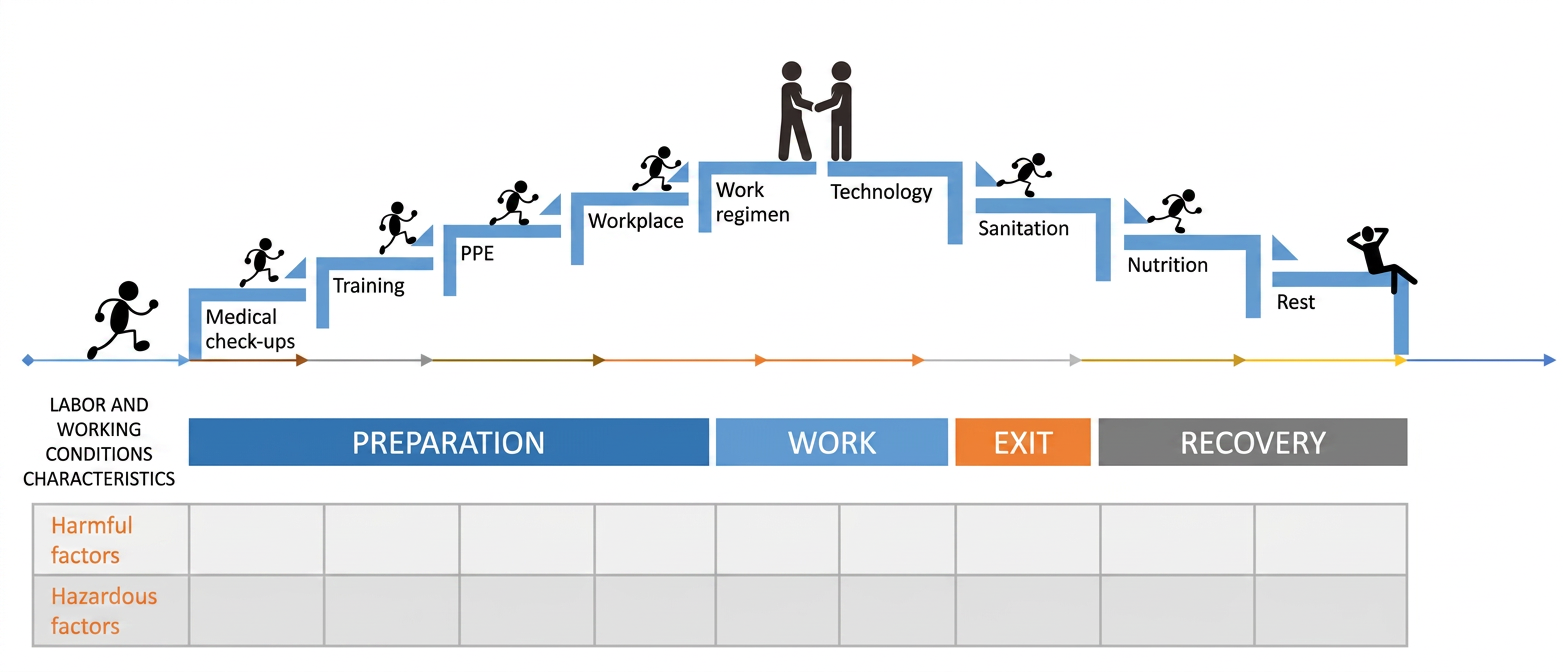
Employee Journey Map in HSE
Occupational health and safety is usually perceived by employees as a complex set of numerous and confusing regulations, rules, and instructions that are impossible to remember anyway. But what if we look at HSE as a system of barriers and restrictions and record them on a single diagram representing the path? This results in an interesting tool called a customer journey map in marketing (demonstrating the customer experience when interacting with a business), and an employee journey map in HR (marking the key points of contact with the company). The image can be in a graphical or tabular format.
How to use the map?
First and foremost, at each stage and at each process touchpoint, ask the following questions:
- How is the process organized at this point? Who are the participants? Do all participants share safety principles?
- What experience does the employee encounter at each stage? At each point? What emotions do they feel? Does the worker know who to contact with questions or suggestions for process improvement?
- What needs to be changed or provided for? What should be abandoned?
- What should be the primary focus to make the interaction process as comfortable and productive as possible?
On our map (Table 1), we will mark the key points of contact between the employee and HSE. There are nine of them, each located at a specific stage with a specific goal. It is important to remember that at the beginning of the journey, there must be a professional risk assessment organized by the employer.

Knowing the job characteristics and working conditions, managers at all levels organize procedures (processes) to ensure the protection of workers' health and lives.
Stage 1 - Preparation for the work process
Before being admitted to work, an employee must:
- Undergo a medical examination and/or psychiatric evaluation. Medical examinations depend on the presence of harmful factors identified during a special assessment of working conditions or on the type of work performed (e.g., work at height).
- Possess the necessary qualifications, including mandatory HSE training and briefings.
- Be provided with personal and collective protective equipment against the effects of harmful production factors.
- Prepare their workplace for the safe performance of work.
If the first three points are not met, the employee must be suspended from work in accordance with Article 76 of the Labor Code of the Russian Federation.
Stage 2 - Work process
First, at the work performance stage, the employee must comply with hygienic standards of labor activity. One of the barriers that helps protect the worker from the effects of harmful production factors is time limits. After all, it is for a reason that a shortened working day was introduced for subclasses above 3.3 based on the results of the special assessment of working conditions.
Second, compliance with the work technology is also a corresponding safety barrier. The employee selects tools, equipment, and materials in accordance with the technical process instructions.
Stage 3 - Exit from the work process
Upon completing the work process, the employee follows sanitary and household norms. This primarily involves cleanliness, tidiness, and orderliness.
Stage 4 - Recovery
Of course, after the end of the work shift, it is necessary to restore strength and energy. This requires proper nutrition and quality rest.
It is advisable to conduct an audit of the entire "employee journey in the HSE system." This will help identify the most critical points and prioritize the implementation of changes. Developing indicators for each process will help track the dynamics of improvements and, ultimately, check the correlation between process indicators and injury rates.