Visual Communications in HSE: An Effective Tool for Reducing Occupational Risks
Visual communications in HSE are a powerful tool for improving occupational safety, engaging personnel, and building a Vision Zero culture at the enterprise.
Safety culture experts note an increase in demand and interest from modern organizations in developing and implementing visual communications, as well as larger budgets for these tools. At the same time, measuring the effectiveness of visual communication implementation is a crucial aspect. This is a key task for assessing their impact on occupational safety and the overall HSE culture.
The benefits of implementing and using this approach in companies are obvious: it allows for more effective communication of HSE information to personnel, visualizes rules, instructions, and requirements, and makes them more memorable and understandable for all categories of workers, including Generation Z, who are increasingly entering the workforce.
Why are visual communications in HSE so popular?
- They help quickly and effectively convey important information to employees, including those with language barriers or disabilities.
- They are more effective because visual images and symbols are remembered better than text.
- Visual, colorful manuals and instructions increase employee engagement in safety issues and motivate them to follow the rules.
- Visual communications are an integral part of modern safety culture at the enterprise and increase interest among the younger generation.
- They allow moving away from ineffective briefings where a worker just flips through a 15-page instruction without understanding its content.
- They speed up briefing time.
- They improve perception and retention.
- They provide the opportunity to create unique content tailored to the specifics of a particular company.
- They can be placed directly in high-danger areas.
- They have a return on investment (ROI) because the time spent on briefings is reduced, allowing for increased labor productivity.
An example of a visual HSE instruction in a "OnePager" format is shown in the figure.
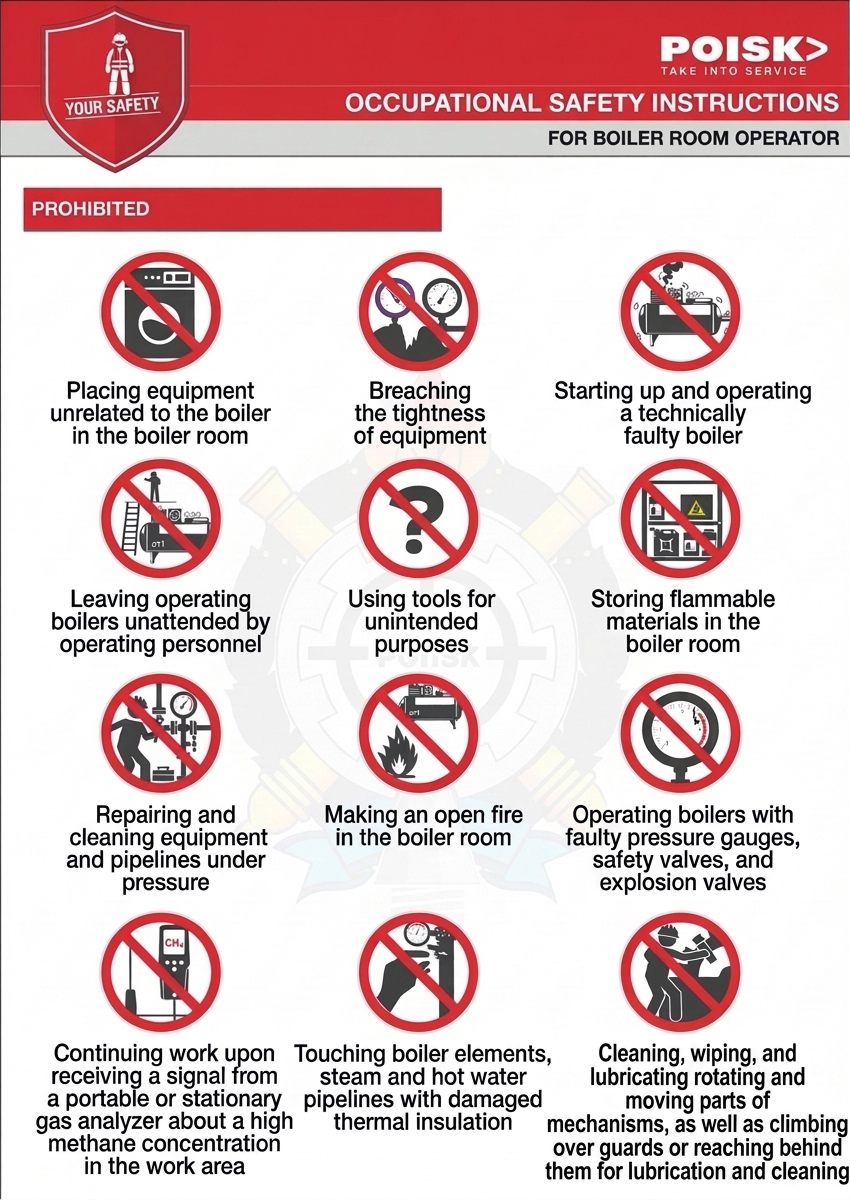
At the same time, the process of creating posters and visual instructions requires an integrated approach, following a specific algorithm and methodology, and working with text — identifying the main points, processing them, and drafting a visual technical brief for the designer.
What visual communication tools exist? Which ones to choose?
Today, the list of visual communication formats used in HSE is diverse:
- Posters and boards with rules, instructions, diagrams, pictograms, and dashboards.
- Warning signs and floor, wall, and equipment markings, including unique signs specific to the enterprise.
- Videos and presentations for training and briefings.
- Information boards with news, statistics, and HSE achievements.
- Photos and success stories demonstrating the company's commitment to safety.
- Souvenir products (calendars, t-shirts, caps, pens) with HSE symbols and slogans, etc.
Another example is shown below:
A board describing 10 key safety rules, featuring an injury counter, as well as news and HSE inspection results.
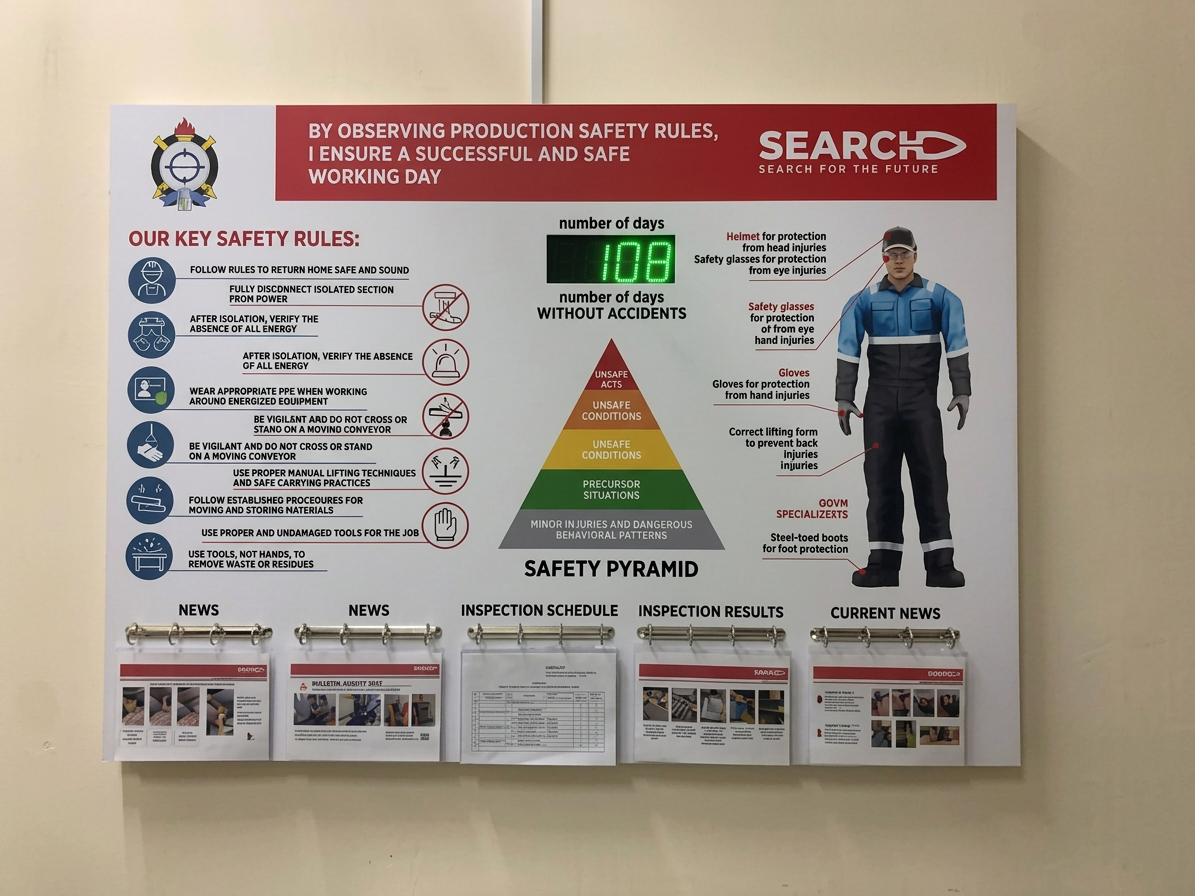
Choosing the right visual communication tools for your company requires a careful approach and consideration of several key factors.
Technology for Creating Visual Communications
For the effective development of visual communication tools in HSE, it is necessary to follow a specific algorithm:
Define the goals and objectives of visual communications. What do we want to convey to the audience, and what changes do we want to trigger? First and foremost, it is necessary to clearly define which tasks you want to solve with visual communications. These may include: Increasing employee awareness of safety rules. Training in safe work methods. Reducing the number of accidents and incidents in production. Study the target audience
It is important to understand who will be using the visual tools. Consider:
- The education level and professional training of employees.
- Language barriers and cultural characteristics.
- Work specifics (e.g., manufacturing, construction, or office environments).
- Conduct an audit of existing visual tools and communications. Identify gaps and areas for improvement. Most likely, some tools already exist in the company, and it is worth understanding how existing experience can be adapted for visual communication goals.
- Develop a concept and style for visual communications that align with the corporate brand and safety culture.
- Create prototypes and layouts of visual tools (instructions, posters, boards, signs, etc.) and test their perception by the target audience. Before implementation, it is recommended to conduct testing among employees. This may include:
- Surveys and questionnaires to obtain feedback.
- Observation of how employees interact with visual materials.
- Adapt visual communication tools to personnel requests and adjust if necessary.
- Implement visual communications into the work environment and train personnel on their use. This stage may include:
- Conducting briefings and training seminars.
- Developing guides and manuals on using visual communications.
- Establishing communication with department heads to inform their subordinates about new HSE training methods.
- Analyze the effectiveness of visual communication implementation. We recommend using the following performance metrics:
– Awareness level: The percentage of employees who can correctly answer HSE questions after the implementation of visual tools.
– Reduction in the number of incidents: The percentage change in the number of workplace accidents before and after the implementation of visual communications. Comparing data on accidents and incidents will help identify their impact on safety. A decrease in incidents may indicate increased worker awareness.
– Engagement metrics: Measuring the level of employee engagement in HSE programs, including participation in safety-related training and events, can serve as an indicator of successful visual communications.
– Feedback – surveys: Assessing employee satisfaction with visual communications on a scale (e.g., from 1 to 5). Regular surveys allow for feedback on the clarity, accessibility, and usefulness of the information presented.
– Observation of safety compliance in the workplace. Direct observation of how employees react to visual instructions and whether they follow safety rules can provide valuable information on the real effectiveness of communications.
These methods and indicators will help enterprises not only evaluate the effectiveness of visual communication implementation but also identify areas for improvement, ultimately leading to an increased level of occupational safety.
- Continuously improve visual tools, monitor their effectiveness, and make enhancements.
What mistakes can occur when implementing visual communication tools at an enterprise?
- Insufficient adaptation to the target audience. Visual materials must be clear and accessible to all workers, considering their education, language skills, and cultural characteristics. Using complex terminology and unclear symbols reduces communication effectiveness.
- Lack of a unified style and concept. Visual tools should align with the company's corporate brand and safety culture. Disjointed, inconsistent materials will be perceived less effectively.
- Information overload. An excess of text, small details, and complex diagrams hinders perception. Visual communications should be concise, with an emphasis on key points.
- Insufficient attention to placement. Visual tools should be placed in the most visible and accessible locations where workers spend time. Poor visibility and limited accessibility reduce their effectiveness.
- Lack of feedback and evaluation. It is necessary to regularly receive feedback from employees regarding visual communications and evaluate their impact on safety.
In today's reality, it is impossible not to touch upon the development of posters and visual instructions using Artificial Intelligence.
Using Artificial Intelligence (AI) to create HSE posters has both advantages and disadvantages.
Pros of using AI:
- Speed: AI can generate many poster options in a short time, which is especially useful when urgent development is needed.
- Resource saving: Automating the visualization process allows for reduced labor costs for designers.
- Accessibility: There are free or low-cost AI tools that even small companies can use.
- Diversity: AI is capable of suggesting unconventional ideas and solutions that a designer might miss.
Cons of using AI:
- Limited understanding of context: AI may not account for the nuances of legislation, industry specifics, or cultural characteristics, which can lead to incorrect or inappropriate images or misinterpretation of the prompt.
- Lack of creativity: AI generates images based on existing templates and data, which may limit the originality and uniqueness of posters, requiring refinement by a designer.
- Difficulties with interpretation: AI may create images that are hard to understand or that cause an ambiguous reaction from the audience.
- Ethical issues: Using AI may raise questions of copyright and responsibility for content.
An unsuccessful example of AI usage is shown in the figure below.
Of course, we formulated a different prompt, but the AI generated exactly what is shown in the figure.

As a result of working on adjusting the prompt for the AI, we achieved the desired result and obtained this poster:
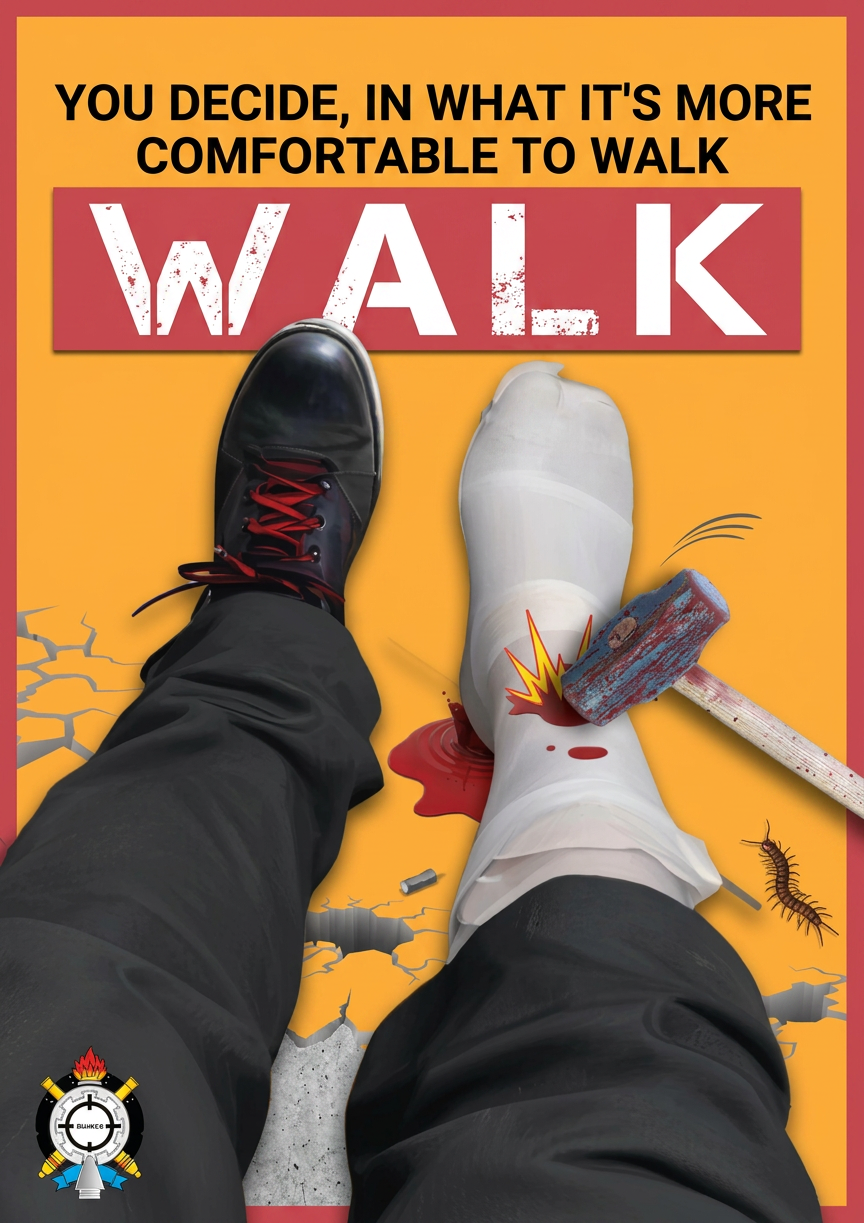
Thus, modern technologies allow for more effective work on implementing visual communication projects. These tools must be used.
Based on the experience of using visual communications, it is clear that this direction in HSE will rapidly develop and improve.
In the meantime, by following the development and implementation algorithm presented above, one can systematically manage the process of forming and enhancing safety culture.