Occupational Risk Management: Using a Gamified Approach in Employee Training
Abstract: Changes in Russian legislation regarding occupational health and safety (the entry into force of Section X of the Labor Code of the Russian Federation on March 1, 2021) require companies to conduct occupational risk assessments. This has led to the need for rapid training of employees and commission members to competently and correctly identify hazards and risks in the workplace. This article explains how to effectively use gamified approaches, including board games, in the field of occupational risk assessment.
Training company employees in risk and hazard identification is becoming one of the most popular tasks currently facing HSE specialists.
Due to active changes in OHS legislation in 2020 and the entry into force of Section X of the Labor Code on March 1, 2021 — when companies became mandatory responsible for conducting occupational risk assessments — the question arose: how to effectively train employees and commission members to correctly identify hazards and risks in the workplace in a short period of time.
At the same time, in a constantly dynamic, rapidly evolving world where multitasking takes center stage and the number of distractions is constantly increasing, classic employee training models are becoming less effective. What engages and captures employees' attention today may be boring tomorrow, and this happens much sooner than we can imagine. Every year, it becomes harder to maintain attention and interest in training, including in the field of HSE, especially when it comes to identifying hazards and risks in the workplace.
How can we solve such a difficult task as creating an effective strategy for engaging employees in occupational risk assessment training? After all, personnel often take a formal approach to training in this area, as employees do not want to spend time on what they consider "ineffective" activities and physically cannot absorb the information provided due to its large volume.
To find the answer to this complex question, it is necessary to recognize the following interrelated conditions and identify possible resources for solving such a challenging task:
- employee engagement is the most valuable resource today. The success or failure of any business process in a company, including HSE training, depends on the level of employee engagement;
- the best way to increase engagement is to give employees the most interesting and exciting experience possible.
Due to demographic and cultural trends, the world is becoming more and more like a game. Industrial safety training is no exception. Thus, gamification (a gamified approach to learning, the use of board games, etc.) is becoming a priority in the issue of employee engagement in training.
Many HSE specialists often lack the knowledge, skills, and experience to teach such a complex, static field based on strict rules and formulations as occupational safety through a game. To solve this problem, it is necessary to move away from the standard representation of a classic game and understand what gamification (a gamified approach) entails.
Gamification is a way of organizing the mastery of specialized knowledge, skills, and abilities based on the inclusion of game elements and game mechanics in the learning process. At the same time, the tasks of gamification in training are: to understand and deal with certain processes (production, technological, etc.) through the game, as well as to assess the competence of personnel in a certain area — in this case, in HSE training for hazard and risk identification.
It is the gamified approach that ensures greater employee engagement according to Edgar Dale's learning model (Dale's Pyramid/Edgar Dale's Cone of Experience) (Fig. 1).
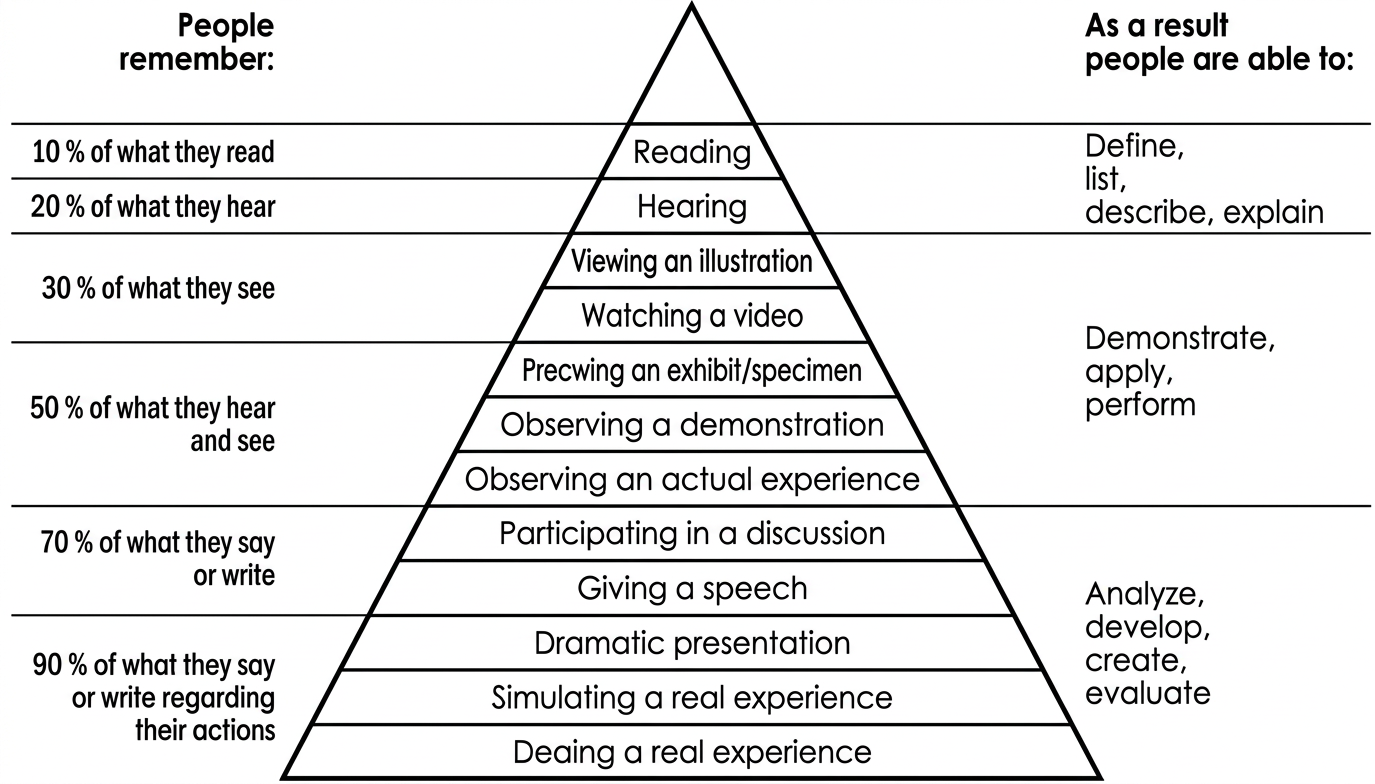
Figure 1. E. Dale's Pyramid applied in employee training.
According to the learning pyramid, a game is the most effective way to absorb information. This approach differs from classic exams and formal education. Thus, we offer an effective training format to improve employees' knowledge of HSE, where every worker can take initiative, improve communication with colleagues, remember material better, and practice skills in a safe game environment. As a result, the knowledge gained contributes to a reduction in injuries, accidents, and emergency situations in production.
To implement the task of training employees and conducting occupational risk identification, we developed the "Safety Marker" business board game.
The name of the game "Safety Marker" was chosen based on the tasks facing the participants. Using cards, players mark the hazards found on the game field, thereby creating a model of safe employee behavior.
The game is aimed at identifying hazards and risks in production units based on the situations described in these units.
The goal of the game is to model safe employee behavior using a specific set of measures that minimize existing risks characteristic of each production area.
The main objectives of the game are:
- identifying risks and hazards in the workplace;
- acquiring knowledge on the interpretation of safety signs, signal markings, and labeling;
- increasing staff engagement in safety culture issues.
The game mechanics can be described as follows: at the beginning, participants randomly end up in one of the locations of a production shop and receive a set of three types of cards: "Risk," "Measures," "Situation," and their descriptions. The task of the players, based on the described situation, is to determine in the minimum amount of time what Risks exist in the area and select Measures that eliminate or minimize that Risk. Players receive bonuses for correctly identified Risks and correct Measures. The game consists of three rounds: "Emergency Liquidation," "Risk Management," and "Audit."
The main game board consists of a production shop divided into 12 areas (zones) where various types of work are carried out, such as painting, welding, and work at height, which also include high-risk activities.
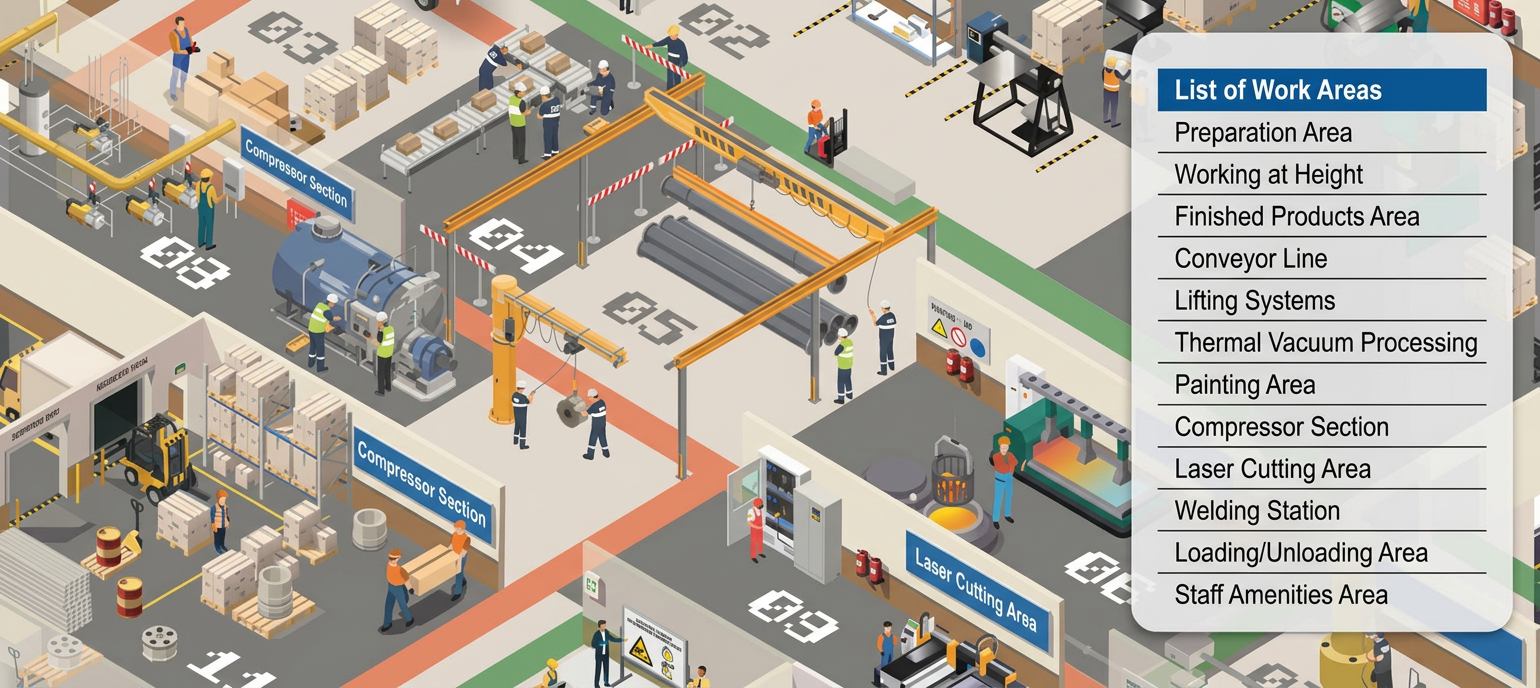
The Safety Marker game is suitable for the following events:
- practicing the risk assessment procedure if the company conducts it independently;
- training new employees and testing knowledge;
- Safety Days and Occupational Health and Safety Days;
- HSE strategic sessions, etc.
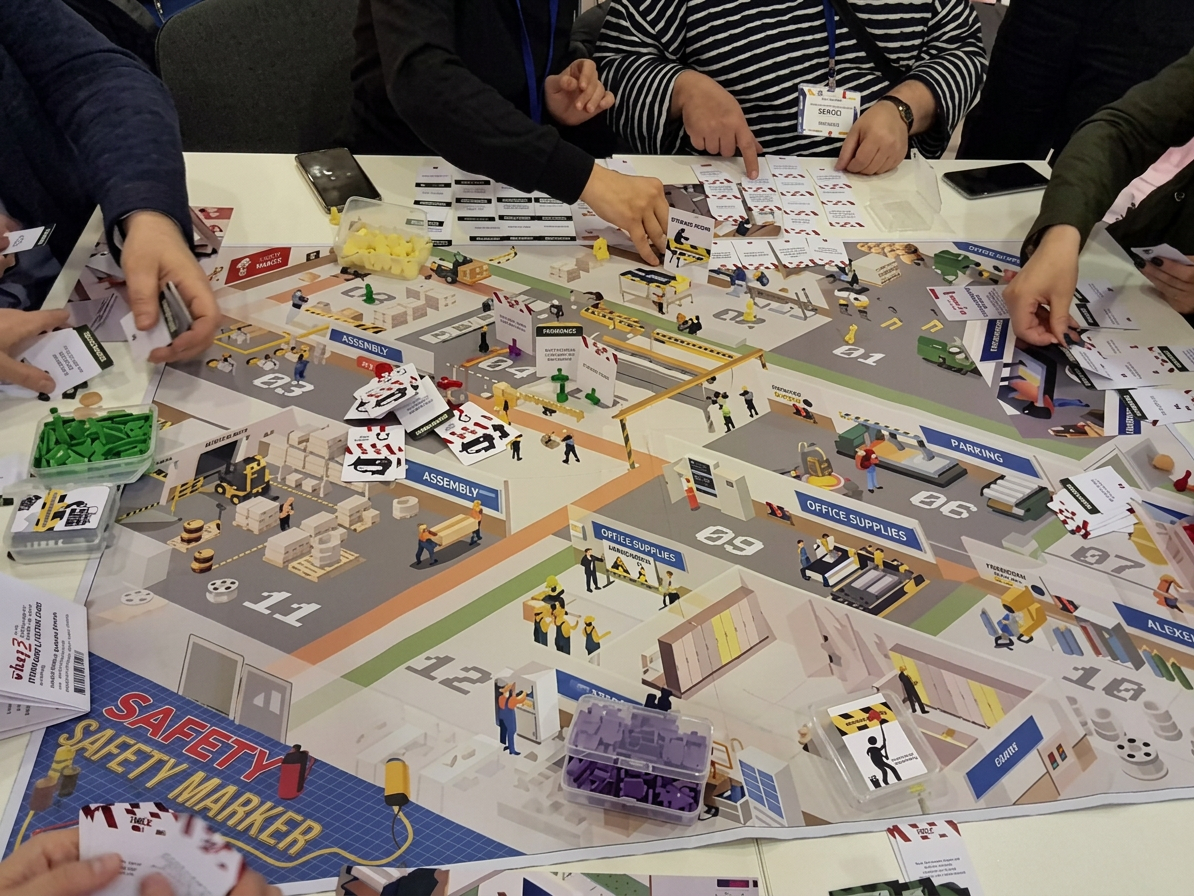
By applying this game format in occupational risk training, the following goals can be achieved:
- safely practice dangerous situations that may arise at the enterprise for employees;
- form a unified understanding among workers of possible risks and measures to prevent them;
- model a safe workspace through visual landmarks — safety signs.
Thus, the gamified approach in the field of risk identification has several advantages:
- high quality of training material (visibility, brightness, high degree of memorability — interaction with physical objects like tokens and cards engages motor memory, allowing the knowledge gained during the game to be consolidated);
- training effectiveness;
- increased employee engagement;
- development of additional related skills and abilities (communication, team building, etc.);
- possibility of multiple use;
In conclusion, gamified methods in training can be effectively used even for the most difficult topics to study and understand, such as occupational risk management. It is HSE professionals who must influence how to competently organize this process and involve the organization's personnel in training to minimize risks and hazards in production.