How to Overcome the Ebbinghaus Forgetting Curve and Reinforce Workers' Knowledge
The Ebbinghaus forgetting curve is a model showing how quickly information is forgotten over time if it is not reviewed. It was developed by the German psychologist Hermann Ebbinghaus in 1885 and demonstrates that forgetting occurs non-linearly, being particularly sharp in the first hours after memorization. Approximately one hour after learning, up to 60% of information is lost, and after 10 hours — up to 65%. To counteract this effect, the spaced repetition method is used, where material is reviewed at the moments it begins to be forgotten.
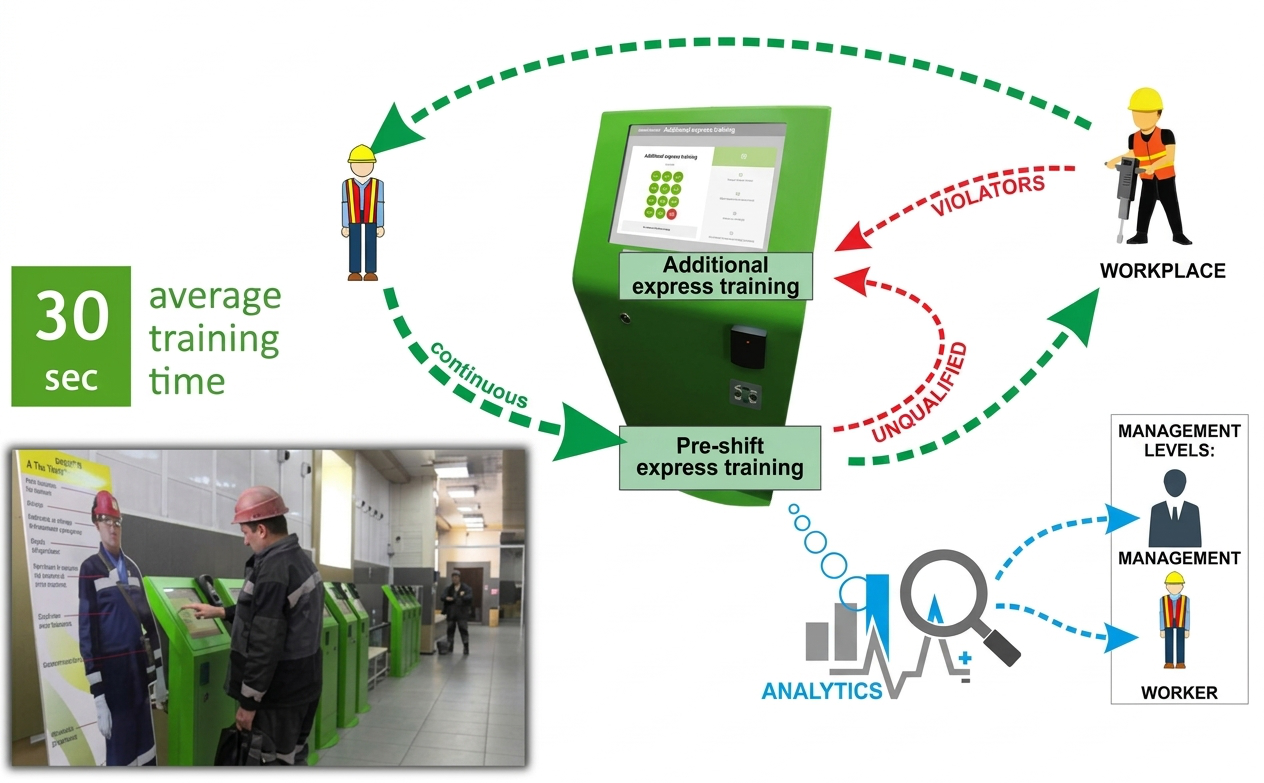
In our company, we manage this process through the software and methodological complex "Video Information Complex for Assessing and Managing Occupational Injury Risks". Technically, this is represented by pre-shift examiner terminals. Before receiving a briefing and a work permit, each worker undergoes express training. Express training is conducted with extensive use of photo and video materials of production operations, HSE video instructions, and short 3D computer-animated micro-films to analyze the causes of real accidents and practice correct actions that prevent injuries.
Differences between express training and pre-shift testing:
- Pre-shift testing of workers (pre-shift examiners)
Function — knowledge control only.
Pre-shift testing measures the workers' knowledge level, after which, in accordance with the logic of labor legislation, an HSE specialist must train the worker on the topics they know poorly.
To do this, the HSE specialist needs to read the questions the worker answered incorrectly, identify their mistake, tell the worker what their mistakes can lead to, and explain how to perform the work using safe methods and practices.
This is easy to do for one person, but impossible for thousands!
- Pre-shift express training of workers
Functions:
- knowledge control and personal assessment of injury risks;
- injury risk management by training workers in safe work methods and practices.
Thus, express training not only controls knowledge but also automatically teaches workers to: identify hazards; assess the risks of health damage (various types of injuries); manage injury risks — perform work using safe methods and practices.
Brief description of the express training procedure.
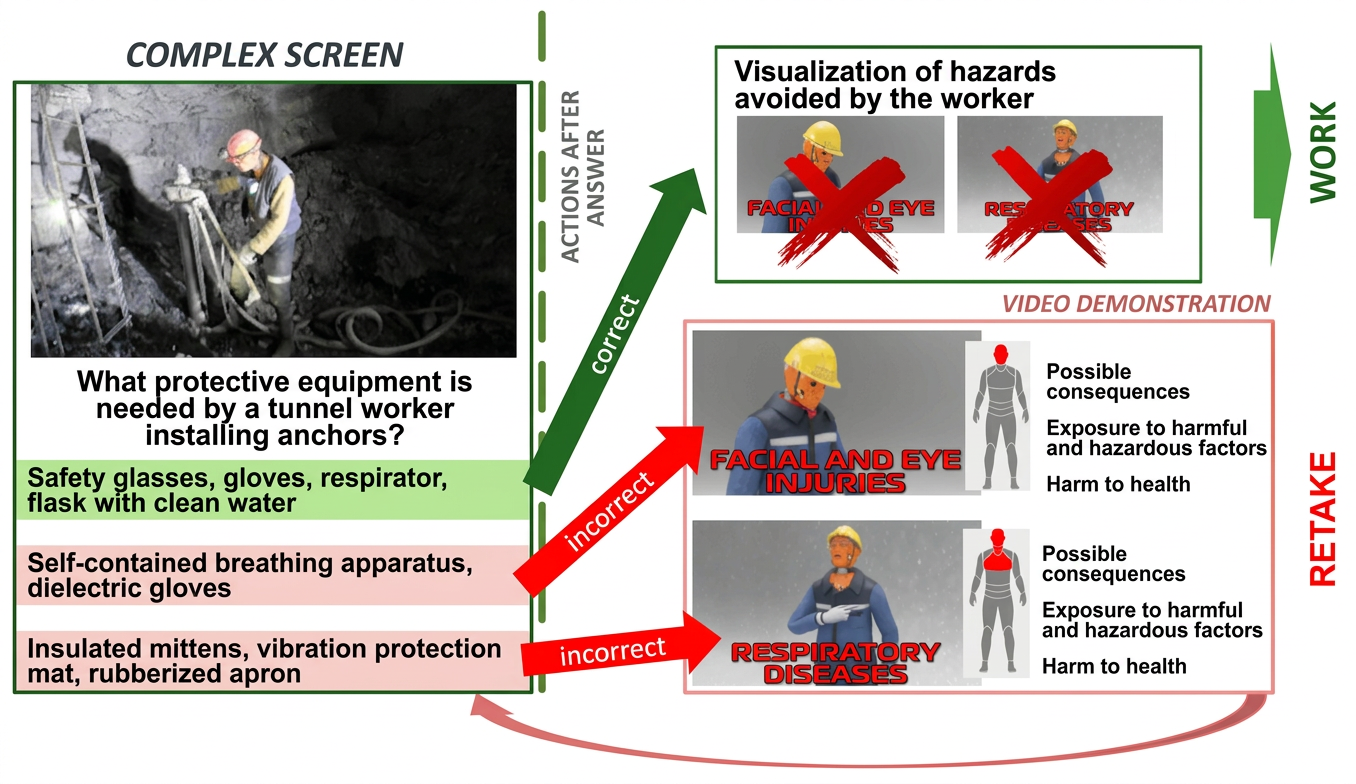
On the terminal screen, the worker sees a task consisting of an illustration, a question about the task, and three possible solutions, one of which is correct.
If answered correctly:
The worker is shown (through visualization) the hazards they avoided, and they are admitted to work.
If answered incorrectly, the risk management procedure is automatically launched — competency adjustment (express training) of the worker:
- Using video clips, the worker is sequentially shown:
– the emergence and development of a hazardous situation;
– various injuries (potential health damage) that the worker could sustain as a result of their incorrect actions.
- The correct solution to the task is provided — training in safe actions takes place.
- The same task is repeated until the worker answers correctly; only after that are they admitted to work, as our main goal is to train and reduce the risks of the worker's unsafe actions.
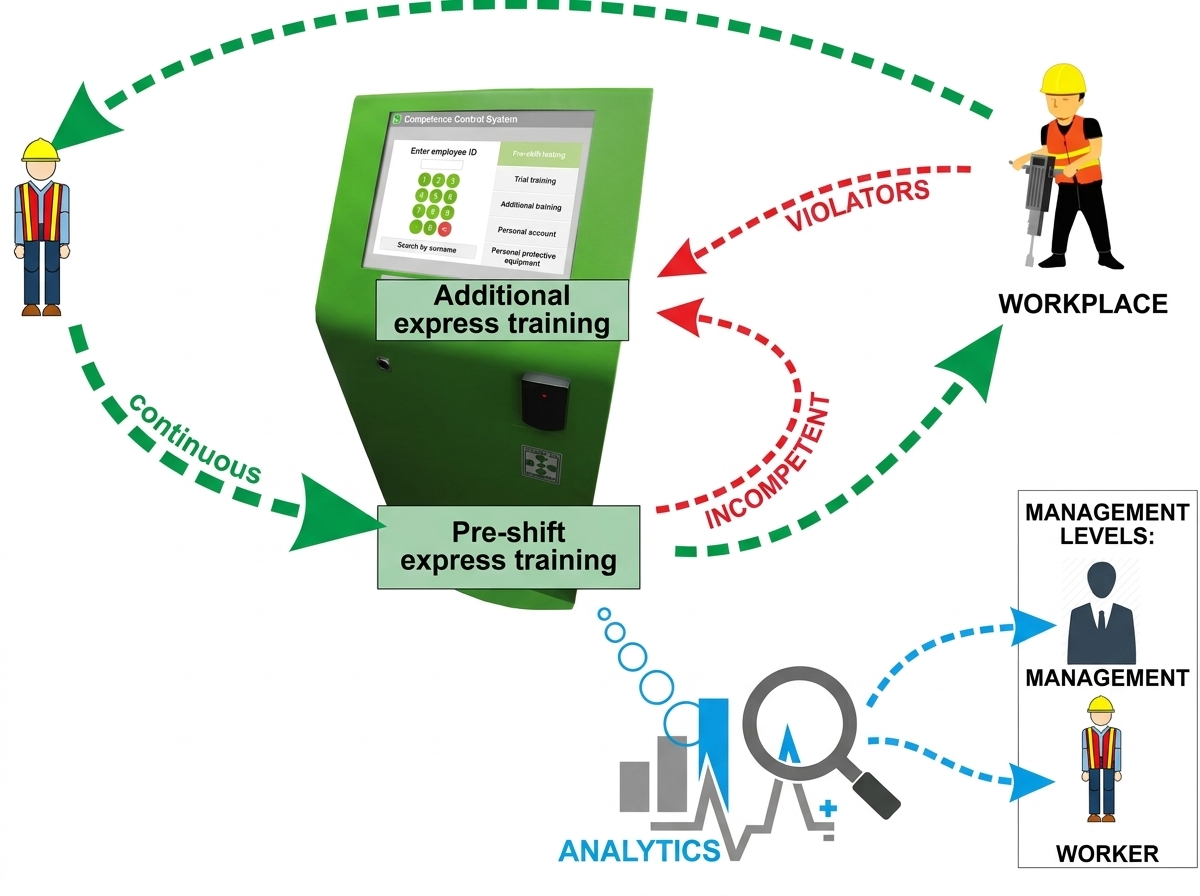
Additional express training is automatically assigned to a worker if they have a high personal injury risk level or if a violation of HSE requirements by the worker is recorded.