Step 3. Promotion. Children and Us
A WANO document clearly defines the criteria for industrial safety: "All employees are guided by high standards of work performance and working conditions that ensure a high level of health and life protection for personnel."
Nevertheless, a great deal of time at the enterprise is devoted to the issues of personnel commitment to safety requirements and the elimination of incorrect actions by personnel.
Amendments to the Labor Code of the Russian Federation in Article 209.1, "Basic Principles of Ensuring Occupational Safety," establish that the primary principles of ensuring occupational safety are the prevention and prophylaxis of hazards, and the minimization of damage to workers' health.
This means that the employer must constantly implement measures to improve working conditions, including the elimination or reduction of risk levels in the workplace. Furthermore, the employer must ensure constant readiness to localize (minimize) and eliminate the consequences of professional risks... That is, risks must still be constantly assessed, i.e., observed, monitored, and eliminated if their level becomes unacceptable.
The question arises: who, when, and how should assess risks? Behind this simple, concise word lies an entire system of measures. Certainly, when opening a workplace, the employer organizes the full range of assessment work: conducting a Special Assessment of Working Conditions (SAWC), identifying hazards with risk assessment based on the probability and severity of occurrence, taking measures, and familiarizing personnel with risks and measures, including collective protective equipment and rules of conduct near sources of risk.
But the technological process does not stand still; the situation at workplaces changes. A clear example is construction. On a construction site, the situation changes before your eyes: building frames and structures are erected, engineering utilities are installed, and assembly and finishing work are carried out. All work entails its own specific features that must be studied, taken into account, observed, and the emerging risks must be managed, keeping them at an acceptable level.
Therefore, operational risks are the responsibility of the work supervisor, the foreman, and even every worker, as risks can arise even with changes in weather conditions. In everyday life, we manage risks: we take an umbrella, we change the tires on the car when ice appears, and in a rope park, we fasten our helmet with a chin strap. This is exactly the approach that should be taken at work. The skills of unconditional safe behavior are developed through their constant execution. But how can we encourage a worker to eliminate the habits of the "it'll be fine" attitude and "...It won't happen to me...", as well as the ironclad justification for their incorrect actions: "We've always done it this way..."?
Training methods vary, and our blogs already feature a library of various practices and effective approaches in different organizations.
Almost everyone is familiar with the method of safety promotion. I want to highlight effective ways of using this method.
One of them is our children.
Everyone probably wants to be a hero for their child, not only because being a hero is cool, but also because anxiety for children remains. How will they cross the road? What if they are on a skateboard? What if they are on a bicycle — will they hear warning signals, will they be able to assess the danger in time?
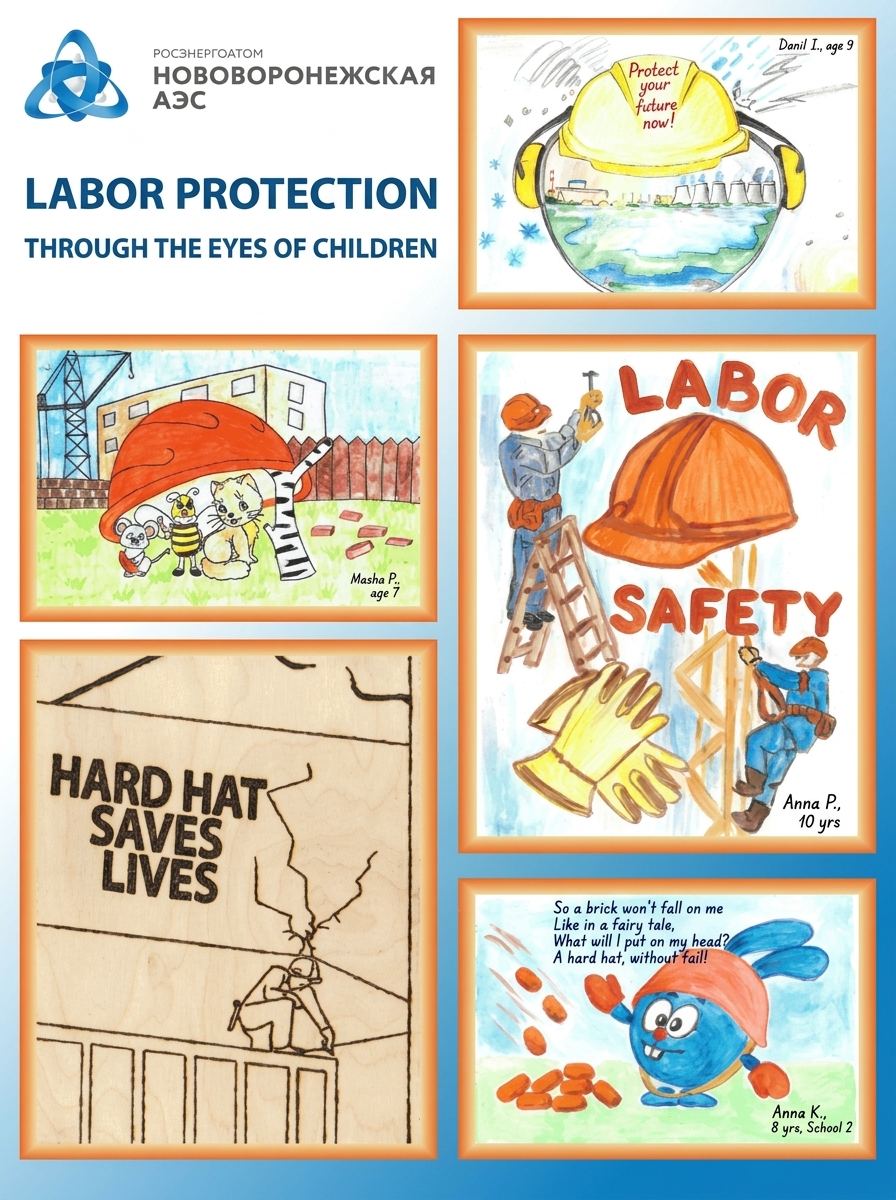
So, children's drawings and appeals from children are among the powerful motivators for correct personnel behavior, self-control, and the drive to perform work correctly rather than in a hurry.
At our enterprise, children's drawings are like a treasure trove and valuable experience; the drawings are compiled into posters and stands.
Then these stands are placed in high-traffic areas and at personnel workplaces.
They may seem like just posters, but in essence, this is the education of our future generation, which from childhood participates in building a safety culture together with their parents.