Targeted Briefing: Moving Beyond Formality
Currently, many leading companies have actively begun to improve their safety culture and change their approaches to ensuring safety by introducing new tools, applying best practices from other companies, and upgrading their employees' skills. Metalloinvest is no exception. One of the largest projects implemented at our company's enterprises is the "PRO-risks" project. The project includes many tools that encourage workers to identify risks and respond to them.
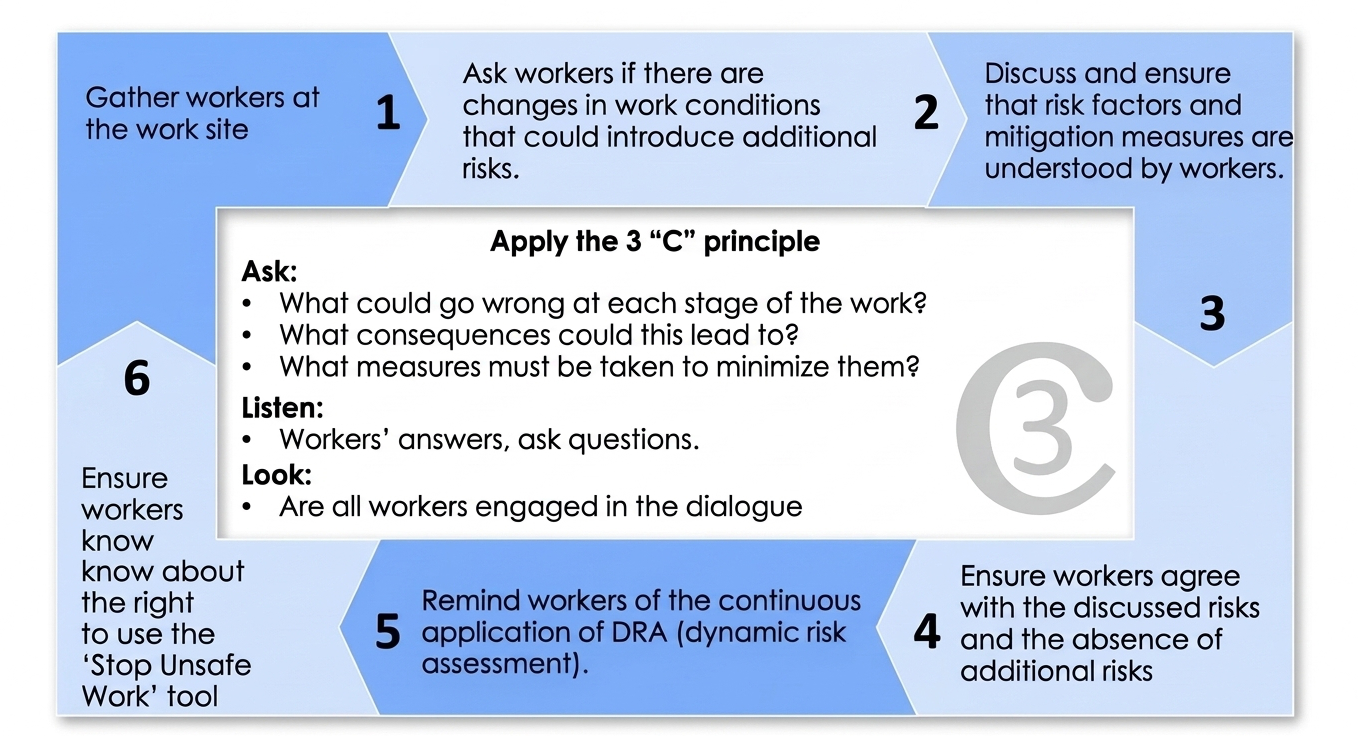
Some of these tools are similar to existing practices but differ in their specific approach. One such tool is PJRD (Pre-Job Risk Discussion). There are several principles for conducting a PJRD:
- PJRD is conducted at the worksite to understand the actual situation;
- The person conducting the PJRD engages in a dialogue with workers to discuss the risks at each stage of the work, what needs to be done to avoid them, and what PPE and tools will be used;
- The PJRD conductor reminds workers that they can stop work if unsafe conditions arise;
- During the PJRD, the workers do most of the talking, while the conductor only asks clarifying questions and guides the discussion in the right direction. In doing so, they ensure that the workers know how to perform the job safely.
When the tool was first introduced in our company, it was quite difficult to gain traction because, from the perspective of the workers, it was just another time-consuming activity. To make the tool work, we combined it with an existing practice. And which existing practice do you think this tool resembles?
Yes, of course, it is the targeted briefing!
Most likely, each of you has thought about questions such as:
- how well targeted briefings are being conducted;
- whether the supervisor manages to clearly explain to the worker what hazards they will face while performing a particular task;
- and the most important question – is a signature in a logbook enough for us to be sure that a person has understood all the risks and knows how to avoid injury?
By combining PJRD with the targeted briefing, we not only gained a functional tool but also improved the quality of the briefings themselves. Additionally, we gained the ability to assess the workers' level of understanding of existing risks and promptly correct their knowledge.
The tools were integrated in stages. First, we developed a PJRD memo and distributed it throughout production, placing it inside the targeted briefing logbooks.
After some time, once we saw that the tool had started to work, we decided to amend the corporate standard "Occupational Health and Safety Training and Knowledge Testing for Plant Employees" to include the principles of conducting PJRD as part of the targeted briefing.