Methodology for Assessing the Safety Level and Favorable (or Unfavorable) Mood of a Workforce
During the implementation of preventive HSE measures at the production facility, I wondered how safe our employees actually feel at work, how much attention they pay to safety issues, and how favorable the psychological climate is within the team. Having analyzed off-the-shelf products and methodologies, and considering that my second degree is in psychology, I felt the desire to develop an analytical method, which I decided to share with the community.
Methodology
As the basis for this method, I took the methodology of the Soviet psychologist, specialist in social and pedagogical psychology, and Candidate of Psychological Sciences Anatoly Nikolaevich Lutoshkin — "What Kind of Team Do We Have." It was originally developed to assess the degree of students' satisfaction with their group, whether they were young children or adult students.
The goal was set to study the level of safety and the favorable or unfavorable mood of the workforce. In the proposed methodology, the level of favorability is determined through a survey (questionnaire). The methodology allows us to study not only the level of safety but also to identify the team traits that unite it (+) and those that divide it ( – ). The survey helps determine the prevailing and relatively stable psychological attitude of the team towards compliance with HSE standards, which manifests itself in various forms throughout all its activities.
The level of the socio-psychological climate in the team is assessed using polar profiles: +3 +2 +1 0 -1 -2 -3.
Ratings:
3 – the trait is always manifested in the team;
2 – the trait is manifested in most cases;
1 – the trait is manifested quite often;
0 – both traits are manifested to an equal degree.
Processing the obtained data is carried out in several stages.
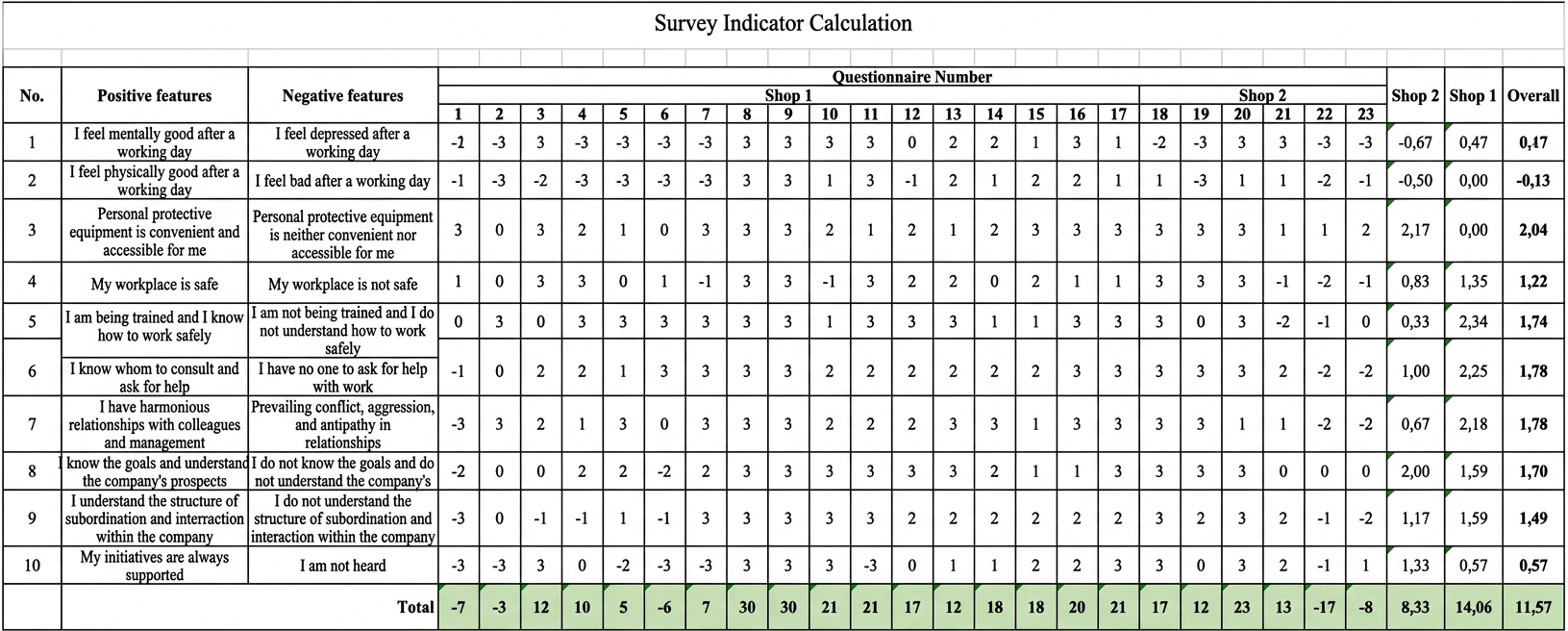
First stage: it is necessary to add up all the absolute values first of the (+), then of the (-) ratings given by each survey participant. Then, add the indicators together (those with a "+" sign and those with a "-" sign).
The result is a number with a positive or negative sign. The responses of each team member are processed in this way.
Second stage: all the numbers obtained after processing the responses of each participant must be added together and divided by the number of respondents. Then, the resulting number is compared with the "key" of the methodology:
Such a calculation can be made for each trait:
a) record, then add up the ratings given to a specific trait by each survey participant;
b) divide the resulting number by the number of participants. Once the indices for each trait are calculated, a ranked series of these numbers is built in descending order of their value. Thus, we identify the traits that contribute both to team cohesion (positive) and its division (traits with a negative sign).
The presented methodology diagnoses the safety level and the favorable or unfavorable mood of the workforce, and also allows (with repeated studies) tracking the dynamics of its development (of those traits included in the questionnaire).
Questions for the Survey
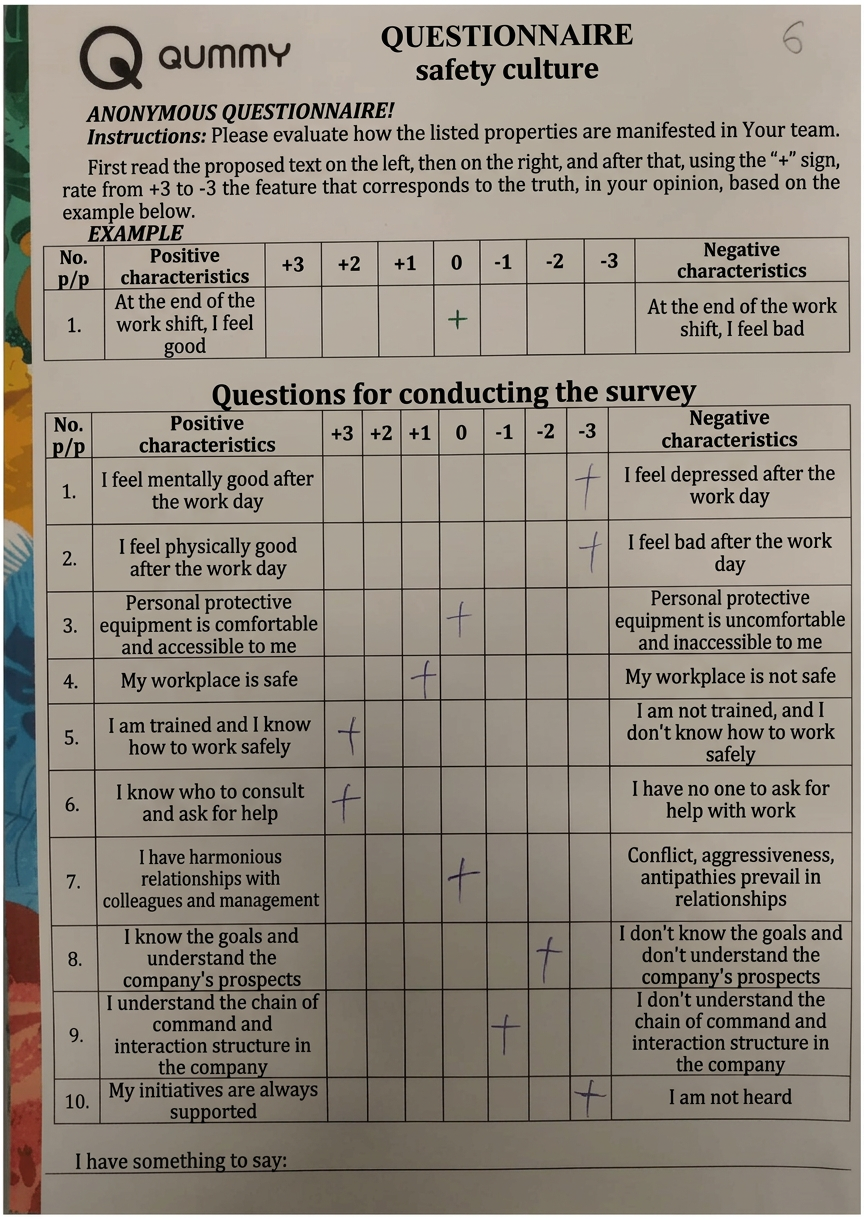
First, read the proposed text on the left, then on the right, and after that, use a "+" sign to rate from +3 to -3 the trait that corresponds to the truth, in your opinion.
|
No. |
Positive traits |
+3 |
+2 |
+1 |
-1 |
-2 |
-3 |
Negative traits |
|
|
1. |
I feel mentally well after the workday |
I feel depressed after the workday |
|||||||
|
2. |
I feel physically well after the workday |
I feel physically unwell after the workday |
|||||||
|
3. |
Personal protective equipment is comfortable and accessible to me |
Personal protective equipment is uncomfortable and inaccessible to me |
|||||||
|
4. |
My workplace is safe |
My workplace is unsafe |
|||||||
|
5. |
I am trained and I know how to work safely |
I am not trained, and I do not understand how to work safely |
|||||||
|
6. |
I know who to consult and ask for help |
I have no one to ask for help at work |
|||||||
|
7. |
I have harmonious relationships with colleagues and management |
Conflict, aggression, and antipathy prevail in relationships |
|||||||
|
8. |
I know the goals and understand the prospects of the company |
I do not know the goals and do not understand the prospects of the company |
|||||||
|
9. |
I understand the reporting structure and interaction in the company |
I do not understand the reporting structure and interaction in the company |
|||||||
|
10. |
My initiatives are always supported |
I am not heard |
|
17 and more |
High level (Level 5) |
|
from 6 to 17 |
Medium level (Level 4) |
|
from 0 to 6 |
Low level (Level 3) |
|
from 0 to (-6) |
Initial unfavorable level (Level 2) |
|
from (-6) and less |
Unfavorable level (Level 1) |
In my opinion, it is important to conduct this survey not in an electronic format, but in a live format using a paper questionnaire that is beautifully designed and pleasant to the touch. This nuance will maximize employee engagement in the process and encourage them to provide an objective response.
Example of questionnaire design
Description of levels for developing preventive measures
After determining the level in accordance with the methodology's "key," it is necessary to develop a plan of preventive measures aimed at improving the indicators. Below I have provided a description of the levels, which gives an understanding of the team's condition. In the description, I tried to preserve the original artistic style of the methodology's founder, which uses associative examples to help understand the state, mood, and engagement of the team.
Level 1. It is not so rare to encounter sand placers on our way. You look at how many grains of sand are gathered together, and yet each of them is on its own. A light breeze blows — it carries away some of the sand lying on the edge; a stronger wind blows — it scatters the sand in all directions until someone rakes it back into a pile. The same happens in human groups, whether specially organized or formed by circumstances. Everyone seems to be together, but at the same time, each person is on their own. There is no "cohesion" between people. In one case, they do not strive to meet each other halfway; in another, they do not wish to find common interests or a common language. There is no core here, no authoritative center around which people would unite and rally, where everyone would feel needed by another and themselves in need of the attention of others. For now, the "sand placer" brings neither joy nor satisfaction to those who make it up.
Level 2. It is known that soft clay is a material that is relatively easy to mold, and various items can be sculpted from it. In the hands of a good master (and in a group, this can be a formal leader, simply an authoritative employee, or a manager), this material turns into a beautiful vessel, a wonderful product. But if no effort is applied to it, it can remain just a simple lump of clay. At this stage, efforts to unite the team are more noticeable, although these may only be the first steps. Not everything works out; there is not enough experience in interaction and mutual assistance, and achieving any goal is difficult. The binding link is often formal discipline and management requirements. Relationships are mostly friendly, although you cannot say that people are always attentive to each other, considerate, or ready to come to each other's aid. If this happens, it is only occasionally. There are closed friendly cliques here that communicate little with each other. There is no real, good organizer yet, or they cannot prove themselves, or it is simply difficult for them because there is no one to support them.
Level 3. In a stormy sea, a flickering lighthouse brings confidence to both novice and experienced sailors that the chosen course is correct. It is only important to be attentive and not lose sight of the flashes of light. Notice that the lighthouse does not burn with a constant light but periodically emits beams of light, as if saying: "I am here, I am ready to help." The team forming in the group also gives everyone signals to "keep it up" and is ready to come to everyone's aid. In such a group, the desire to work together, help each other, and be friends prevails. But desire is not everything. Friendship and mutual assistance require constant burning, not single, even if very frequent, flashes. At the same time, there is already someone to rely on in the group. The "lighthouse keepers" — the core activists — are authoritative. It can also be noted that the group stands out among other groups for its "dissimilarity" and individuality. However, the difficulties encountered often halt the group's activities. Initiative is insufficiently manifested; proposals for improving things not only in their own group but in the whole organization are rarely made. We see manifestations of activity in bursts, and even then, not from everyone.
Level 4. The Sail is a symbol of forward striving, friendly loyalty, and duty. Here they live and act according to the principle "one for all and all for one." Friendly participation and interest in each other's affairs are combined with strong principles and mutual demandingness. The command staff of the sailboat consists of knowledgeable and reliable organizers and authoritative comrades. People go to them for advice and ask for help. Most members of the "crew" show a sense of pride in the team; everyone worries when someone suffers a setback. The group is keenly interested in how things are going in neighboring departments or teams, and sometimes its members come to the rescue when asked to do so. Although the group is cohesive, it is not always ready to go against the "storms," and it does not always have the courage to admit mistakes immediately, but this situation can be corrected.
Level 5. The Torch is a living flame, the combustible material of which is close friendship, a united will, excellent mutual understanding, business cooperation, and the responsibility of everyone not only for themselves but also for others. All the qualities of the team that are characteristic of the "Sail" are clearly manifested here. But not only that. You can shine for yourself, making your way through thickets, climbing peaks, descending into gorges, breaking the first trails. A true team can only be called a group that does not isolate itself within the narrow framework of even a friendly, cohesive association. A true team is one where people themselves see when they are needed and go to help on their own; one where they do not remain indifferent if other groups are doing poorly; one that leads the way, illuminating the path forward.