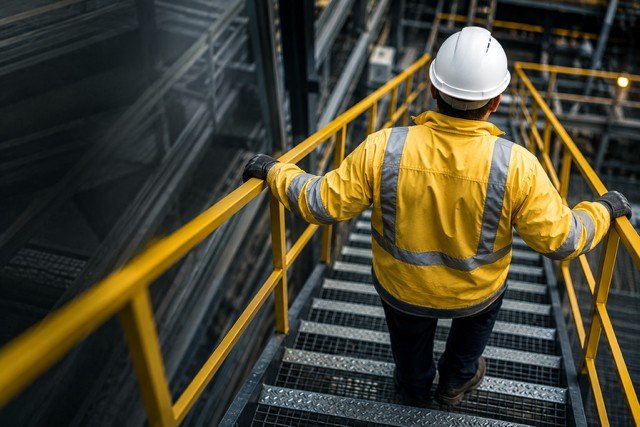
The Handrail: Your Silent Safety Colleague
Have you ever noticed someone on site descending a staircase with a phone in one hand and a cup of coffee in the other? In those moments, the same question always pops into my head: is a handrail truly a functioning safety measure, or just a "formality from the manual"?
What do the statistics say?
Let's start with the unpleasant facts. According to Rostrud, about 30% of industrial accidents in Russia occur due to falls — and these are mostly not falls from heights in the classic sense (scaffolding, roofs), but a simple loss of balance while walking, on stairs, and at crossings. According to Rostrud data, about 30% of industrial accidents in Russia are related to falls, and most often this is the result of losing balance due to slipping or tripping.
And here is another figure that I personally find key to this topic: up to 85% of fall injuries occur not from a great height, but from a low one — because the level of danger is underestimated. In other words, a fall from 20-meter scaffolding isn't what's truly frightening — everything there is regulated and under control. What is truly scary is the mundane "tripping on a flight of stairs between floors."
Global statistics tell the same story. In 2020, according to the US Bureau of Labor Statistics, falls caused 805 worker deaths, and more than 210,000 people lost their ability to work for one or more days due to serious fall injuries (National Safety Council data). For years, falls have remained among the top causes of industrial injuries and fatalities — even in a country with one of the most developed regulatory systems in the world.
Do the rules even require holding the handrail?
This is where it gets interesting — this is the detail I usually bring up to colleagues when I hear the argument that "using the handrail is optional; a staircase isn't a stepladder."
OSHA (the US regulator) requires "three points of contact" (two hands + one foot, or two feet + one hand) specifically for stepladders and extension ladders — this is a direct requirement in our HSE instructions.
However, for regular staircases, the regulator's logic is completely different: the three-points-of-contact requirement does not apply to stair flights — they are governed by a separate standard (29 CFR 1910.25), which sets requirements for the structure rather than human behavior: step height, tread depth, and the presence and characteristics of handrails. It turns out OSHA's approach is quite elegant: the safety of a staircase is built into the *design* itself (width, handrails on both sides, non-slip coating), rather than requiring "discipline" to hold on with hands as one would on a ladder — because on a staircase, the hands don't carry the load; the legs do.
From this comes an important practical conclusion for us as specialists: the fact that the law doesn't always explicitly mandate "holding on" doesn't mean the handrail isn't necessary. It doesn't so much protect against a fall during a loss of support (as on a ladder) as it turns a single slip of the foot into a minor stumble rather than a full-body fall. This is why major companies embed the habit of "holding on" into their culture rather than just the law.
How do others do it?
A good example is TotalEnergies with their famous "12 Golden Safety Rules." One of the employee's personal commitment points there literally states: I hold the handrails when moving on stairs. This is not a technical requirement for the structure, but a personal behavioral commitment for every worker — on par with traffic rules and the right to refuse unsafe work.
At Rosneft, the "Golden Rules of Labor Safety" are built on similar logic — a short and visual set of rules for the most typical and dangerous types of work, compiled based on an analysis of real incidents in the industry. The "Golden Rules of Labor Safety" are a concise and visual guide for the safe performance of the eleven most characteristic and dangerous types of work, formulated taking into account the production experience of leading companies in the industry and incident analysis. I like this format better than a long regulatory article — precisely because it is easy to verify visually: either the hand is on the rail, or it isn't.
Severstal followed a similar path in its time. In the early 2010s, the company developed the "Employee Code of Conduct" and "Key Safety Rules," and even earlier, since 2005, the "Safety for All" program with cardinal safety requirements has been in effect at the group's enterprises. Cardinal safety requirements were introduced as part of the "Safety for All" program, which has been in effect at all Severstal-Resurs enterprises since 2005 with the aim of radically improving industrial safety and reducing injuries. The logic is the same as with TotalEnergies and Rosneft: general HSE requirements are translated into specific, literal personal commitments for every worker — what is known today as behavioral safety. Essentially, this is the same principle that underlies the "Risk Hunting" methodology we are currently using in the transformation of contractor safety management at Uralkali: not general rules "somewhere in a manual," but a specific observable action of a person here and now.
And now, on a personal note
I'll be honest: for me, this isn't abstract theory from presentations. Over years of working on sites — both at a mining enterprise and now — the habit of holding the handrail has literally saved me from falling face-first several times. A foot slips off a step, the body is already losing balance — and a hand on the rail turns it into a minor scare instead of a broken nose, or something even worse. And tellingly: every time it happened, it wasn't at a complex technological facility where everyone is already alert and focused, but in the most ordinary, "unremarkable" places — on a staircase between floors, at a crossing. That's why I am convinced: such an example works better than any statistics when explaining to colleagues why they should hold handrails at all — including those who are sure it will never happen to them.
So, what's the bottom line?
A handrail is not about a lack of trust in the employee or a "box-ticking" exercise. It is a cheap, almost free barrier between a loss of balance and a fall. In production, this is especially obvious: wet steps, changes in lighting, hands occupied with tools. But the same logic applies in the office — 85% of fall injuries occur exactly where no one expects trouble, rather than during obviously dangerous high-altitude work.
So yes — holding handrails is necessary both in the office and in production. And this rule should be reinforced not only in instructions but also in the personal safety culture of every employee — following the example of the "Golden Rules."
Where, in your opinion, should the balance lie between strict regulation and the development of a personal habit of safe behavior?
Write your thoughts on this measure in the comments.
Comments 2