Is Your Risk Management System Actually Working?
The essence of the methodology in brief:
The classic hazard and risk management process looks like this: 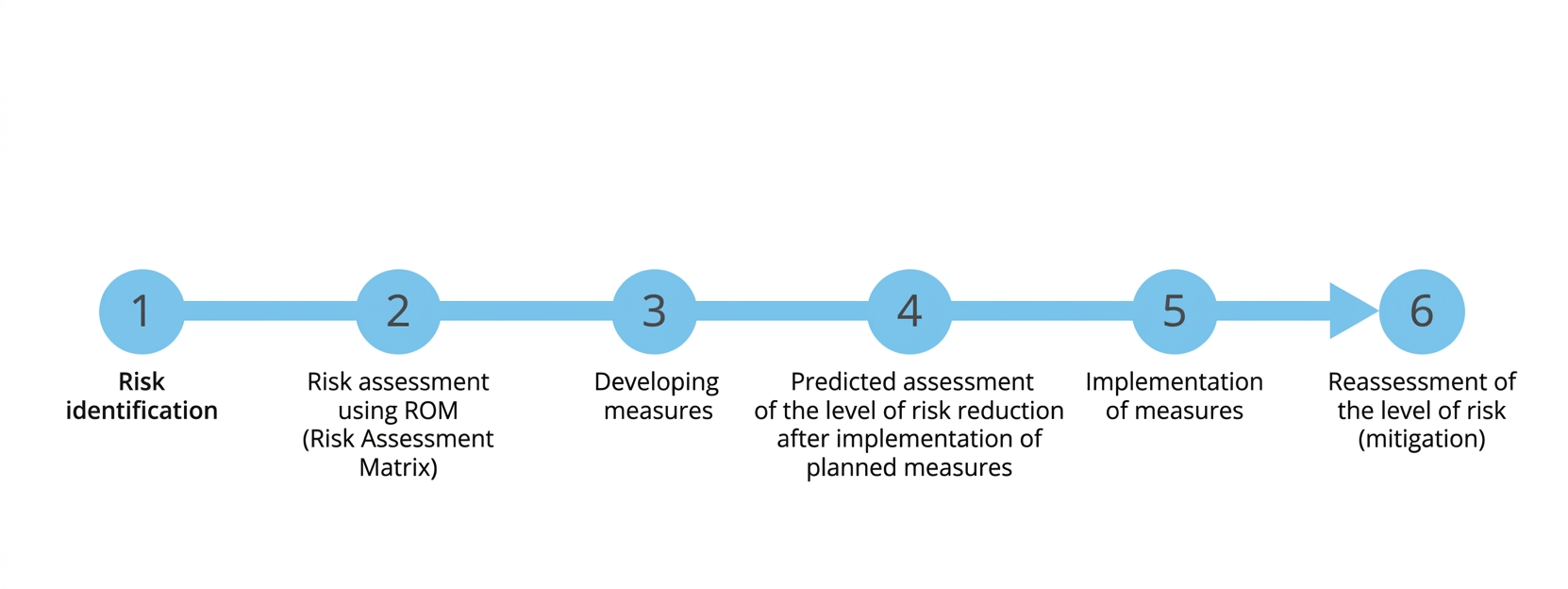 I will not describe the entire methodology in this article; instead, I will highlight what I consider to be the key points at each stage!
Key points by stage:
- Stage 1:
- worker involvement (via questionnaires, focus groups, and inclusion in "risk hunting" teams);
- availability of a hazard classifier;
- a three-component risk formulation (consequences - hazardous event - cause);
- the methodology must account for both HSE and industrial safety risks.
- Stage 2:
- a balanced risk assessment matrix (no more than 5% of risks should fall into the red zone based on assessment results);
- the risk assessment methodology using the matrix should consider (in addition to statistics): the frequency of personnel presence in the risk zone, the concentration of hazardous substances (MPC) that could impact workers or the environment if the risk materializes, etc.
- Stage 3:
- conduct an analysis of existing barriers;
- use the SMART principle when developing mitigation measures;
- apply the hierarchy of controls.
- Stage 4:
- simplicity of the methodology for calculating the predicted risk reduction (theoretical calculation) after implementing measures.
- Stage 5:
- group measures for TOP risks into targeted programs;
- assign responsibility for monitoring the implementation of measures for each TOP risk to business leaders (e.g., Risk: falling from height – monitored by the Maintenance Director).
- Stage 6:
- remember to perform risk reassessments and present the results to the business.
Crucial points:
- Establish an annual risk management cycle so that the planned hazard and risk review process begins at the start of each year (Q1) and aligns logically with the annual budgeting cycle.
- The entire process is built through a cascade of working groups, each assigned specific roles:
- site-level working groups;
- department-level working groups;
- facility-level working group (central commission).
- Process methodologist: Risk Manager.
- Process automation through a unified HSE IT system (no Excel).
- Establish a framework for planned/unplanned budgeting of risk mitigation measures.
- Process monitoring is tracked through a cascade of Risk Committees:
- Departmental Risk Committees;
- Facility Risk Committee;
- Corporate Risk Committee.
Like any system, the risk management system must be built and developed according to the PDCA cycle (Deming Cycle).