How to Calculate the Effectiveness of HSEMS Processes?
In an environment where any business counts its money, the question of the effectiveness of company processes, departments, and services always arises. HSE managers are constantly asking themselves how to increase the effectiveness of the HSE Management System (HSEMS) — how to meet all legal requirements and carry out all necessary activities at the lowest cost, without losing quality, while reducing injury risks and the risks of being held liable for regulatory violations to zero.
HSE managers and teams are expected to perform "miracles" in cost reduction, including through process optimization. As a rule, the transformation process is gradual and continuous. This is precisely why the results of efforts to improve process efficiency are often difficult to quantify in order to demonstrate the effectiveness of work in this area to both themselves and management.
In this article, I will discuss just one aspect that significantly impacts process efficiency indicators: labor costs.
What approaches and algorithms for quantifying labor costs do we use in our work?
- We analyze the effects of our process transformations at set intervals.
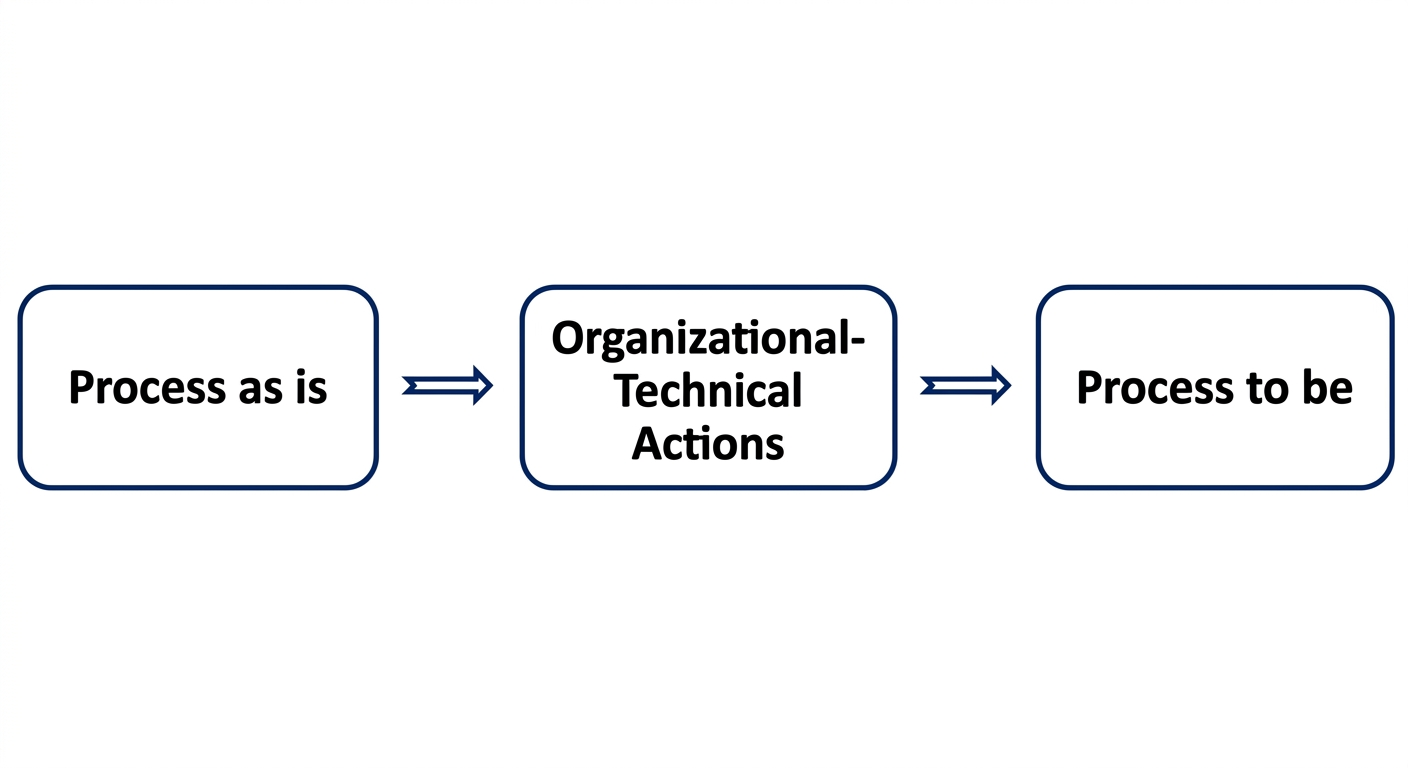
- To do this, at the point of analysis, we compare previous "as-is" processes (requiring improvement) with transformed (or partially transformed) "to-be" processes:
- We divide processes into stages and operations to make assessment easier and more accurate. Using the example of recruiting and hiring a candidate, we divide the processes into the following interaction stages:
– at the recruitment stage – interaction between Recruitment and the Candidate; Recruitment and HSE (regarding medical examinations);
– at the hiring stage – interaction between HR Administration and the Candidate (who transitions to Employee status upon hiring);
– during the hiring process – interaction between the Employee and HSE; the Employee and the Fire Safety Officer; the Employee and the Electrical Safety Officer;
– at the stage of briefings and work authorization – interaction between the Employee and the Supervisor.
- To evaluate all processes, stages within processes, and each individual operation, we use a uniform and fairly transparent Efficiency Calculation Formula:
T (hrs) * N (pcs) * ₽ (RUB) = Σ costs (RUB)
where T – time per 1 operation/document;
N – number of operations/documents;
₽ - cost of 1 hour for each process participant (total);
Σ - total costs per 1 operation/document
For example, if we are calculating the efficiency of the workplace briefing process, we would calculate, at a minimum, the labor costs of the Supervisor and the Employee.
If we are calculating the efficiency of more complex, cross-functional processes with a large number of stages and participants, we perform the calculations in several iterations.
*It is important to note that the algorithm can be automated.
- In the calculations, it is also important not to forget to quantify operations related to monitoring activities and processing documentation.
- Additionally, for the most accurate result, we evaluate our own labor costs for the process transformation activities themselves. These are the costs invested to achieve the calculated effect.
- Thus, by comparing the total costs of processes "before" and "after," we can always clearly see the effectiveness of process simplification efforts and quantify their impact on the company's overall performance indicators.
At the same time, it is important to understand that if we incur one-time costs for process transformation and achieve even seemingly insignificant efficiency, in the long term (over a horizon of 1-2 years or more), the process efficiency capitalizes, and the investments pay off.
From the perspective of HSEMS effectiveness in our company, automated processes and electronic document management are considered the most effective. Calculating their efficiency helped us during the implementation stage and is now contributing to their further improvement.