From System to Initiative: Leadership as a Trigger for a Cultural Shift in Safety
Imagine a production facility where workers do not scatter at the sight of a manager or an HSE specialist, but are instead ready for an open dialogue. Where "white hats" are not a source of fear, but partners in identifying and eliminating risks. Where safety is not a set of rules from a thick binder, but a conscious choice made by everyone.
This is not a utopia. This is the result of a targeted project to develop safety leadership at Bystrinsky GOK.
The Dead End of the Systemic Approach: Why Have We Hit a "Plateau"?
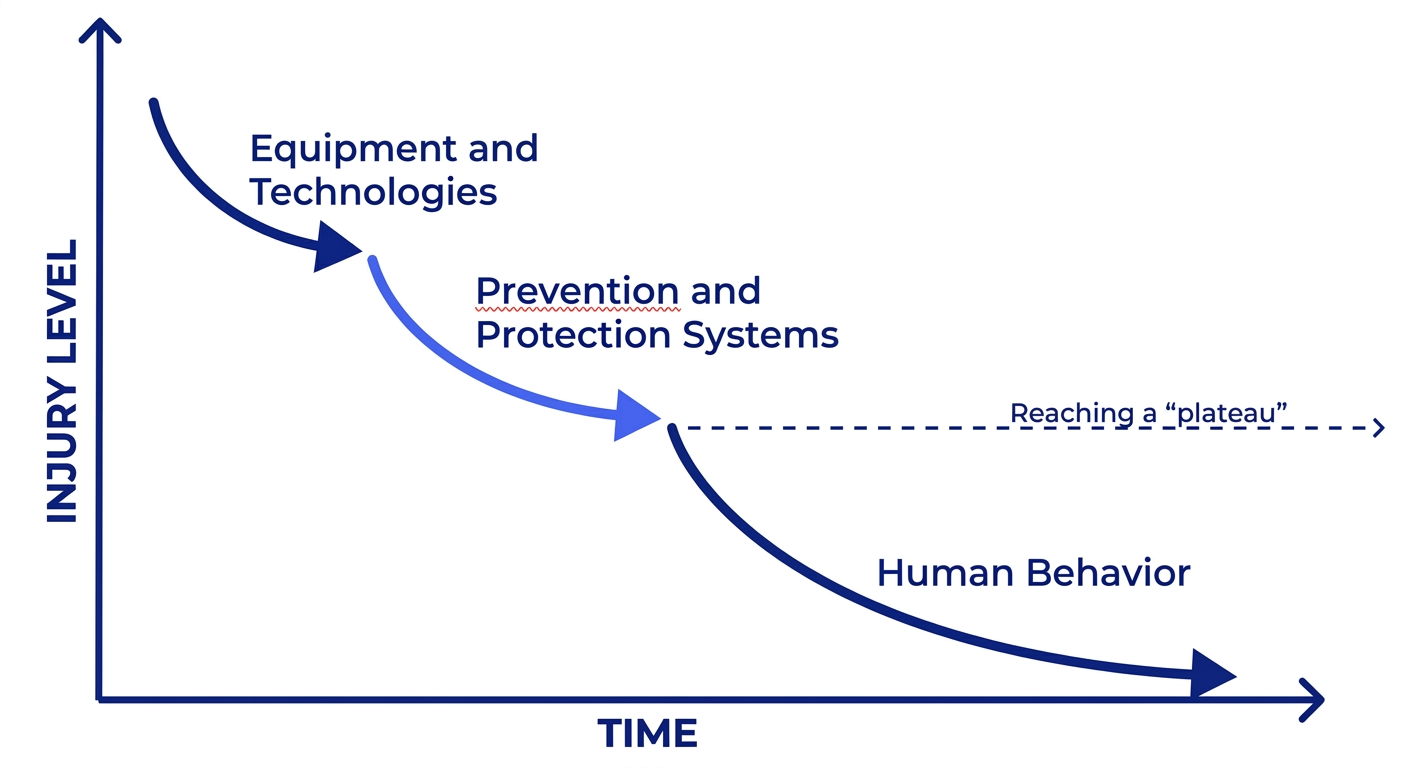
If we look at the graph of injury rate changes in a historical context, initially, injury rates decreased due to equipment upgrades and process automation, and later through the active development and implementation of warning and protection systems (interlocks, alarms, guarding, etc.). Furthermore, many enterprises have learned to draw lessons from incidents and develop high-quality technical and organizational measures.
But at some point, this is no longer enough, and the injury rate hits a "plateau".
This graph can also be applied on the scale of a specific enterprise.
Statistically, the majority of injuries are related to human error and the unsafe, unconscious behavior of employees.
Example: A driver, waiting for his vehicle to be washed, was walking along a concrete wheel stop, stumbled, and got injured. Could he have avoided walking on it, and does he need a separate instruction and training for this?
No matter what safety systems and guarding we put in place, we will always encounter these errors, as it is human nature to make mistakes, be lazy, and "cut corners". You cannot write an instruction for everything, nor can you assign an inspector to every single person.
It is necessary to develop conscious safe behavior among employees: involve them in identifying and eliminating risks, create conditions where they can refuse dangerous work without fear, and encourage a proactive attitude towards the unsafe actions of others.
And who better than a manager to create the appropriate environment and have the greatest influence on their team?
Patrick Hudson's safety culture ladder describes the behavioral aspects at each level very well.
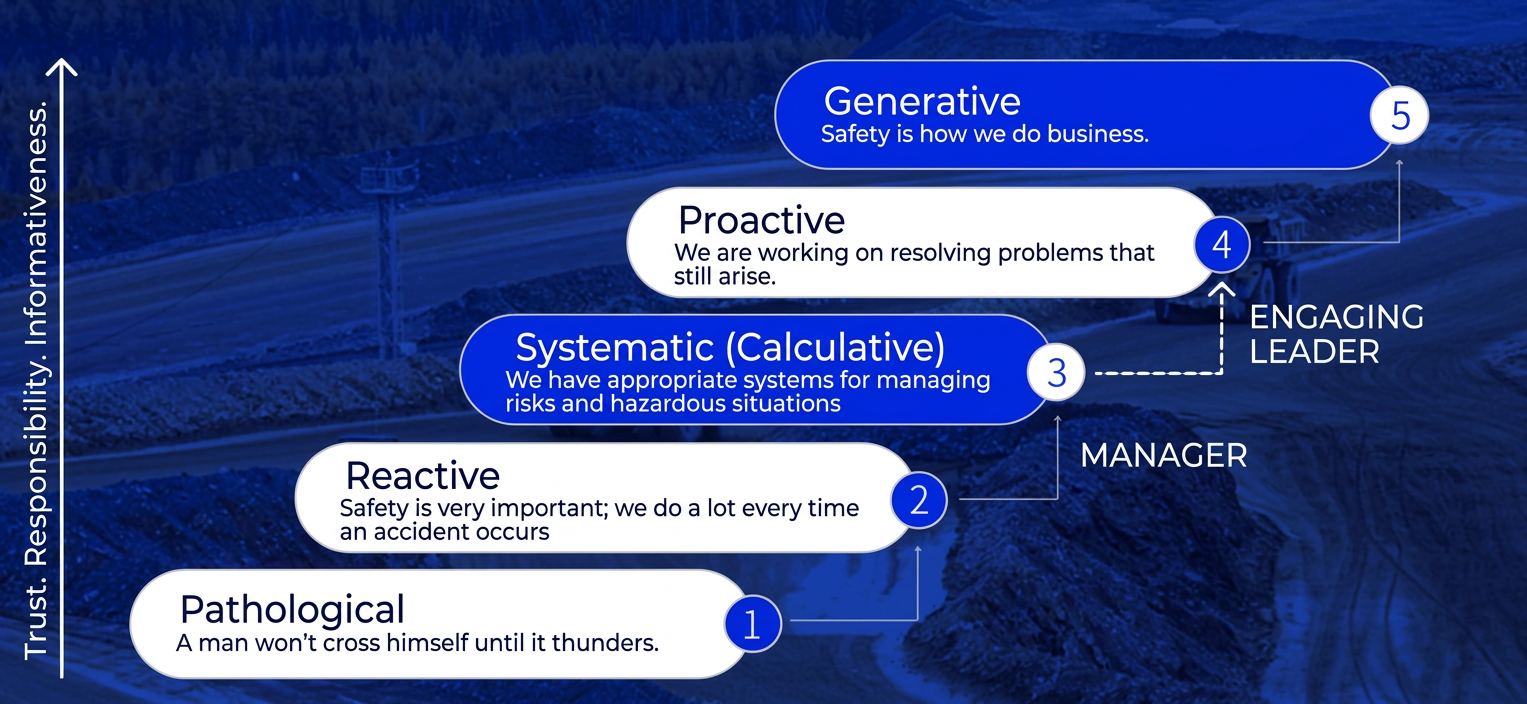
Many companies get stuck at the calculative (systemic) level. Why? Because the transition to the proactive level is directly linked to the behavioral aspects of every employee, not just senior management. And as we know, working with behavior is difficult and time-consuming, but possible.
This cannot be achieved without highly skilled managers. What does "highly skilled" mean here? While managerial qualities are sufficient for managers to reach the systemic level, making the leap to the proactive level requires different qualities — those of engaging leadership.
Leadership is the engine driving the development of a safety culture. In turn, safety culture is an important part of the overall corporate culture, which is shaped by leaders from the top down.
That is exactly why the Safety Leadership project was initiated at Bystrinsky GOK in 2024. You can find more detailed information about the project's progress, its results, and the content of the "Safety Leadership" training in my webinar "From System to Initiative: Leadership as a Trigger for a Cultural Shift in Safety," the recording of which is available on the HSE DAYS website.
In this article, I will share the key decisions that were applied when developing the project's methodology.
Principles of Leadership Development for Managers:
- Leaders develop leaders. We cannot achieve leadership if there are no leaders. It is the leader who sets the tone, determining the level of safety culture that the team can achieve.
If there is no support from the top, there will be no success. Therefore, we began implementing the project in stages, level by level: first, senior managers go through the training program, followed by their subordinate managers.
- A leader is a professional in what they do. Leaders must be well-versed in leadership tools and safety practices.
- Both a leader's beliefs and actions matter. The project places the greatest emphasis on leadership practices, because Safety Leadership is impossible without real actions, primarily regular safety practices. At the same time, practices will not be implemented effectively without a leadership mindset. The key transformation of managers' beliefs occurs during the "Safety Leadership" training.
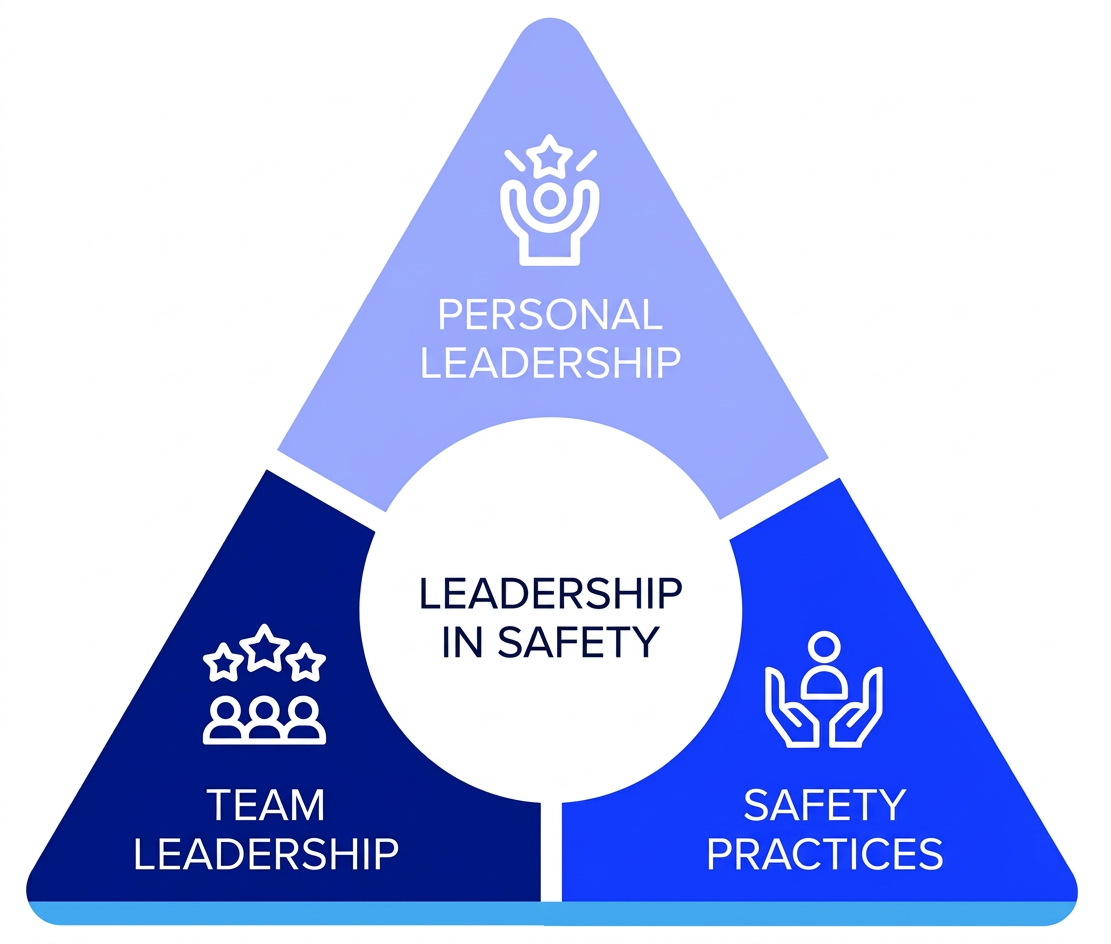
Based on these key principles, a Safety Leadership Model was created, which includes:
- Personal leadership: the manager themselves is an example of safety;
- Team leadership: the manager successfully influences their team;
- Safety practices: the manager implements and uses regular safety practices.
Why Does a Manager Need Regular Practices?
It is well known that at different levels of safety culture development, practices are perceived differently. For example, the well-known Behavioral Safety Audit (BSA): at the reactive level, BSA = punishment, the goal is to find the violator and fulfill the BSA quota. Gradually, during the transition to the proactive level, BSA begins to be perceived by participants as a "peer-to-peer" dialogue for joint problem identification and resolution; often, formal BSA registrations are abolished. At the generative level, BSA turns into an unconscious skill of proper communication with workers, fostering a culture of openness and trust, while BSAs are initiated by the workers themselves, who exchange best practices in the process.
Therefore, one of the project's objectives was to change the attitude towards existing practices, to infuse them with new meaning rather than creating new ones. Why managers need regular safety practices:
- Demonstrating commitment to safety:
Safety is not a one-time campaign, but a constant focus of the manager's attention. - Involving workers in identifying hidden risks and solving problems through dialogue. Developing a culture of openness and trust.
- Practices are a source of information:
- two-way feedback
- transferring information, knowledge, and experience to personnel "firsthand"
- verifying the condition "Subordinates' reports = Reality"?
Difficulties and Barriers: Solutions
1. Methodology from scratch:
- At the start, we agreed upon and shared the overall concept, principles, roles, methodology, and roadmap with the CEO and functional directors.
- An Agile approach in the project team's work, using weekly sprints. For example, upon realizing that managers were struggling with communication, we promptly developed intensive workshops to practice the skill in mini-groups, which had not been planned previously.
2. "Fading" interest among participants, focus on operational tasks:
- Post-training support for at least 3 months (posting assignments and memos in chats, consultations with experts, joint leadership walkarounds).
- Status meetings with TOP managers.
3. Reluctance to change, resistance from project participants:
- Do not overcomplicate the project methodology.
- "Soft" methods of working with participants: no top-down quotas, only personal commitments and agreements. They are leaders!
- Praise the best performers publicly.
- Developmental and motivating feedback from the senior manager.
4. Different levels of managerial skills among participants:
- Individual work with HR consultants.
- Joint leadership walkarounds with TOP managers.
The project also actively utilizes well-known management theories, such as Kurt Lewin's three-stage theory of change and situational leadership. They translate very well into practice when a manager needs to implement changes (for example, HSE measures that are "inconvenient" for workers but effective) and convince people to work safely based on their competencies and motivation for a specific task.
Because many managers already know about these theories from managerial competency training, there is a synergy of efforts between the HR and HSE departments. As a result, managers find practical applications for the theories they hear in training, which helps them develop and consolidate the necessary skills.
What is important to consider when implementing a similar project?
- The position of TOP management and their demand for leadership. Without sincere and visible commitment from the TOP, the project is doomed.
- Take into account existing managerial competency training programs from the HR department — avoid using conflicting theories.
- Move in stages. First — top managers, then — middle management, and so on. Leaders must develop leaders.
- Acknowledge the specifics of each management level in terms of tasks and competencies — strategic planning at the top management level and strengthening the role of executors at subsequent levels.
- Forget about coercion. Top-down KPIs on the number of walkarounds kill sincerity. Work with personal motivation.
Conclusion.
A safety culture is not built by orders and regulations. Its engine is leaders at all levels who show by their example every day that safety is a value, not a formality. Our project has confirmed: working with beliefs and behavior is the only way to get off the "plateau" and reach a new level!