Safety Leader: A Catchy Project Title or a Conscious Choice?
Morning briefing. The first slide reads in bold letters: "Safety is our top priority." Ten minutes later, the shop superintendent says: "We close out this shipment today, whatever it takes." Both statements were made in the same room, in front of the same people. Which one will they carry out onto the shop floor?
Anyone who has ever worked a shift knows the answer: the second one. Not because people are cynical, but simply because the second statement describes the real rules of the game, while the first is just window dressing.
Sound familiar? Today, the word "leader" appears in almost every corporate initiative: "Safety Leaders," "Leadership Academy," "Leadership Walks." These are good initiatives—I have taken part in them myself. Yet more and more often, I see leadership turning into a genre of corporate theater: a lapel pin, a slide deck, a photo next to a poster. Let's figure out who a safety leader really is, what exactly they pass on to their team, and why this is a matter of operational performance rather than morality.
A Position Is Appointed, Leadership Is Passed On
A manager is appointed by an official order. A leader is chosen by people—and they make that choice every single day when deciding whose example to follow. These are two very different appointments, and they do not always coincide.
Look at a department as a living organism. A newcomer arrives, watches how the veterans work, and does the same. Six months later, they are showing the next newcomer "how we do things around here." They read the safety procedure once to sign off on it, whereas they see their coworkers' behavior every day. What gets copied from one generation of employees to the next is the department's genome.
Hence the central thesis of this article. A safety leader is someone who consciously encodes this genome. Not someone who merely "communicates requirements": the requirements are already written down in the Model HSE Management System Regulations (Ministry of Labor Order No. 776n) and in GOST R ISO 45001-2020, which devotes the entire Section 5 to leadership. Encoding means deciding which behavioral patterns will be replicated and which will die out on the very first attempt.
There is a subtle detail here that I consider crucial. Companies within the same industry operate under nearly identical rules: the same FNiP regulations, the same codes of practice, the same standards. Those are the "genes," and everyone shares them. Yet injury rates at neighboring sites can differ severalfold. Why?
Biologists know the answer: identical genes can be "switched on" or remain silent depending on the environment. This is called epigenetics. The manager is the primary epigenetic factor of a department. They determine which written rules will actually be followed and which will remain on paper. The exact same permit-to-work acts as a real safety barrier in one shop and as a mere formality filled out retroactively in the shop next door.
Six Channels Through Which the Genome Is Transmitted
MIT Professor Edgar Schein, one of the founders of organizational culture studies, described the mechanisms through which a leader embeds culture within a team. Applied to safety, there are six of them.
- Attention. Whatever a manager asks about regularly becomes important. If the first question at the morning meeting is about output targets and safety only comes up under "any other business," the team will set its own priorities. No further explanation will be needed.
- Response to incidents. The first five minutes after an incident is reported say more about culture than an annual report. If the manager looks for someone to blame, next time nobody will report it. If they look for the root cause, workers will report even minor first-aid injuries. Let me emphasize this separately: unreported minor events distort both statistics and any analytical systems we build on top of those statistics.
- Resources. Where money and time go when both are scarce. When budget cuts hit training and PPE first, employees draw conclusions faster than any auditor.
- Personal example. A hard hat kept in the car "just in case." Safety glasses taken off "just for a minute." A single violation like that wipes out a dozen safety briefings.
- Rewards and consequences. Who gets praised in public: the person who hit the target by cutting corners, or the person who stopped the job and lost two hours? Stop-work authority without fear of reprisal exists only when someone has actually used it at least once and been thanked for doing so.
- People decisions. Who gets promoted. A supervisor appointed for knowing how to "squeeze out the quota at any cost" becomes the role model for the next generation of supervisors. This is the slowest-acting channel: its full effect becomes visible five years down the line.
Notice that out of the six channels, only one involves words—and even then, indirectly. The other five are actions. That is why no safety poster can ever shout louder than a manager who walks past a violation.
Lieutenant General David Morrison, former Chief of the Australian Army, summed this up in a single sentence: "The standard you walk past is the standard you accept." I would hang that quote not in the hallway, but inside every manager's office, directly facing their desk.
And one more observation from research. Israeli psychologist Dov Zohar demonstrated that safety climate is shaped primarily at the level of the immediate supervisor—the foreman and shift supervisor—rather than the CEO. When frontline supervisors began regularly discussing safety with their crews, minor injury rates dropped. The takeaway is simple: being a safety leader is a function, not a job title. And the supervisor closest to the worker has a stronger influence on them than anyone else.
Mutations: How the Genome Quietly Degrades
If culture is passed on like a genome, it is also subject to mutations. In 1986, the Space Shuttle Challenger broke apart. Sociologist Diane Vaughan, who investigated the disaster, coined the term "normalization of deviance." Flaws in the O-ring seals had been noticed earlier, but previous flights had returned safely, so each deviation gradually became the new normal.
The exact same thing happens in industrial operations. Once, a crew started work without testing the gas atmosphere because they were "in a rush." Nothing bad happened. The second time, nobody was even rushing—it was simply "faster that way." By the third time, a newcomer is told that gas testing is "something we do when inspectors are around." The mutation has taken hold and is now being passed along.
A leader's job is not only to encode safe behavior, but also to perform "DNA repair": spotting deviations while they are still isolated incidents and correcting them before they harden into tradition. That is precisely why a site walkthrough is needed—not to fill a logbook with violations, but to see work as it actually happens rather than how procedures describe it. Erik Hollnagel calls this the gap between "work-as-imagined" and "work-as-done." As long as a manager sees only the former, they are managing a fantasy.
Two Strands: Value and Calculation
Now let's examine what "consciously" means. Safety leadership is often described as something that must come "from the heart." That is true—but only half true.
A manager whose commitment to safety rests purely on emotion eventually turns into a moralizer. People listen, nod, and go right back to the old ways. Conversely, a manager whose safety commitment rests purely on financial calculation will scrap it at the first market downturn—after all, the numbers will suggest "we can cut costs this quarter."
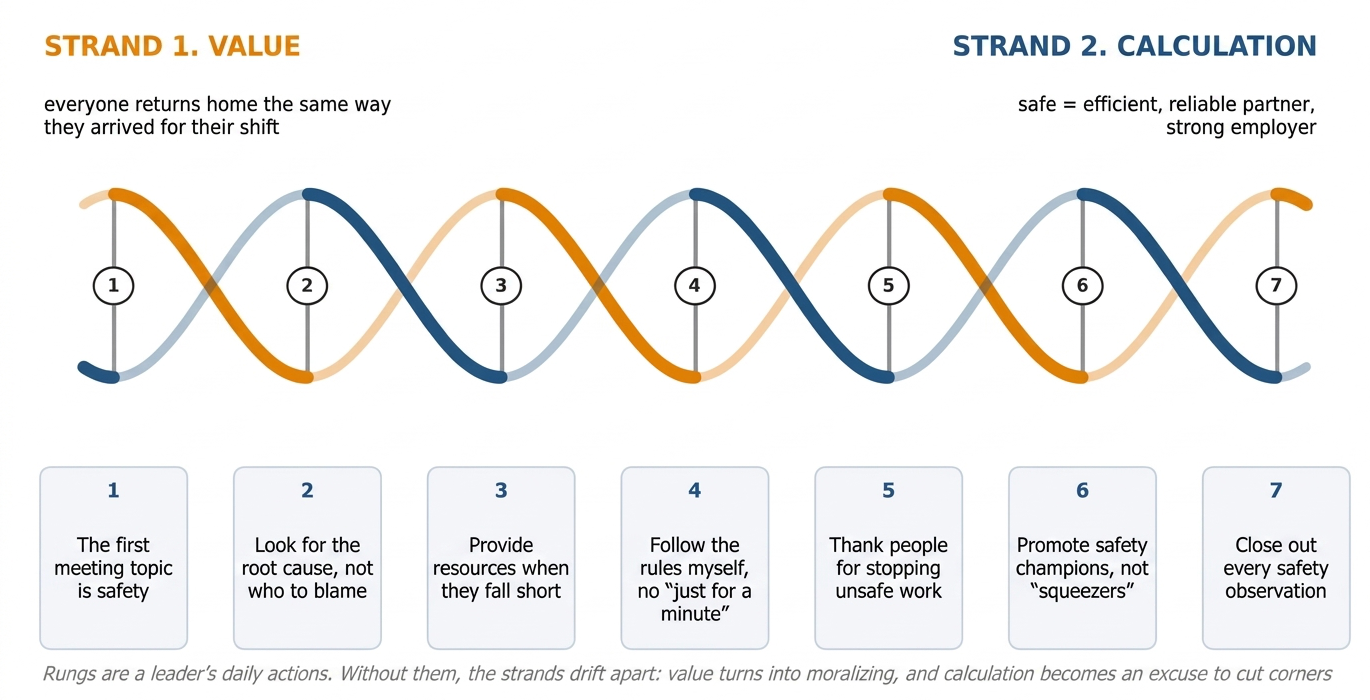
A resilient structure looks like a DNA double helix (Fig. 1). One strand is value: every person must go home at the end of the shift in the same condition they arrived. The second strand is calculation: safe operations cost less than unsafe ones. What binds the two strands together are the manager's daily actions. Without action, the strands unravel and the helix collapses.
The business calculation deserves a closer look, because people are often reluctant to talk about it openly.
Safe operations are efficient operations. The classic example is Alcoa. In 1987, newly appointed CEO Paul O'Neill used his very first meeting with Wall Street investors to talk about worker injuries rather than profits or market share. After the meeting, several analysts advised their clients to sell the stock. Yet O'Neill's logic was pure engineering: to understand why workers get hurt, you have to understand the production process down to the smallest detail—and whoever truly understands the process controls it. According to figures cited by Charles Duhigg in The Power of Habit—by the time O'Neill retired in 2000, the company's net income had grown fivefold and its market capitalization had risen by $27 billion. Safety was not an expense line; it was the gateway to operational discipline.
Safe operations make an attractive business partner. Major clients and cargo owners have long evaluated safety performance when selecting contractors and operators. We ourselves screen contractors based on their incident history. Anyone unable to demonstrate transparent statistics and a working safety management system simply does not make the shortlist. Insurers draw the exact same conclusions—they just express them through premium rates.
Safe operations make an attractive employer. When a skilled specialist chooses between two plants, they ask about workplace culture. And more often than not, they learn the truth not during the job interview, but from friends who already work there. You cannot buy this kind of reputation with recruitment ads; it is broadcast directly by that organizational genome.
There is also a hidden side: losses that never show up cleanly on balance sheets—downtime, investigations, replacement staffing, litigation, eroded trust. I wrote in detail about the submerged part of the "loss iceberg" in an earlier article on false fire alarms. The exact same logic applies here: the visible cost is always smaller than the true cost.
The Poster Leader vs. the Carrier Leader
To make the distinction clear, let me compare two types of managers. Both genuinely consider themselves safety leaders.
| Situation | Poster Leader | Carrier Leader |
|---|---|---|
| Views safety as | a project, a campaign, a report | the way operations are run |
| During a site walkthrough | hunts for violations to log | asks what gets in the way of working safely |
| When an incident occurs | "Who is at fault?" | "What in our system allowed this to happen?" |
| When deadlines are burning | "Just this once is fine" | "Just this once becomes the new rule" |
| Learns about minor events | from complaints and audits | firsthand, directly from workers |
| Primary metric | zero injuries in the report | number of hazard reports and mitigated risks |
| After they move on | everything reverts to the old ways | the practices endure |
The final row is the ultimate litmus test. A genome has truly been passed on only when it continues to function without its original carrier.
DuPont has a well-known safety culture maturity model called the Bradley Curve (Fig. 2). It outlines four stages: reactive (safety relies on natural instincts and luck), dependent (driven by rules and supervision), independent (rooted in personal ownership), and interdependent (people look out not just for themselves, but for one another).
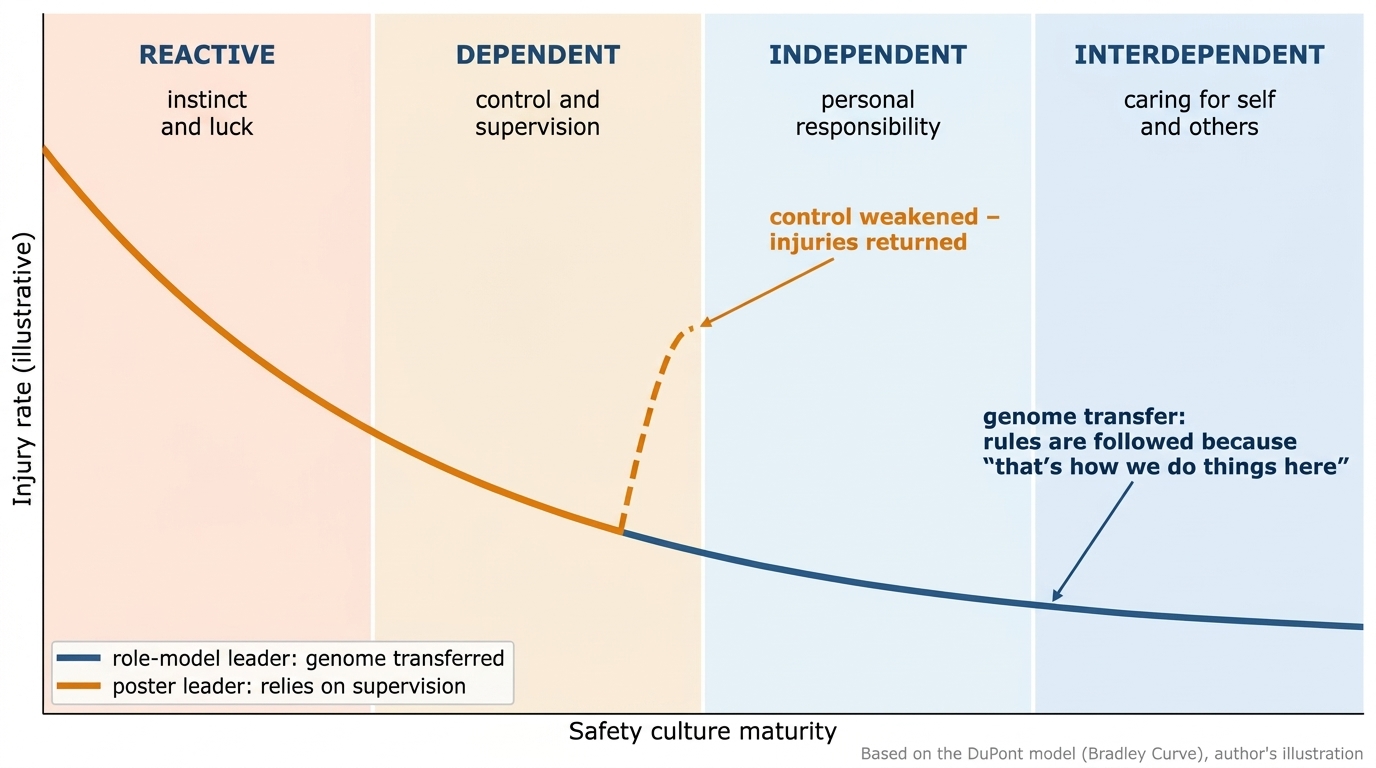
A poster leader almost always stalls their department at the second stage. Things stay safe only as long as the boss is watching; the moment oversight relaxes, injuries rebound. Advancing to the third and fourth stages requires transmitting the genome rather than tightening supervision: people follow safe practices not because someone is checking up on them, but because "that is who we are."
Principles of a Safety Leader
I can distill everything above into seven practical principles. Start with these—not with branded campaigns or merchandise.
- Know your risks better than the report about them. A manager should be able to name their department's top five hazards off the top of their head, complete with existing controls and weak points.
- See work as it actually happens. Walk the floor for dialogue, not for citations. The best question to ask on a walkthrough is: "What is making it hard for you to do this job safely today?"
- Speak last. When the boss states an opinion first, everyone else falls in line. When the boss asks questions first, they hear the truth.
- Never walk past. Not a single deviation should go unaddressed. Addressing it does not always mean punishment—often it simply means stopping to ask, "Why are we doing it this way?"
- Protect the messenger. Every hazard report is a gift. Punish someone for bringing one forward, and neither they nor their coworkers will ever bring you another.
- Close the feedback loop. Every concern raised deserves a clear response: done, not done and why, or when it will be done. Unresolved walkthrough items teach workers that speaking up is pointless.
- Develop successors. A supervisor who mentors two new supervisors with the same attitude toward risk accomplishes more for safety than any corporate campaign ever could.
Here is a simple self-audit I recommend to peers. Open your calendar for the past month and add up how many hours went into live, hands-on safety: floor walks, one-on-one conversations with crews, learning teams and incident reviews. Not committee meetings about safety, but direct engagement with it. That number—without any slides—is your true priority.
Check Yourself
- Can I name my department's top five risks and the safety barriers for each without looking at notes?
- What is the very first question I ask at my shift or morning briefings?
- When was the last time someone reported a near miss or hazard to me voluntarily rather than on demand?
- How did I react to our most recent incident: did I look for a culprit or for systemic causes?
- Has anyone on my team exercised stop-work authority over the past quarter, and what did I say to them?
- How many action items from my safety walks have been closed out, and do the people who raised them know the outcome?
- Have I broken a site safety rule myself "just for a minute"?
- What habits and practices will remain in my department if I leave tomorrow?
If three or more of these questions yield uncomfortable answers, that is no reason for self-flagellation. It is simply the starting point where real leadership begins.
Final Takeaway
Being a safety leader is neither a project title nor a bullet point in a job description. It is a conscious choice a manager makes every day—at the morning briefing, out on the shop floor, and in the heat of a threatened production target. Workers read that choice more accurately than any auditor and mirror it in their own work. Safety cannot be declared by decree; it can only be passed down.
Comments 1
A very interesting topic!