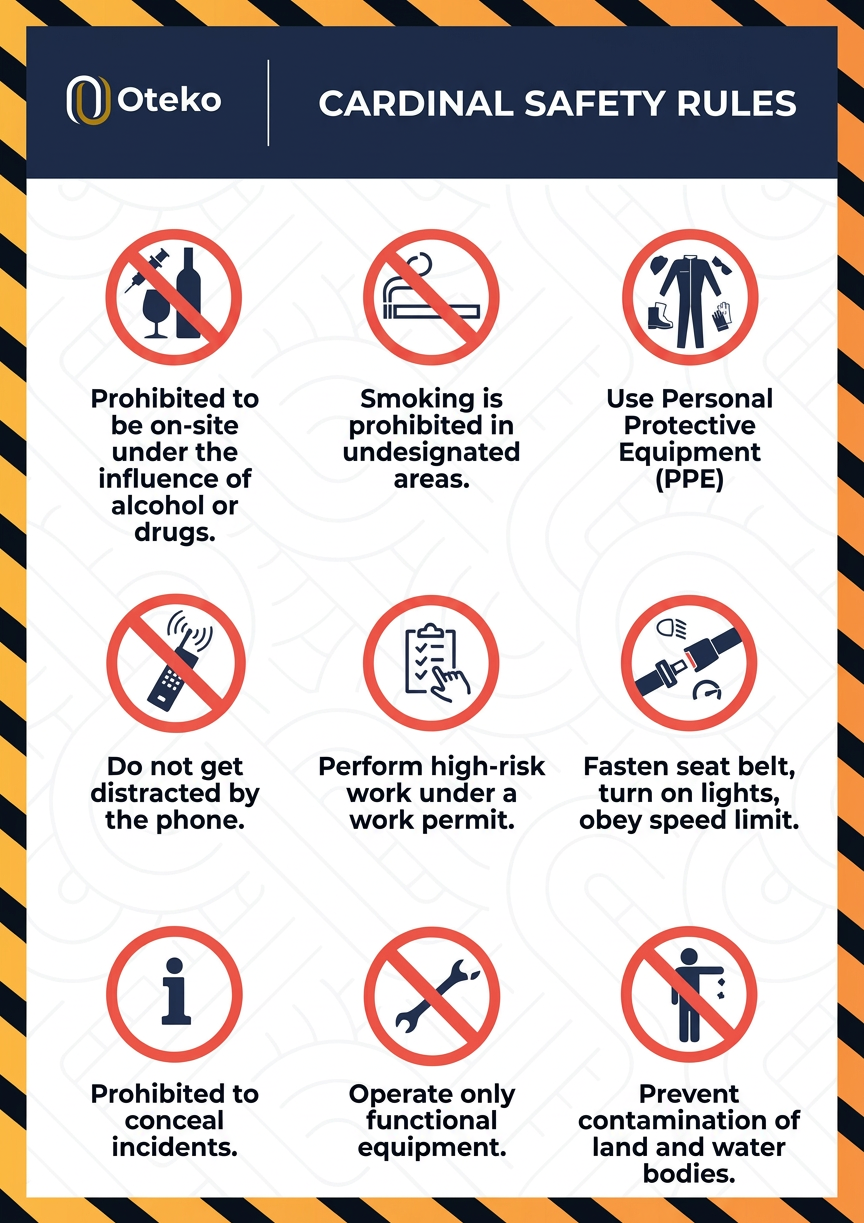
Nine Rules for Life and Work: Cardinal Safety Rules and Their Implementation Mechanism
Today, it is hard to imagine an employee at our port production site without personal protective equipment (PPE). When getting into a car, most colleagues now automatically fasten their seatbelts. "Most" because, unfortunately, there are exceptions to every rule. To every rule, except for the Cardinal Safety Rules.
Cardinal Rules represent discipline at a hazardous production facility. When dealing with simple unsafe acts, a warning or a preventive conversation might suffice. However, people do not always change their behavior afterward. Therefore, when Cardinal Safety Rules specifically are violated, punishment must be inevitable. At the same time, violations and the resulting measures of responsibility can vary. It is not always about dismissal. For example, if a person walks down a staircase while talking on the phone, they only endanger themselves. But if a driver operates a bus while talking on the phone, they endanger many people. These are different levels of risk and must be treated accordingly.
In March 2024, we revised the set of Cardinal Safety Rules and introduced a point-based assessment for violations. What is the essence? For each specific violation, an employee is assigned a certain number of points from 1 to 10, depending on the severity of potential consequences and the degree of intent. Ten points is the maximum, at which a decision is made to dismiss the employee or suspend/remove a contractor from the Company/Enterprise facility.
Points remain valid for one year from the date of the violation, after which they are canceled. If a person commits a single violation and points are assigned, but nothing fatal occurs and there are no other violations within the year, the points simply expire. On the other hand, if an employee violates rules regularly, they can accumulate the maximum number of points over the year and receive a "red card."
To dismiss an employee or limit the action to a disciplinary sanction? It is important for us to ensure collegiality and transparency in decision-making. The documentation for this process is prepared thoroughly. All Cardinal Rule violations are recorded in the Automated Safety Management System (ASMS). Within each legal entity of the Company, relevant commissions have been formed to review each situation individually and make decisions. These commissions include HR representatives, lawyers, HSE specialists, the CEO of the legal entity, and labor collective representatives. A violation of Cardinal Rules is not always the result of the employee's own behavior. For instance, an employee might be forced to perform work without a work permit. Or they might be told to work with an angle grinder without being provided with safety goggles. The commission investigates whether conditions for safe work were established and if there are circumstances to be taken into account (force majeure, lack of experience in the specific type of work where violations were detected, pressure from a supervisor, etc.). The commission has the right to hold the supervisor of the violating employee accountable for the Cardinal Rule violation if the necessary conditions for safe work were not provided.
Will there be exceptions to the point system? Yes, there are gross violations that have led or could have led to severe consequences. Specifically, alcohol or drug intoxication, failure to provide or use fall protection equipment, etc. — in these cases, an employee can violate the Cardinal Rules only once and be dismissed.
The results of the commissions' work are reviewed monthly during the corporate Safety Day.