"Don't Fall into the 'Pitfall'!" Methodology
The author set out to study and block the possibility of unintentional errors and personnel violations (intentional errors).
My HSE colleagues might find the form I developed for teaching employees the "Methodology for assessing the relative probability of performing dangerous actions/making erroneous decisions ("Don't Fall into the 'Pitfall'!" methodology)" of interest.
I take into account that for blue-collar workers, information is best absorbed if it can be visualized and perceived emotionally. (Psychologists' data: approximately 10% of people cannot satisfactorily master textual material at all. Most people are predominantly visual — 80% of information is absorbed through sight).
We will distinguish between ERRORS as UNINTENTIONAL actions/inactions of personnel ("unintentional sins"), and ERRORS as INTENTIONAL actions (i.e., VIOLATIONS) of personnel ("intentional sins").
I identify 4 types of "Pitfalls" ("P.F.") for occurrences (accidents, incidents, emergencies):
- 1- situational-personal;
- 2- organizational;
- 3 – situational-mental;
- 4 – personal.
I also identify three characteristic sizes of "P.F." (listed in descending order of risk in Checklist No. 1):
- 1 – "for the Amphicoelias dinosaur" (the largest known dinosaur, 40-62m long and weighing up to 155t); these are "INTENTIONAL SINS" in Checklist No. 1;
- 2 – "for a mammoth";
- 3 – "for a grizzly".
A worker/operator is more likely to perform dangerous actions / make erroneous decisions if they are in one or several "P.F." (situations/conditions) at once; these are subtypes 1.1-4.4 (below). I proposed a corresponding "Checklist No. 1" for self-check/verification against the 16 specified "Pitfalls":
1. Situational-personal ("P.F."):
1.1. Destructive (uncontrolled) stress. Can be physical or emotional; caused by unfavorable circumstances in personal life or at work; Pitfall Size – 2: "For a mammoth";
1.2. Fatigue; Pitfall Size – 2: "For a mammoth";
1.3. Time pressure (lack of time due to personal disorganization or high work intensity); Pitfall Size – 2: "For a mammoth";
2. Organizational "P.F." (imperfections in management systems):
2.1. Priority of business interests over safety interests; Pitfall Size – 1: "For the Amphicoelias dinosaur";
2.2. Insufficient demonstration of the "leadership" principle or "double standards"; Pitfall Size – 1: "For the Amphicoelias dinosaur";
2.3. Ineffective training (poor information); Pitfall Size – 3: "For a grizzly";
2.4. Unclear, unmemorable, ambiguous work instructions; Pitfall Size – 3: "For a grizzly";
2.5. Presence of distractions; Pitfall Size – 3: "For a grizzly";
3. Situational-mental "P.F.":
3.1. First working day after holidays, absence > 3 days (in the field of work risks); Pitfall Size – 3: "For a grizzly";
3.2. Task performed rarely/for the first time; Pitfall Size – 3: "For a grizzly";
3.3. Complacency from luck (distance from the last incident); Pitfall Size – 3: "For a grizzly";
3.4. End of shift, work week, on the eve of a holiday (people may take increased risks "near the goal"); Pitfall Size – 3: "For a grizzly";
The probability of dangerous actions/erroneous decisions increases many times over if a worker who possesses Type 4 "Personal Pitfalls" falls into the above-mentioned "P.F." (if the management system "allowed" them onto a hazardous facility):
4.1. OVERCONFIDENCE; (incl. "I'm not like others: it happens to them, but I won't let it..."); Pitfall Size – 1: "For the Amphicoelias dinosaur";
4.2. CARELESSNESS, LACK OF AWARENESS, LAZINESS; Pitfall Size – 1: "For the Amphicoelias dinosaur";
4.3. INATTENTIVENESS; Pitfall Size – 2: "For a mammoth";
4.4. INSUFFICIENT ABILITY TO CRITICALLY ASSESS THE RISKS OF UPCOMING ACTIVITIES; Pitfall Size – 2: "For a mammoth".
Such workers need to be identified (including through psychophysiological testing) during hiring; we call this "FILTER 1" (I discussed it in a report on 11/23/2023).
Such workers often commit ERRORS as INTENTIONAL ACTIONS/INACTIONS (i.e., VIOLATIONS) of personnel ("INTENTIONAL SINS").
FIRST AND FOREMOST, before starting work, we check the P.F. related to situational-personal state (items 1.1-1.3) and personal characteristics (items 4.1-4.4): a) INDEPENDENTLY (SELF-ASSESSMENT – items 1.1-1.3), b) ASSESSMENT – by the worker's supervisor - items 1.1-1.3; items 4.1-4.4.
DIAGNOSIS: if according to Checklist No. 1 you are a prisoner of one or more P.F. (items 1.1-1.3; items 4.1-4.4), then do not start work! First, get out of the Pitfalls!
GOOD NEWS: Diagnoses for items 4.1-4.4, as well as for items 1.1-1.3, ARE TREATABLE! Through special TRAINING, the author and his colleagues teach how to get out of these "Pitfalls" (we provide Knowledge + Skills) and teach how to behave preventively so as not to end up in them again!
Table 1. Examples of mini-TRAININGS conducted to develop ERROR AVOIDANCE/ELIMINATION TECHNIQUES ("Don't Fall into the 'Pitfall'!" or "Vaccination" according to Checklist No. 1)
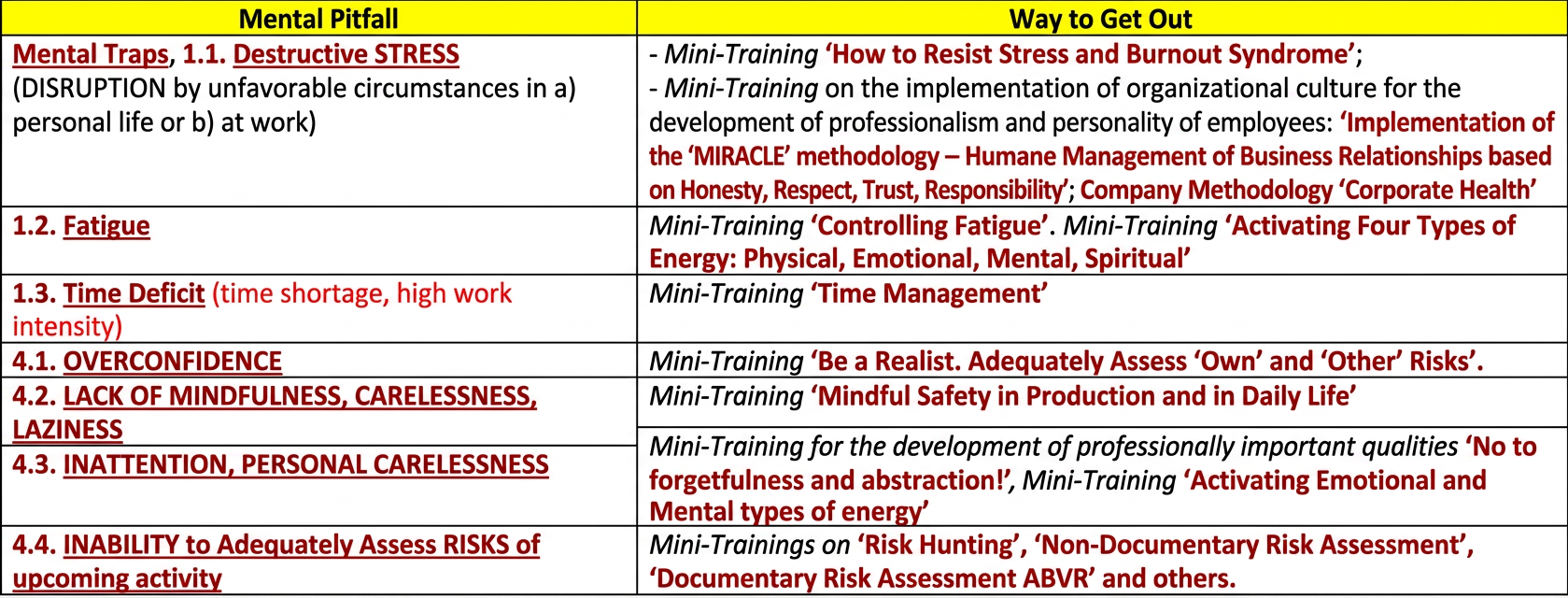
The final ALGORITHM for avoiding unplanned losses due to the "Human Factor" is as follows:
I. THE FIRST BARRIER for unplanned losses is an analysis according to Checklist No. 1 ("Don't Fall into the 'Pitfalls'"):
i) assess if there is a risk of being in situational-personal "P.F." 1.1-1.3?
If "YES" - refrain from high-risk work until you exit the "P.F.", complete the NECESSARY TRAINING (Table 1); if "NO" - proceed to item ii
ii) assess if there is a risk of being in personal "P.F." 4.1-4.4?
If "YES" - refrain from high-risk work until you exit the "P.F." by completing the NECESSARY TRAINING (Table 1); if "NO" - proceed to item iii
iii) assess if there is a risk of being in situational-mental "P.F." 3.1-3.4?
If "YES" - risks increase sharply! You have been FOREWARNED! Which means – FOREARMED! We also recommend taking TRAINING on "Conscious Safety" and for developing attentiveness and memory (Table 1); if "NO" - proceed to item iiii
iiii) assess if there is a risk of being in serious organizational "P.F." 2.1-2.2 (size "For the Amphicoelias dinosaur")?
If "YES" - we also recommend taking TRAINING on "Conscious Safety"; if "NO" - proceed to item iiiii
iiiii) assess if there is a risk of being in "P.F." 2.3-2.5?
If "YES" - "If you don't know — ask someone who does! Better to look foolish than to get injured!" Finish your training!; if "NO" - proceed to item II (check yourself against the questions of the Second Barrier - Checklist No. 2 (mental "mines" associated with major cognitive biases). These are detailed in the next separate Blog.