Psychological Tools for Conducting Targeted Briefings
Overall, an analysis of accident and occupational injury reports from open sources shows a general downward trend, but the number of such incidents remains significant.
The graph shows data on the number of occupational accident victims resulting in lost time of 1 day or more, as well as fatal outcomes, according to Rosstat data.
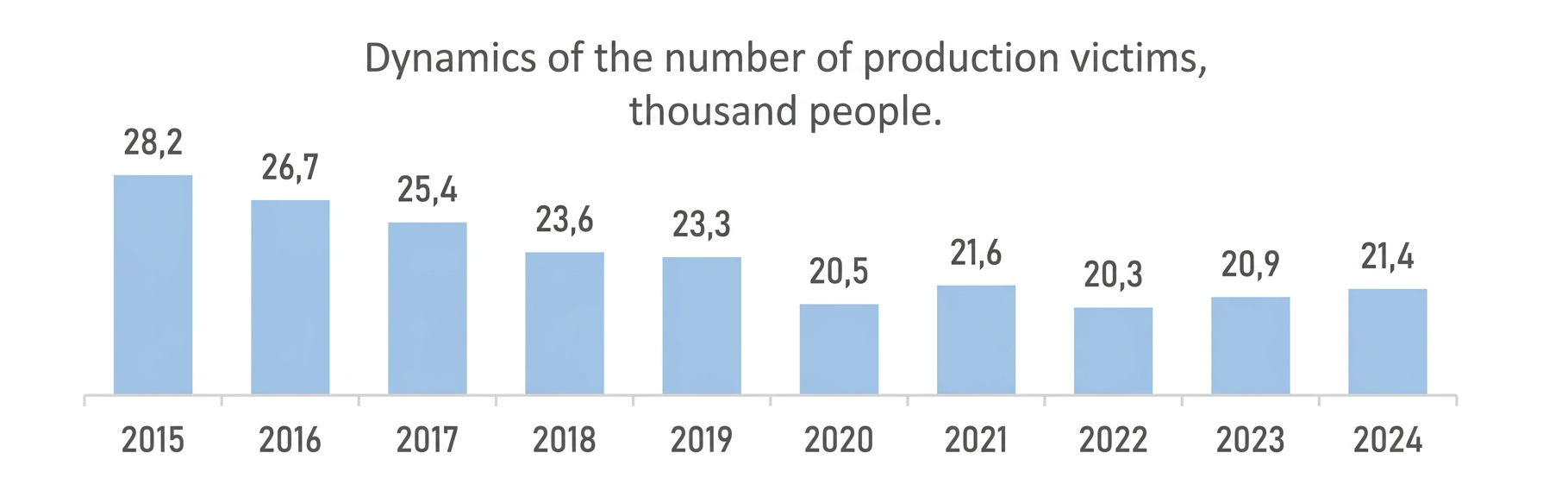
However, no decrease has been observed over the past 4 years. This may indicate that the implemented organizational and technical measures have reached their maximum effect, and to continue the downward trend in injury rates, it is necessary to move to a qualitatively new level of occupational safety.
According to research by a subsidiary of PJSC Gazprom, one of the main causes of injuries is the human factor, which can be summarized in the following points:
- Does not know how – the employee lacks the necessary knowledge for the job and has not mastered the appropriate skills, methods, techniques, or procedures.
- Does not want to – the employee knows how to perform the work (operation) safely and with high quality, but lacks the desire to comply with safety requirements, lacks motivation, and has not developed a psychological mindset to adhere to these requirements.
- Cannot – the employee is in a physical or psychological state where, despite their skills and desire, they commit an unsafe act.
One of the tools for influencing human psychological factors is a targeted briefing, which differs from standard requirements and is primarily aimed at working with a person's emotional and psychological state.
The main differences in briefing methodologies are shown in the table:
|
Traditional |
Psychologically Effective |
|
|
Main goal |
monologue |
active dialogue |
|
Method |
attracting attention |
managing attention |
|
Trainee's role |
passive listening |
active participation in the conversation driven by engaging questions |
|
Emotional tone |
negative, focus on accidents (negative reinforcement) |
positive, reinforcing information on risk control (positive reinforcement) |
|
Setting |
standard office setting |
high-impact setting |
Ultimately, try to structure the briefing as a dialogue. Ask more questions where the answers are not a simple "Yes" or "No". Frame your questions to elicit detailed responses. Ask unconventional and follow-up questions.
As a result, refining the briefing mechanism will allow you to focus the employee's attention on hazards they can identify themselves, helping them understand why and what safety measures need to be applied.
Take care of your personnel! Wishing you safe work!