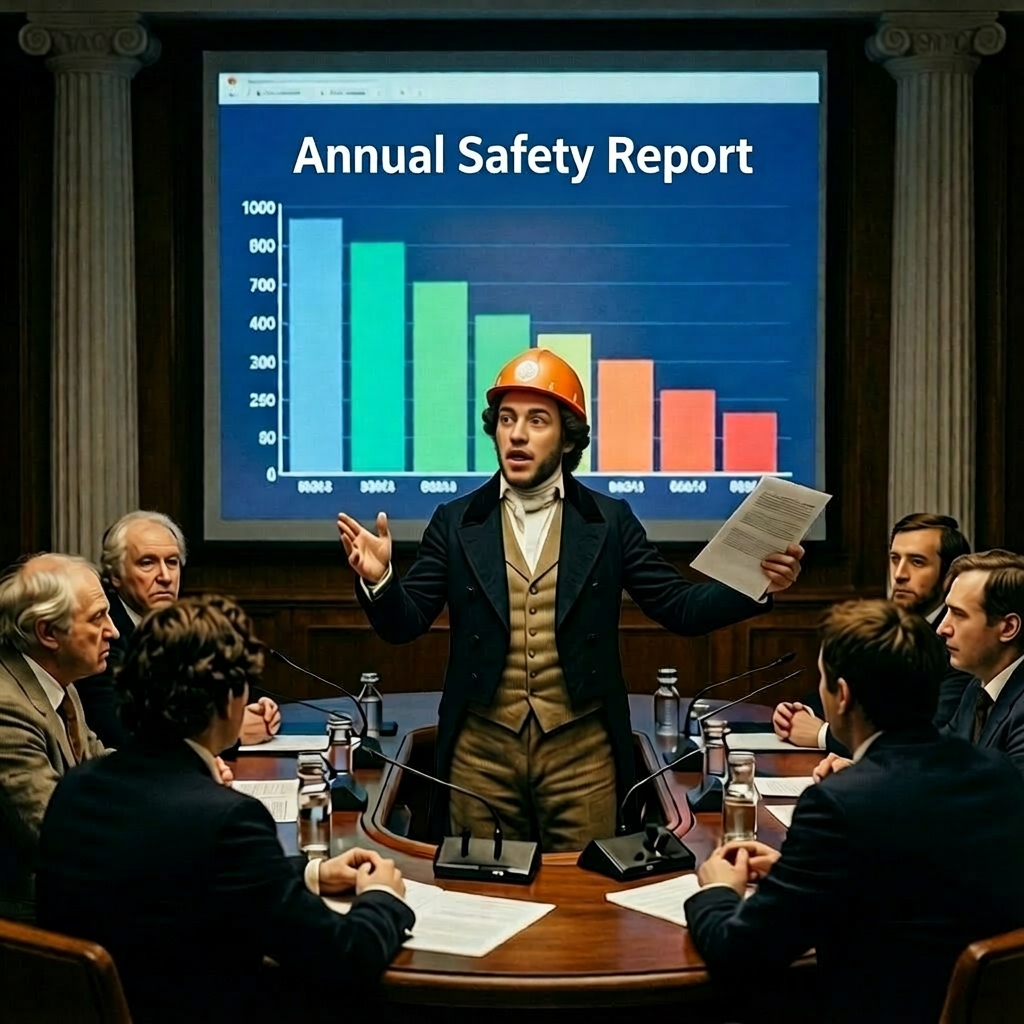
🛡️ Safety: Is the "Polished Reports" Disease Curable?
Have you ever encountered "polished" reports and presentations on HSE? Sometimes they are so captivating that they resemble the fairy tales of Alexander Pushkin. Why does this genre remain so popular in our professional environment? 🤔
The answer is simple: if such fairy tales are written, it means someone needs them. It is common to think that the CEO or the Board of Directors believes in the effective operation of the HSE system simply due to a lack of data on the real situation. However, this is a misconception.
One should not underestimate the insight of top management. Senior executives have many communication channels, and they always receive exactly the information they need. This means that the "polished reports" disease is born at the very top — where they are "ordered" by the carriers of corporate culture — and only then infects other departments. 😷
The good news is that the solution to the problem lies at that same level.
However, two sensitive questions arise here:
📍Are you, as an HSE professional, ready to take the initiative and honestly discuss the problem with the CEO?
📍Do you have enough courage to risk your career for the sake of the lives and health of people and the well-being of the company you are called to protect?
And who promised that working in HSE would be easy?
There is no "magic pill" here. And even the most advanced AI will not be able to help. 🤖
By the way, AI is just another tool in the extensive HSE arsenal. But has the presence of a hammer or a screwdriver in a toolbox ever meant they were being used correctly? We remember the high-profile accidents of the last 10 – 15 years that occurred despite the most sophisticated, automatic protection systems. Similarly, with AI, people will sooner or later figure out how to bypass it and make it work "correctly." So, one should not rely solely on technology.
Occupational safety is something created and destroyed by people. It is a matter of morality and personal choice. No HSE tools (AI, KPIs, instructions and rules, director's walkabouts, etc.) are capable of fixing a safety culture. The only thing that works is the "ownership approach" of the CEO, their personal example, and their high standards. If people feel that the boss cares, then there is no need to "polish" anything.
Personally, I have been fortunate enough to meet such leaders, work with them, and learn from them. Have you?
P.S. It's all James Reason's fault and his "Taxonomy of Human Error." 😉
💬 Do you recognize the character in the drawing? Does he remind you of anyone?
Colleagues, please share your thoughts in the comments! 👇
Comments 3
What I did not mention in the main text of the blog, but might be useful.
The main secret of success — to speak in the language of top management: in the language of numbers, laws and continuity of business processes:
1. Financial arguments (The language of money)
2. Legal security (The language of laws)
3. Operational efficiency (The language of processes)
How to build the conversation itself?
I think you are absolutely right. I am glad that the article prompted you to such precise thoughts.