Seven Golden Rules of Vision Zero: How to Implement Zero Injuries in Practice
In the first part of the article, we examined in detail how the occupational safety system in Russia evolved from formal compliance to a risk-oriented approach, and what role the international Vision Zero concept played in this.
Now it is time to move from theory to practice — and break down exactly how Vision Zero principles are implemented at enterprises: from leadership and engagement to designing a safe environment, developing competencies, and investing in people.
In this article, we will look at the "seven golden rules" of Vision Zero, which form the foundation of the modern approach to managing occupational health, industrial, and environmental safety. And I will show how these principles are reflected in Russian legislation and in the real practices of the Zarubezhneft Group of Companies.
Rule I: Take leadership – demonstrate commitment (to safety).
Vision Zero emphasizes that the interest in zero injuries must come from the very top – from company management. Without active and visible support from executives, a zero injury program is doomed to fail.
Russian legislation also places personal responsibility for ensuring safe working conditions on the employer and the company's line managers.
Examples of implementing this concept's rule at ZNDKh include the "HSE Policy", which recognizes the life and health of employees as the company's top priority, as well as the "Policy on Declaring the Right of Every Employee to Refuse Work in Case of a Threat to Life and Health".
In addition, company leaders demonstrate visible commitment to safety by conducting site walkdowns, holding meetings and dialogues with personnel, and allocating resources for occupational health and industrial safety.
Involvement in occupational safety concerns not only management but all employees.
Vision Zero views workers not as objects for briefings, but as a key resource for identifying hazards, assessing risks, and finding solutions to minimize them, since they know their work best.
Russian legislation also emphasizes the importance of the employees' role in the enterprise's occupational safety management system. Thus, in accordance with legal requirements and ZNDKh's internal regulations, every employee is obliged to:
- suspend work in the event of a threat to people's lives and health;
- pay attention to the behavior of other employees, their compliance with personal safety measures, remind them of the need to use safe work practices, and comply with the requirements of legislation and the Company's internal HSE regulations;
- participate in hazard identification and occupational risk assessment at their workplace, as well as in determining risk management measures;
- participate in activities to improve working conditions.
These employee responsibilities are enshrined in the HSE Management System Regulation, approved by a Company Order.
Rule II: Identify hazards and assess risks.
Vision Zero makes proactivity its core essence. Instead of asking "Why did this happen?", the system asks "What can we do in advance so this never happens?" and emphasizes the importance of involving the workers themselves in risk assessment, as they know the processes best.
The cornerstones of a modern HSE management system are the HAZID and HAZOP risk assessment methods developed in Europe.
HAZOP (Hazard and Operability Study) is a structured and systematic method for finding potential hazards and problems in a design or existing process that could lead to abnormal situations or affect system operability. The key idea of the method: investigating deviations from the design operating mode.
HAZID (Hazard Identification) is an earlier and more generalized process aimed at the initial identification of all potential hazard sources at a facility. The key idea of the method: compiling a general list of hazards without an in-depth analysis of their causes and consequences.
Both of these methods are used in ZNDKh's operations.
Legislation, as already noted, is also increasingly shifting from reacting to accidents to preventing them (for example, through mandatory occupational risk assessment).
The modern legislative approach requires employers to:
- Identify hazards: determine what can cause harm to an employee.
- Assess risks: analyze the likelihood and severity of consequences from each hazard.
- Manage risks: take measures, first and foremost, to eliminate or reduce the most serious risks, rather than all of them at once. Measures are prioritized: hazard elimination → engineering controls → administrative controls → PPE.
- Strive for continuous improvement: the risk assessment and management process is continuous and is reviewed when conditions change.
At ZNDKh, risk assessments are regularly conducted with the participation of field workers appointed by Company orders. Based on the results, hazard and risk registers are formed, and management measures are developed.
In accordance with new occupational safety legislative requirements, occupational risk assessments are conducted at ZNDKh.
Rule III: Define targets and develop programs.
The rule "Define targets and develop programs" is not just a declaration of intent, but a concrete, structured, and measurable process that turns the abstract goal of "zero fatalities" into real actions.
This rule states that to achieve the goal of "zero fatalities and serious injuries", it is not enough to simply react to accidents and incidents that have already occurred. It is necessary to proactively create and implement holistic programs and strategies that systematically eliminate risks before they lead to tragedy.
This is a shift from the logic of "Who is to blame?" to the logic of "What can we do to prevent this?".
This rule consists of several interconnected stages:
Setting clear and measurable goals.
The goal should not be vague. Instead of "improve safety" or "reduce accident rates", specific, ambitious, yet achievable goals are set.
Such goals are:
- Clear and understandable to all process participants.
- Measurable: their progress can be tracked using data.
- Focused on the result (preserving life and health), rather than on activity (installing 10 new signs).
Data analysis and prioritization
It is impossible to tackle all risks at once. Programs must be based on deep data analysis to identify key problems.
- Analysis by participant types: Workers of which professions get injured at our facilities?
- Analysis by locations: Where do the most severe accidents occur?
- Analysis by causes and types of incidents: What employee actions most often lead to severe consequences?
- Analysis by time: Are there incident peaks by time of day or days of the week?
Priorities are determined based on this analysis. For example, if data shows that 40% of incidents are falls from height, the safety program will primarily focus on this issue.
Developing comprehensive programs (strategies).
This is the core of the rule. A program is not a single method, but a set of complementary measures affecting all elements of the system.
Distribution of responsibility and partnership.
Vision Zero emphasizes that safety is a shared responsibility. Programs are developed and implemented not by a single department, but by a coalition of stakeholders. Each of these parties contributes to the overall program.
Monitoring, evaluation, and adaptation.
A program is not a static document. It is a living process that requires constant adjustment.
- Monitoring: Regularly keeping statistics and analyzing incidents, as well as tracking the implementation of preventive measures.
- Evaluation: Analyzing effectiveness. Did the implemented measures work? Did they lead to a reduction in injuries? If not, why?
- Adaptation: Based on the evaluation, the program is adjusted. Ineffective measures are replaced with others, and new priorities emerge.
Ultimately, the "Define targets and develop programs" rule is a roadmap for achieving Vision Zero. It turns the statement "every life is priceless" into a practical, actionable plan to save human lives in production.
Examples of defining targets and developing HSE programs at ZNDKh:
- annual approval of HSE Goals by a Company order, including reducing the Lost Time Injury Frequency Rate (LTIFR) and ensuring zero fatal accidents;
- developing and approving an action plan to reduce the risk of accidents at hazardous production facilities (HPF);
- schedules for training, certification, and knowledge testing of Company employees in HSE;
- developing and approving schedules for inspection, diagnostics, maintenance, and repair of pipelines, etc.
According to legislative requirements, the employer is obliged to implement measures annually to improve working conditions and occupational safety, eliminate or reduce occupational risk levels, or prevent their increase. The employer's funding for such measures must be at least 0.2 percent of the production costs. Corresponding plans are developed and approved annually by Company orders.
Rule IV: Ensure a safe working environment.
The traditional approach to safety often sounds like this: "Follow the rules, be careful, and accidents won't happen." Here, the responsibility for safety is placed primarily on the employee.
Vision Zero has the opposite logic: "Accidents and occupational diseases can be prevented. The responsibility for creating safe working conditions lies with the one who designs, organizes, and manages the work system." This is a shift from "human fault" to "system imperfection".
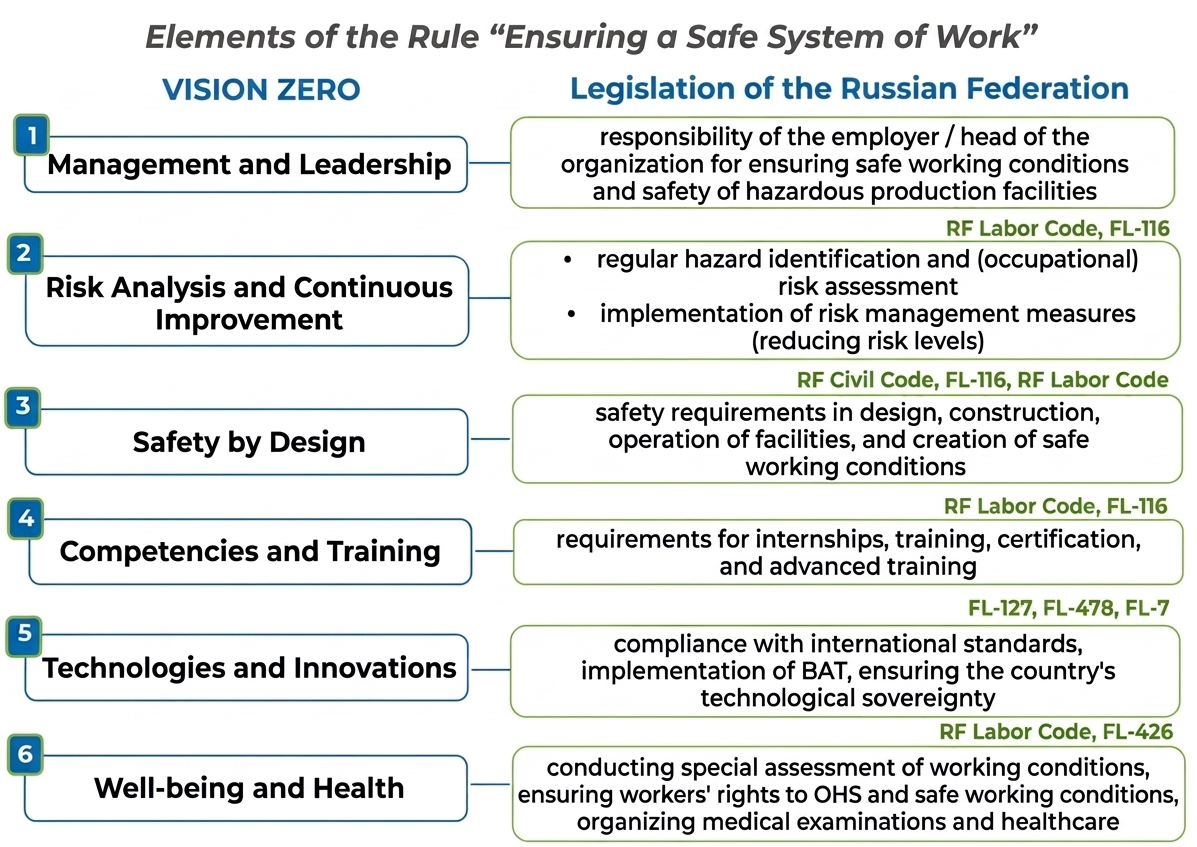
The rule "Ensure a safe working environment" is based on several interconnected elements:
Management and leadership
Safety is not an additional function, but an integral part of business processes and the management system. Company management bears direct responsibility for:
- Allocating resources: finances, time, and personnel to implement safety measures.
- Integration into processes: safety issues must be built into planning, procurement, design, and production meetings.
- Creating a culture: fostering an environment where safety is valued above task speed, and employees are encouraged to report hazards.
This Vision Zero element is reflected in the requirements of the Labor Code of the Russian Federation and Federal Law No. 116-FZ, which place personal responsibility on the employer/head of the organization for ensuring safe working conditions and the safety of hazardous production facilities.
Risk analysis and continuous improvement
Instead of reacting to incidents that have already occurred, the system aims to proactively identify and eliminate potential hazards.
- Regular risk assessments: Systematic analysis of all workplaces, processes, and equipment to identify hazards (noise, chemicals, moving parts, ergonomics, psychosocial factors).
- Hierarchy of controls: This is a methodology for selecting the most effective protective measures. Measures are applied in order from most to least effective:
- Elimination: Completely remove the hazard (e.g., replace a toxic substance with a safe one).
- Substitution: Use a less hazardous process or material.
- Engineering controls: Isolate people from the hazard (guards, ventilation, automation).
- Administrative controls: Change the way people work (instructions, training, signs, limiting exposure time).
- PPE: Protecting the worker as the last line of defense (helmets, gloves, respirators). Vision Zero emphasizes that relying solely on PPE and following instructions is the least effective strategy.
Order of the Ministry of Labor of Russia dated December 28, 2021, No. 926 "On Approval of Recommendations for Choosing Methods for Assessing Occupational Risk Levels and Reducing Such Risk Levels" also prioritizes the elimination of hazardous or harmful work, or the use of the safest work methods, in the hierarchy of occupational risk management measures, placing the use of PPE in last place.
This Vision Zero element is reflected in the Labor Code of the Russian Federation and Federal Law No. 116-FZ, which require employers/heads of organizations operating hazardous production facilities to regularly identify hazards and assess risks, including occupational ones, as well as to implement risk management measures (risk level reduction).
Safety by design
This is one of the most powerful Vision Zero tools. Hazards must be eliminated at the design stage:
- Workplace design: Equipment and premises are designed to minimize the movement of people and machinery, removing the need for heavy manual labor.
- Equipment selection: Purchasing machines and tools that inherently have a high level of built-in safety (protective covers, interlocks, light and sound alarms).
- Process design: Technological processes are developed taking into account human factors and potential errors.
This concept element correlates with the requirements of the Urban Planning Code of the Russian Federation, Federal Law No. 116-FZ, the Labor Code of the Russian Federation, and subordinate acts, which provide for ensuring safety requirements during the design, construction, operation, and decommissioning of facilities, as well as creating safe working conditions for employees.
Competencies and training
Workers must not only be briefed but also possess real competencies to perform work safely.
- Practical training: Teaching how to perform tasks safely, not just memorizing rules.
- Risk recognition training: Employees learn to identify potential hazards around them.
- Participation and engagement: Frontline workers know the nuances of their tasks best. They are involved in developing instructions, assessing risks, and finding solutions.
Requirements for regular internships, training, certification, and professional development are contained in the Labor Code of the Russian Federation, Federal Law No. 116-FZ, and other laws and regulations of the Russian Federation.
In accordance with legislative requirements and Vision Zero concept rules, ZNDKh employees are involved in developing HSE instructions, assessing risks, and acquiring practical skills in safe work practices during internships.
Technologies and innovations
Using modern technologies to improve safety:
- Robotics: For performing monotonous, heavy, or dangerous tasks.
- Sensors: Monitoring levels of harmful substances, noise, and vibration.
- VR/AR: For realistic and safe training on working in hazardous conditions.
- Data analytics: Predicting potential incidents based on the analysis of micro-injuries and near-miss reports.
In recent years, this element has become an important part of the development of Russian companies, as one of the state's strategies has become ensuring the country's technological sovereignty, introducing best available technologies (BAT), and complying with international standards.
Requirements for the use of BAT are defined in Federal Law No. 7-FZ "On Environmental Protection", and state support measures for companies using innovative technologies are provided for by Federal Law No. 478-FZ dated August 4, 2023 "On the Development of Technology Companies in the Russian Federation" and Federal Law No. 127-FZ dated August 23, 1996 "On Science and State Scientific and Technical Policy".
Well-being and health
Vision Zero views safety comprehensively, including not only physical injuries but also psychosocial risks:
- Prevention of stress and burnout.
- Combating harassment and violence in the workplace.
- Ergonomics: Designing workplaces to prevent musculoskeletal disorders.
In Russian legislation, Federal Law No. 426-FZ "On Special Assessment of Working Conditions" and the Labor Code of the Russian Federation provide for employers to conduct a special assessment of working conditions (SAWC), ensure employees' rights to occupational safety and safe working conditions, and organize medical examinations and medical support for employees.
Let me give an example of what the rule "Ensure a safe work system in practice" means.
Traditional approach:
A worker slips on a wet floor.
- Reaction: Reprimand him for carelessness, put up a "Caution, wet floor" sign.
- The problem is not solved: The floor remains slippery, a cleaner might remove the sign, and another worker might also slip.
Vision Zero approach (safe system):
A worker slips on a wet floor.
- Investigation: Why is the floor wet? (the roof is leaking, liquid spilled from a machine, cleaning is poorly organized).
- Applying the hierarchy of controls:
- Elimination/Substitution: Fix the roof/machine so liquid doesn't get on the floor.
- Engineering controls: Install a drip tray or curbs around the machine to prevent liquid from spreading; use anti-slip flooring.
- Administrative controls: Develop a safe cleaning procedure (e.g., mop floors during non-working hours and cordon off the area).
- PPE: Issue shoes with non-slip soles (as an additional, not primary, measure).
Thus, the "Ensure a safe working environment" rule in Vision Zero is a systematic, science-based approach that shifts the focus from the behavior of an individual worker to designing, organizing, and managing the work environment in such a way that human error does not lead to tragic consequences. This makes safety an integral part of productivity and quality, rather than a burden or a formality.
Rule V: Ensure safety when working with equipment.
The essence of the rule: from a reactive to a proactive approach.
The traditional approach to safety is often reactive: we wait until an incident or accident occurs, and then try to prevent its recurrence (install protective guards, write new instructions).
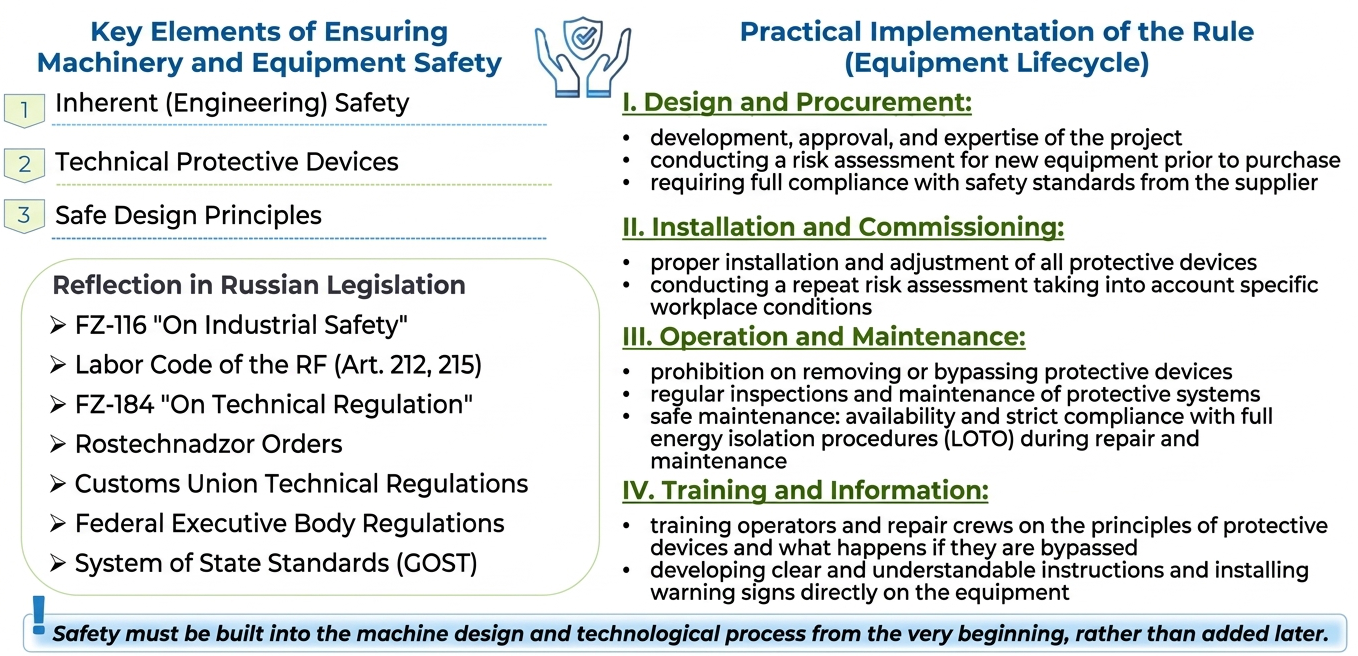
Vision Zero requires a proactive approach: Safety must be built into the machine design and technological process from the start, not added later. The goal is to make a hazardous situation or operator error either impossible or non-injury-causing.
This rule is directly related to the hierarchy of risk controls, where the most effective methods are those that eliminate the hazard at the design stage.
Key elements of ensuring machine and equipment safety
1. Built-in (engineering) safety
This is the most important and effective level. Engineers and designers are obliged to eliminate or minimize hazards at the design stage.
Examples:
- Hazard elimination: Replacing mechanical knives with laser or ultrasonic cutting, which eliminates worker contact with the cutting element.
- Energy reduction: Using drives with less force, which is insufficient to cause serious injury (e.g., in robotic manipulators working alongside humans).
- Preventing access to hazardous zones: A design in which moving parts, pinch points, and heating zones are inherently located inside the housing, without the need for additional protective covers.
2. Technical protective devices
If a hazard cannot be completely eliminated, it must be guarded using technical means that physically prevent a person from entering the danger zone.
Types of protective devices:
- Fixed guards: Sturdy covers enclosing chains, gears, belts, and other hazardous elements, which often require a tool to remove.
- Interlocking devices: Devices that cut off power or stop the machine when a protective guard is opened. For example, a door to a laser machine must be equipped with such a switch.
- Optical barriers (light curtains): When the light beam is interrupted (a person's hand enters the danger zone), the machine stops immediately.
- Two-hand control: The operator must simultaneously press two buttons located far apart, ensuring their hands are in a safe place during cycle start.
- Emergency stops: Bright red buttons, easily accessible anywhere on the equipment, for immediate shutdown in a critical situation.
3. Principles of safe design
- Error-proofing: The design must prevent incorrect assembly or use. For example, unique connectors that can only be plugged in one correct way.
- Ergonomics: Equipment must be designed to minimize operator strain (comfortable height, no need for awkward postures, ease of control), which reduces the risk of errors due to fatigue and musculoskeletal disorders.
- Fault tolerance: In the event of a component failure (pneumatics, electricity, sensor), the system must default to a safe state (e.g., brakes are applied by a spring when air pressure is lost).
Let's consider the practical implementation of the principle (Equipment lifecycle).
1. Design and procurement:
- Conducting a risk assessment for new equipment prior to purchase.
- Requiring full compliance with safety standards from the supplier.
- Refusing to purchase equipment that does not comply with Vision Zero principles.
2. Installation and commissioning:
- Proper installation and configuration of all protective devices.
- Conducting a reassessment of risks taking into account specific workplace conditions.
3. Operation and maintenance:
- Prohibition on removing or bypassing protective devices. This is absolutely unacceptable in a Vision Zero culture.
- Regular inspections and maintenance of protective systems (e.g., testing interlocks and light curtains).
- Safe maintenance (Lockout-Tagout / LOTO): The presence and strict adherence to procedures for completely isolating energy (electrical, pneumatic, hydraulic) and locking it out during repair and maintenance.
4. Training and awareness:
- Training operators and repair crews not only on how to operate the equipment, but also on why the protective measures are designed that way and what will happen if they are bypassed.
- Clear and understandable instructions and warning signs directly on the equipment.
Advantages of this approach
- High efficiency: Reduces the number of incidents at the very initial design stage.
- Independent of human error: Does not require constant concentration from the operator. Even if they are tired or distracted, the protection will work.
- Increased productivity: Safe equipment is generally more reliable and modern. No downtime due to injuries and accident investigations.
- Safety culture: Creates an environment where safety is an integral part of the process, not a burden.
Conclusion: The rule of ensuring safety when working with equipment under Vision Zero is not just about "installing a protective cover". It is a fundamental requirement for a business to invest in safety at the design and procurement stage, making the hazard physically inaccessible to humans. It is an investment in people, in business continuity, and in creating modern, high-tech, and responsible production.
Russian legislation regulating machine and equipment safety:
- Federal Law No. 116-FZ "On Industrial Safety"
- Labor Code of the Russian Federation (Art. 212, 215)
- Federal Law No. 184-FZ "On Technical Regulation"
- Rostekhnadzor Orders
- Customs Union Technical Regulations
- Regulatory Legal Acts of Federal Executive Bodies
- State Standard System (GOST)
Rule VI: Improve qualifications – develop competencies.
This rule recognizes that even the most perfect infrastructure and technologies will not work effectively without trained, aware, and motivated people.
The rule states that safety is a skill that can and must be taught. It is aimed at the continuous development of knowledge, skills, and motivation in absolutely all process participants: from top management to ordinary employees and contractors.
The goal is to create a safety culture where everyone:
- Knows the risks associated with their work.
- Understands how to manage these risks.
- Possesses practical skills to perform work safely.
- Is motivated to act safely and has the right to stop unsafe work.
Training under Vision Zero is not one-size-fits-all. It is specifically targeted at different groups:
- Top managers and senior executives
They set the tone for the entire safety culture in the organization. Their commitment is a key success factor.
What are they taught?
- The strategic vision of Vision Zero and safety leadership principles.
- How to integrate safety into all business processes (planning, procurement, project management).
- How to analyze incident data and make decisions at a systemic level, rather than looking for someone to blame.
- Effective safety communication methods.
Line managers and middle management (foremen, site and shop managers)
They are the ones who manage risks on the ground daily, and their behavior is most visible to employees.
What are they taught?
- Practical risk management tools: conducting risk assessments, briefings, workplace walkdowns.
- Skills in observing work and providing constructive feedback (not punishment, but coaching).
- How to motivate the team and involve workers in discussing safety issues.
- Actions in abnormal and emergency situations.
Frontline employees
They are on the front lines and are directly exposed to risks. Their competence is the last and most important barrier to an incident.
What are they taught?
- Specific safe work procedures for their particular task (e.g., working at heights, equipment lockout, welding).
- The ability to identify hazards and risks around them.
- Exercising the right and obligation to stop work in case of danger.
- First aid and evacuation.
- Proper use of PPE and understanding why it is needed.
Occupational Health and Safety (HSE) Specialists
Their role transforms from a controller and "punisher" to a consultant, internal coach, and expert.
What are they taught?
- Modern risk management methods and safety culture promotion.
- Facilitation, coaching, and communication skills for working with managers and employees.
- Data analysis and predictive analytics to prevent incidents.
Contractors and temporary workers
They are often the most vulnerable group and must be fully integrated into the client company's safety system.
What are they taught?
- Safety standards and rules adopted at the client's facilities.
- Site-specific risks.
- Work permit procedures.
Key aspects of competency development in Vision Zero
From training to development: This is not a one-time course, but a continuous process. It includes briefings, training sessions, on-the-job internships, self-study, simulations, etc.
From knowledge to action: The goal is not just to provide information, but to form sustainable behavioral skills. Theory must be reinforced by practice.
Human-centric approach: Training should be interactive, engaging, and understandable. It is important to consider the educational level and perception characteristics of the audience.
Effectiveness evaluation: It is not enough to just conduct a training session. It is necessary to evaluate how people's behavior in the workplace has changed, whether the number of unsafe acts has decreased, etc.
The "Improve qualifications and develop competencies" rule in Vision Zero is an investment in people. It turns safety from a list of rules and prohibitions into a living, understandable, and valuable practice for every employee. This creates an environment where people do not just obey rules, but understand, want, and know how to work safely, becoming active participants in creating zero injuries rather than passive executors.
Examples of implementing the "Improve qualifications – develop competencies" rule at Zarubezhneft Group of Companies:
- strategic safety sessions for management
- VISION ZERO and risk assessment training for line managers
- HSE training for all Company employees in accordance with legislative requirements
- training at the corporate "Safety School"
- conducting training and individual development plans for contractors
Rule VII: Invest in personnel — motivate and engage.
The traditional approach often views the worker as a problem or a weak link that needs to be controlled, punished for violations, and forced to follow instructions. This breeds:
- Fear and a culture of silence (errors and incidents are hidden).
- A passive attitude towards safety ("I am forced to").
- A gap between management and frontline employees.
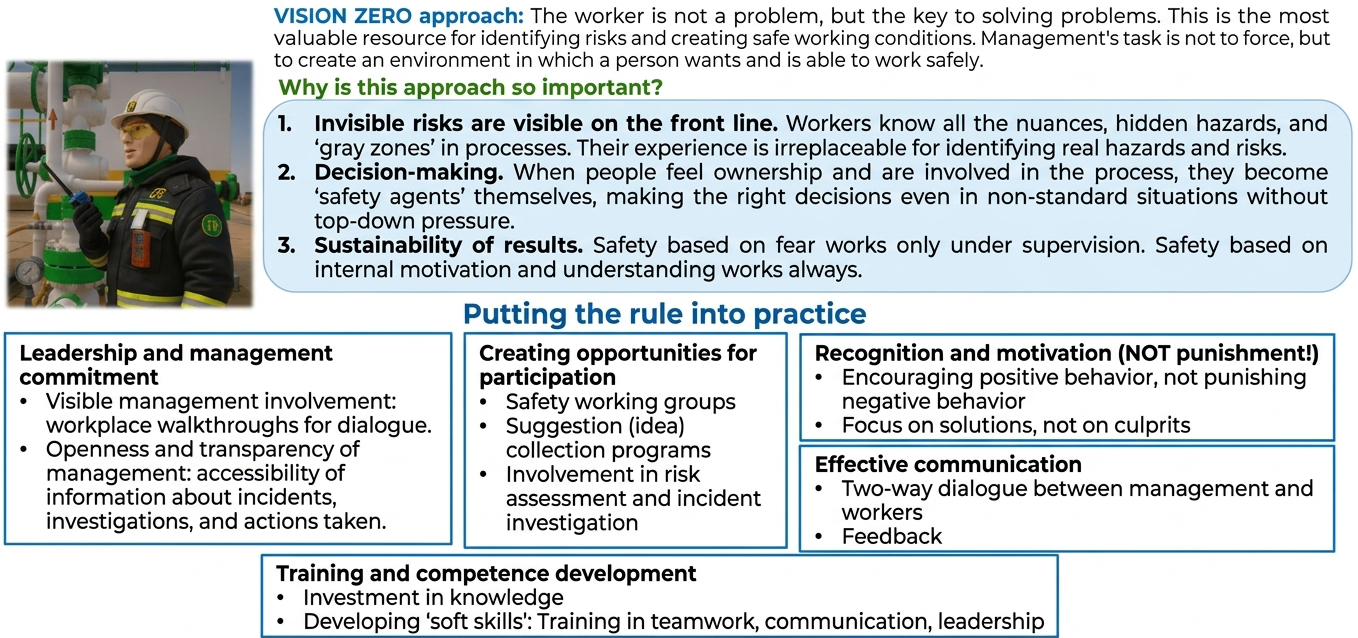
This Vision Zero rule refutes this logic. It states: the worker is not the problem, but the key to the solution. They are the most valuable resource for identifying risks and creating safe working conditions. Management's task is not to force, but to create an environment in which a person wants and is able to work safely.
Why is this approach so important?
- Invisible risks are visible on the front lines. Workers who perform tasks daily know all the nuances, hidden hazards, and "gray areas" in procedures. Their experience is indispensable for identifying real, not paper, risks.
- Decision making. When people feel responsible and are involved in the process, they themselves become "safety agents", making the right decisions even in non-standard situations without pressure from above.
- Sustainability of results. Safety based on fear only works under supervision. Safety based on intrinsic motivation and understanding works always.
How to implement this rule in practice? Concrete steps:
1. Leadership and management commitment
- Visible involvement: Managers should regularly visit workplaces, not for inspection, but for dialogue. Ask questions: "What is preventing you from working safely today?", "What suggestions for improvement do you have?".
- Openness and transparency: Management must openly share information about incidents, investigations, and measures taken. This is the foundation of trust.
2. Creating opportunities for participation
- Safety groups: Create structured groups of workers from different levels who meet regularly to discuss safety issues, analyze risks, and develop proposals.
- Idea collection programs: Implement a simple and fast system through which any employee can suggest an improvement (e.g., regarding working conditions, tools, procedures). Key point: every suggestion must be reviewed, and feedback must be given on accepted decisions, along with public gratitude.
- Involvement in risk assessment and incident investigation: Workers should not be the object of investigation, but active participants in the process. Their goal is not to find a culprit, but to understand systemic causes and find a solution.
3. Training and competency development
- Investing in knowledge, not "checkboxes": Training must be practical, understandable, and adequate. Not just "read the instruction", but practice skills and analyze case studies.
- Developing soft skills: Training in teamwork, communication, leadership, and the ability to constructively express safety concerns.
4. Recognition and motivation (NOT punishment!)
- Encourage positive behavior, rather than punish negative behavior: The system should be built on recognizing those who show initiative, submit proposals, and intervene in unsafe situations. This can be symbolic awards, certificates, bonuses, or simply public recognition.
- Focus on solutions, not culprits: When an incident occurs, the main question should not be "Who is to blame?", but "What can we change in the system (procedure, equipment, work organization) so that this does not happen again?". This removes fear and encourages people not to hide information about hazardous conditions and unsafe acts.
5. Effective communication
- Two-way dialogue: Use all channels (meetings, bulletin boards, corporate portal) not only to pass down instructions from above, but also to collect feedback.
- Feedback: It is mandatory to inform employees about what was done based on their suggestions and comments. Without this, the feedback loop breaks, and motivation disappears.
Implementation example:
Traditional approach: A worker sees a protruding cable that someone could trip over. He thinks: "Not my business", or "If I report it, I'll have to fill out a request log", or "The boss will say again that I work sloppily".
Vision Zero culture: A worker sees a cable. He knows that:
- He will be praised for his vigilance.
- There is a simple and fast reporting system (e.g., a mobile app or a sheet on a board).
- His report is guaranteed to be reviewed, and the problem will likely be fixed promptly.
- At the next morning meeting, he will be thanked, and this will become a positive example for others.
Result: The risk is eliminated before anyone gets hurt. The employee feels valued and engaged. The safety culture is strengthened.
The "Invest in personnel — motivate and engage" rule in Vision Zero is a strategic approach that turns safety from a budget expense item (fines, compensation, downtime) into an investment in the company's most valuable asset — its employees. This creates a solid foundation for continuous improvement, where everyone feels responsible not only for their own results, but also for the well-being of themselves and their colleagues. This is the path from compliance to genuine care.
Summarizing, we can conclude that the relationship between Russian legislation and the Vision Zero concept lies in:
- A common fundamental goal - Preventing harm.
- Legislation establishes mandatory minimum standards and requirements to protect the life and health of workers. Its goal is to reduce risks to an acceptable level.
- Vision Zero: Proclaims that no death or injury in the workplace is acceptable. This is not just a goal to "reduce metrics", but a moral imperative — to strive for zero.
- A proactive, rather than reactive, approach.
Modern legislation is also increasingly shifting from reacting to accidents to preventing them (for example, through mandatory occupational risk assessment). Vision Zero: Makes proactivity its core essence.
- Systemic approach versus Human fault.
Vision Zero assumes that people can make mistakes, and the system must be designed so that these mistakes do not lead to tragic consequences. The blame is shifted from the person to the system. This is fully consistent with modern trends in legislation, which obliges the employer to create safe work systems.
- The principle of the "Hierarchy of Risk Controls".
This principle is a direct bridge between the Vision Zero philosophy and practical legislative requirements.
Both approaches recognize that not all control measures are equal. Preference is given in the exact same order:
- Risk elimination.
- Substituting a hazardous process with a less hazardous one.
- Engineering controls.
- Administrative controls.
- And only then – PPE, as the last line of defense.
Vision Zero urges using the top levels of the hierarchy (1-3) first and foremost, which is a direct requirement of Russian legislation.
- The importance of leadership and management commitment
The law places personal responsibility on the employer and managers for ensuring safe working conditions and the safety of hazardous production facilities.
Vision Zero: Emphasizes that the commitment to ensuring zero injuries must come from the very top.
- Employee engagement
Legislation enshrines the right of employees to participate in occupational safety matters, create HSE committees, and the right to refuse hazardous work. Vision Zero views workers not as objects for briefings, but as a key resource for identifying risks and finding solutions, since they know their work best. The risk-oriented approach of modern legislation places a similar emphasis on employee engagement.
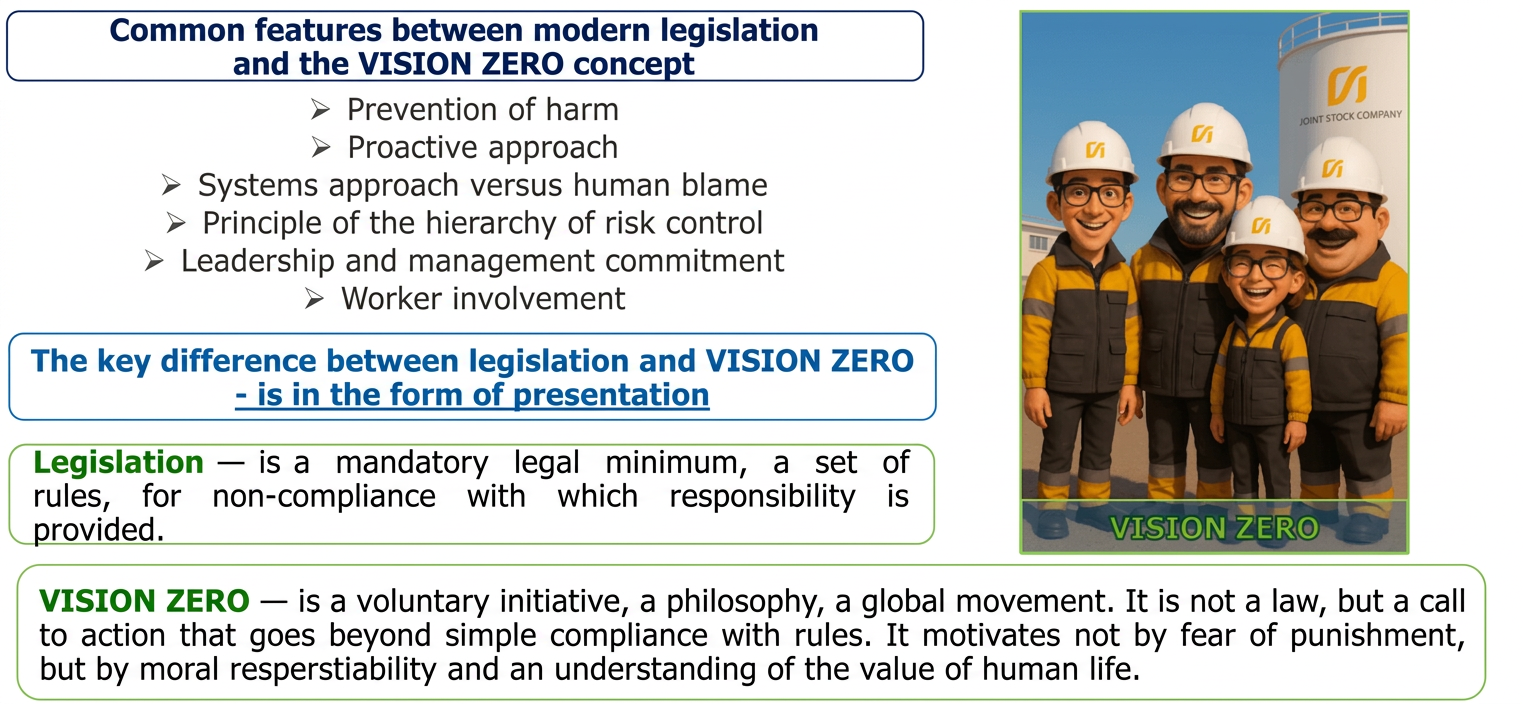
The key difference between legislation and the Vision Zero concept lies in the form of presentation. Legislation is a mandatory legal minimum, a set of rules for non-compliance with which liability is provided. It is "carrots and sticks". Vision Zero is a voluntary initiative, a philosophy, a global movement. It is not a law, but a call to action that goes beyond simple rule compliance. It motivates not by the fear of punishment, but by moral responsibility and an awareness of the value of human life.