The International Vision Zero Concept and Russian Legislation: Evolution of the Safety Approach
The oil and gas industry is considered one of the most hazardous industrial sectors. This is due to the presence of dangerous and harmful occupational factors in the workplace.
1. Physical hazards are the most common and obvious group of risks.
- Fire and explosion hazards of substances and materials are the main risk in the industry.
- Hydrocarbon leaks, the formation of explosive gas-air mixtures, sparks from equipment, static electricity, and hot work can cause explosions and fires, leading to catastrophic destruction and loss of life.
- High pressure: Technological processes of well drilling, oil production, transportation, and treatment occur under high pressure. Their sources include pumping equipment, manifolds, pipelines, process vessels, and compressors. Operating them entails risks such as pipeline depressurization, equipment blowouts, and injuries from high-pressure jets.
- Machinery and equipment: Rotating parts, moving mechanisms, and heavy machinery such as drawworks, rotary tables, hoisting cranes, and pipelayers carry the risk of injuries from clothing entanglement, falling loads, and collisions.
- Falling objects from a height: Especially relevant on drilling rigs and production sites. This includes falling tools and structural elements.
- Workers falling from a height: Work on drilling rigs, platforms, tanks, and overpasses involves the risk of falling.
- Elevated noise and vibration levels generated by the operation of drilling equipment, compressor stations, and turbines can lead to occupational diseases (hearing loss) and disorders of the cardiovascular and nervous systems.
- Adverse weather conditions: Work is often carried out in extreme climate zones (the Arctic, deserts, offshore). There is a risk of hypothermia, frostbite, and heatstroke.
2. Chemical hazards are associated with the toxic effects of substances used and extracted in the industry.
- Hydrocarbon vapors have a narcotic effect on the central nervous system, irritate the respiratory tract, and at high concentrations lead to asphyxiation.
- Hydrogen sulfide (H₂S) is an extremely toxic gas found in associated petroleum gas. Even low concentrations cause olfactory paralysis, while high concentrations lead to instant respiratory arrest. It has a high density and accumulates in low-lying areas.
- Chemical reagents: Drilling and production use numerous chemicals (corrosion inhibitors, well-cleaning agents, drilling fluid components), many of which are toxic, carcinogenic, or cause allergic reactions.
- Accidental releases and oil or gas spills lead to large-scale chemical contamination of the area and pose a direct threat to personnel health.
3. Psychophysiological factors
- High work intensity: The work requires constant attention and responsibility, as a mistake can lead to a severe accident. This causes chronic stress.
- Confined space entry: Descending into tanks, vessels, and cisterns involves the risk of asphyxiation, poisoning, and evacuation difficulties.
- Shift work (fly-in/fly-out method): Disruption of circadian rhythms, prolonged time away from family, and a monotonous environment negatively affect mental and physical health.
This list of dangerous and harmful occupational factors could go on.
According to statistics from the Ministry of Labor of the Russian Federation, falls from a height are the main causes of injuries and fatalities in the oil and gas industry every year.
The primary causes of injuries include employees' failure to comply with HSE requirements, lack of supervision and control over safe work execution by line management, among others.
According to statistics from LLC ZARUBEZHNEFT-Dobycha Kharyaga, from 2016 to 2025, workers sustained the most severe injuries as a result of incidents involving falls from a height and the depressurization of equipment operating under overpressure.
Russian legislation ensures safe working conditions for employees and the safe operation of hazardous production facilities (HPF) through a complex, multi-level system of legal norms, which can be divided into several key elements.
Element 1: Constitutional foundations.
The highest guarantee is Article 37 of the Constitution of the Russian Federation, which proclaims:
- Everyone's right to work in conditions that meet safety and hygiene requirements.
- The right to rest.
- The right to protection against unemployment.
Element 2: The Labor Code of the Russian Federation and Federal Law No. 116-FZ "On Industrial Safety of Hazardous Production Facilities." These are the main regulators.
Section X of the Labor Code of the Russian Federation is titled "Occupational Safety and Health" and details all aspects of employer-employee relations in this area, while Federal Law No. 116-FZ establishes requirements for the design, construction, operation, mothballing, and liquidation of HPFs, the training of personnel working at HPFs, and the conduct of industrial safety expertise.
In accordance with the requirements of the Labor Code of the Russian Federation and Federal Law No. 116-FZ, organizations are obliged to establish and ensure the functioning of HSE Management Systems.
What is an HSE Management System? An HSE Management System is a set of measures and procedures that define the occupational safety policy and objectives at an enterprise, including the job responsibilities of managers and specialists, as well as a set of organizational and technical measures applied by an organization operating an HPF to prevent accidents and incidents, and to localize and eliminate the consequences of accidents.
Element 3: Federal Law No. 426-FZ "On Special Assessment of Working Conditions" (SAWC). This is one of the key tools at the present stage.
The goal of SAWC: To identify harmful and dangerous occupational factors at each workplace and assess their exposure levels.
Working conditions are divided into four classes:
- Optimal (Class I).
- Permissible (Class II).
- Harmful (Class III).
- Hazardous (Class IV).
Working conditions at all workplaces of ZNDKh are assigned Class II – the working conditions are considered permissible.
The results of the SAWC determine:
- the need to provide employees with personal protective equipment (PPE);
- guarantees and compensations for employees (additional leave, reduced working hours, increased pay, etc.);
- the amount of insurance premiums to the Pension Fund and the Social Insurance Fund (the worse the working conditions, the higher the insurance rate).
Element 4: Federal laws, Decrees of the Government of the Russian Federation, regulatory legal acts of Federal Executive Bodies, and GOST standards establish mandatory requirements aimed at preserving the life and health of workers, as well as preventing accidents and incidents at HPFs.
Element 5: The system of technical regulation: Technical Regulations.
These are laws that establish mandatory safety requirements for products, production processes, and equipment. For example, TR CU 019/2011 "On the Safety of Personal Protective Equipment" obliges employers to use only certified PPE.
Element 6: State supervision and control.
Special authorities monitor compliance with the legislation:
- The Federal Service for Labor and Employment (Rostrud) and its territorial inspectorates (State Labor Inspectorate) conduct scheduled and unscheduled inspections, can issue orders to eliminate violations, and impose heavy fines.
- Rostekhnadzor controls safety at hazardous production facilities.
- The Prosecutor's Office oversees the execution of all laws, including labor laws.
Element 7: Liability for violating HSE and industrial safety requirements.
The legislation provides for strict liability for employers:
- Disciplinary (reprimand, warning, dismissal for officials).
- Administrative (heavy fines for officials and legal entities, suspension of enterprise operations).
- Criminal (under Article 143 of the Criminal Code of the Russian Federation — if a violation of occupational safety rules negligently results in severe harm to health or human death, penalties up to imprisonment are provided).
Summarizing the above, it should be emphasized that Russian legislation creates a comprehensive system for ensuring occupational and HPF safety, which includes regulatory requirements, assessment mechanisms, guarantees and compensations, supervision, and strict liability. However, the effectiveness of this system in practice heavily depends on the specific employer and the activity of regulatory authorities.
Element 8: Trade union participation.
Trade unions are created on the initiative of workers. Usually, an initiative group of at least three people is gathered to form a trade union. These can be any employees of the organization who are at least 14 years old.
Trade unions have the right to:
- Monitor compliance with labor legislation.
- Participate in accident investigations.
- Demand the suspension of work in the event of an imminent threat to the life and health of workers.
- Make proposals for improving working conditions.
In 1997, as an additional element to ensure safe working conditions for employees, the Vision Zero concept was developed in Sweden, initially aimed at completely eliminating fatalities and severe injuries from road traffic accidents.
During the implementation of the program in Sweden, the road traffic mortality rate dropped from 7 cases per 100,000 people in 1997 to 2.5 – 3 by the second half of the 2010s. Later, the principles of the concept spread to the industrial sector in various countries and began to be applied to prevent workplace injuries.
The core principles of Vision Zero applicable to industrial production:
Principle 1: Priority of safety over production tasks.
This is the cornerstone of the concept. No plans, deadlines, or production volumes can justify violating safety rules.
Practical implementation: An employee has the full right and obligation to stop any operation if they consider it unsafe, without fear of punishment. Management must not only support but also encourage such behavior.
Principle 2: Leadership and commitment of top management.
Safety starts at the top. Leaders must not only declare the importance of safety but also demonstrate it through their actions.
Practical implementation: Regular walkthroughs of departments by top management with a focus on safety (rather than productivity), personal involvement in incident investigations, and the allocation of necessary resources for HSE activities.
Principle 3: A systematic approach and prevention.
Instead of reacting to incidents that have already occurred, the focus shifts to proactively identifying and eliminating potential risks.
Practical implementation: Implementation of an HSE management system compliant with international ISO standards. Regular occupational risk assessments for all processes, not just "hazardous" areas. Analysis of not only accidents but also "unsafe conditions and unsafe acts."
Principle 4: Employee involvement and participation.
Frontline workers know their workplaces and the associated risks better than anyone else. Their experience is invaluable for identifying hazards.
Practical implementation: Creating mechanisms for feedback (improvement proposals, statistics on unsafe conditions and unsafe acts), conducting pre-job safety meetings, "5 minutes before work" briefings, etc.
Principle 5: Ensuring safety as an integral part of business processes
Safety should not be a separate "function" or a "folder of documents." It must be integrated into planning, procurement, design, training, and performance evaluation.
Practical implementation: When purchasing new equipment, its safety is a mandatory criterion (presence of protective guards, emergency stop systems, etc.). When planning maintenance work, a safety action plan is developed in advance.
Principle 6: Continuous improvement.
Vision Zero is not a static state, but a continuous process. Even if a zero injury rate is achieved, the work does not stop.
Practical implementation: Regular audits and reviews of procedures, benchmarking, and the introduction of new, safer technologies and materials.
Principle 7: Focus on the human factor and safety culture.
Acknowledging that people can make mistakes. The goal of the system is not to punish for a mistake, but to ensure that the mistake does not lead to an injury.
Practical implementation: Creating a flawless safety culture where workers are not afraid to report their mistakes or unsafe conditions and acts. Training aimed not at memorizing rules, but at understanding risks and their consequences.
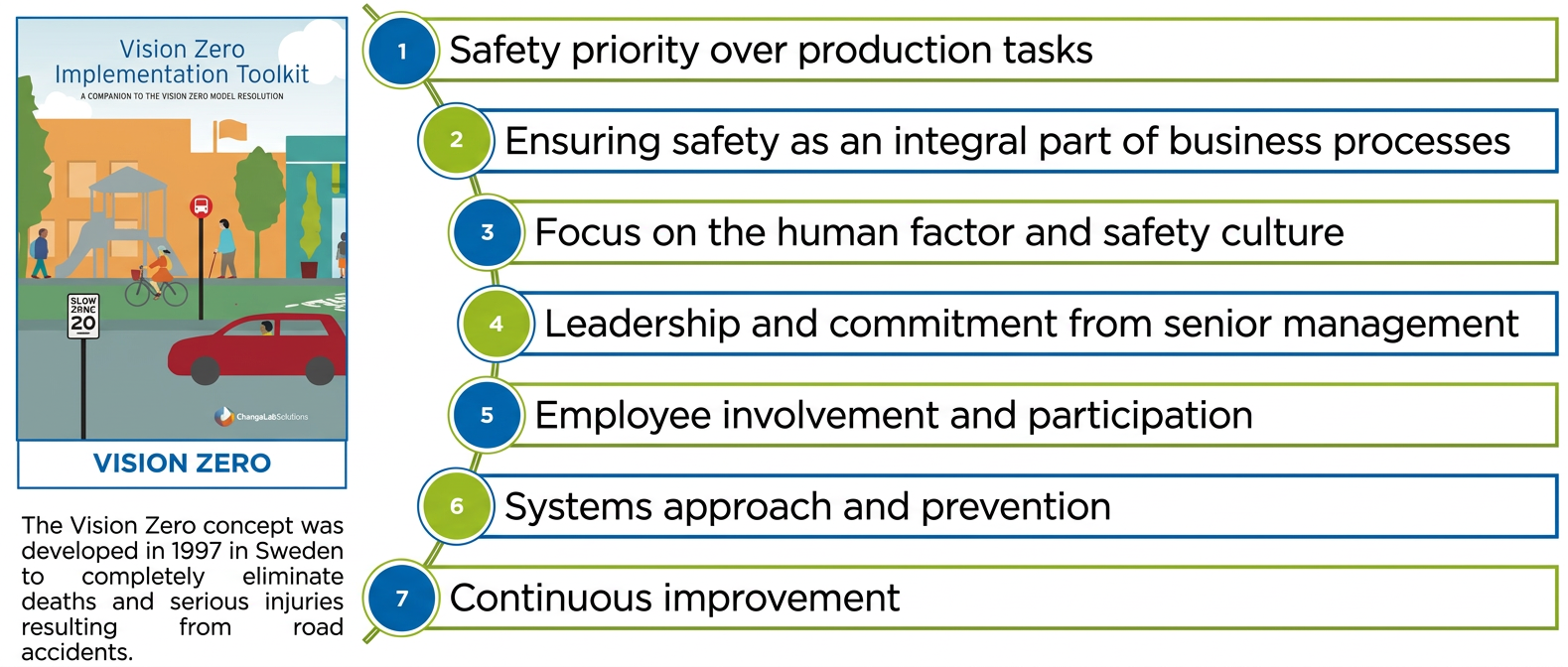
In 1997, the Swedish Parliament adopted the Vision Zero concept at the state level for the first time. Initially, it was approved by the Swedish Ministry of Transport and was aimed at completely eliminating fatalities and severe injuries resulting from road traffic accidents.
In 2014, the Swedish Parliament initiated negotiations with social partners to extend the Vision Zero concept to all workplaces in the country. The goal was to eliminate cases of fatal occupational injuries.
In 2017, at the World Congress on Safety and Health at Work in Singapore, representatives of the International Social Security Association (ISSA) confirmed that the Vision Zero strategy had gained international status.
In Russia, in 2017, the Russian Ministry of Labor signed an agreement with ISSA; later, the concept was adopted at the state level and enshrined in Government Decree No. 883-r.
One of the principles of the Vision Zero concept is the identification and elimination of potential risks. In 2018, there was a shift in the focus of Russian legislation towards a risk-oriented approach. Prior to its implementation, occupational safety in Russia was largely "cost-driven" and "reactive" — the main focus was on complying with government orders and investigating accidents that had already occurred.
Speaking of the key date when the risk-oriented approach officially became the foundation of the state HSE and industrial safety management system, it is January 1, 2018. On this exact date, the main amendments to Federal Law No. 116-FZ "On Industrial Safety of Hazardous Production Facilities" came into force, which mandated the implementation of an industrial safety management system based on risk assessment. In the same year, JSC Zarubezhneft joined the international Vision Zero concept.
On March 1, 2022, amendments to the Labor Code of the Russian Federation concerning occupational safety came into force. The key aspect of the changes was the transition to applying a risk-oriented approach in the field of occupational safety. In particular, the following changes were made:
- the basic principles of ensuring safe working conditions were formulated – prevention, hazard prophylaxis, and minimizing damage to workers' health;
- the procedure for managing occupational risks in the workplace was established;
- the procedure for imposing a ban on work in hazardous working conditions was regulated;
- guarantees of the right of workers to work in conditions meeting occupational safety requirements were restated in a new edition;
- the procedure for investigating and recording occupational micro-injuries was established.
Overall, from 2019 to 2024, Rostrud and the Ministry of Labor began to more actively implement a risk-oriented approach in state supervision as well. This means that scheduled inspections by labor inspectorates are now more frequently conducted at enterprises with a high risk class, while extended "supervisory holidays" have been introduced for low-risk enterprises. In addition, the development and updating of risk assessment methodologies and standards continue in order to unify and streamline this process for employers.
Given the paradigm shift in Russian HSE legislation, it should be emphasized that the Vision Zero concept and the legislation have a lot in common, as their fundamental goal is absolutely identical: preventing fatalities and injuries in the workplace.
Essentially, Vision Zero is a philosophical and strategic superstructure that transforms the traditional approach to occupational safety embedded in the legislation. It sets the highest bar and provides a roadmap for achieving the goal of "zero injuries."
The foundation of the Vision Zero concept is the seven golden rules, which run parallel to the requirements of Russian legislation.
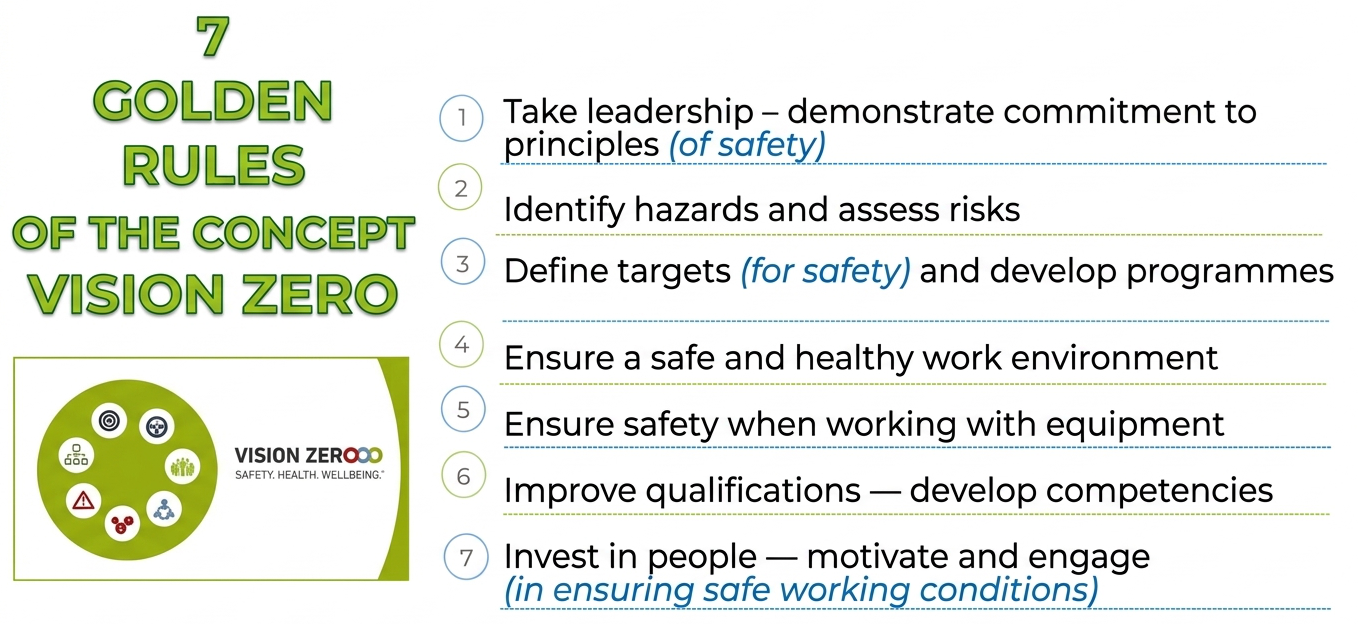
In the next article, we will analyze each of the "seven golden rules" of the Vision Zero concept in detail, show their practical implementation, and draw parallels with Russian legislation.